

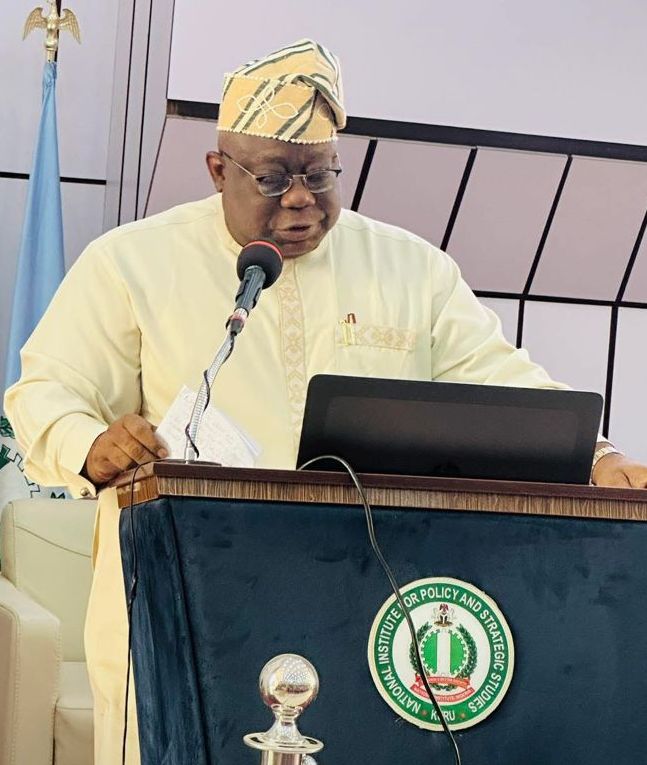
The Chairman of the Federal Civil Service Commission , Prof. Tunji Olaopa, has proferred ways to reform political leadership recruitment to ensure development.
Olaopa gave his insight in a lecture he delivered on Monday April 20, 2026, to the participants of SEC 48 2026 at the National Institute of Policy and Strategic Studies, Kuru, Plateau State.
He decried what he identified as a flawed recruitment of political leadership that is plagued by godfatherism , sit-tighterism , and that is devoid of competence and meritocracy, thereby undermining development in Nigeria and many other African countries.
For him, “real development in Nigeria and other African countries is unlikely to happen unless the leadership selection, succession and development questions facing them are fully resolved.”
What has been missing, in the Nigerian leadership recruitment equation, among others, according to him, “is effective mentoring, especially in preparation of people for public service and roles in policy making and management. Such leaders ensure continuity and maintain the culture and values of institutions by climbing the shoulders of mentors. Mentoring should however not be confused with godfatherism which is exploitative. Mentoring is a power- free relationship based on mutual respect and value for both mentor and mentee.
“These leaders frequently lack the fundamental skills necessary for effective governance, resulting in poor decision making, reliance on narrow circles of influence, and inability to address nation challenges.”
This, according to him, stands in contrast to good practices in advanced polities where political leadership development and recruitment follow a structured process involving various forms of grooming, role plays in shadow cabinets, mentoring opportunities and training.
On the way forward, he stressed the necessity for a multi-faceted solution framework and action plan that would involve strengthening political parties’ internal democracy; enabling merit-based recruitment of eligible candidates for elections; strengthening multi-level mentoring for more structured process of leadership grooming, training and development; and investing more in voters’ education to deepen citizens and civil society organisations’ involvement in the political and electoral process.
Olaopa also stressed the need for strengthening anti-corruption agencies to investigate and prosecute electoral offences and improve the judiciary’s capacity to resolve electoral disputes in more timely and efficient manner; profiling the cost structure of the electoral process to stem the tide of money politics and structural disenfranchisement of core professions and young people.
He added that the Nigerian federation should be restructured to strengthen grassroots and people-centred politicking as basis for strengthened local governance and bottom-up development planning and management.
🚨 BREAKING: Watch the full clip here ➤

