

By Udora Orizu
“Peace is a daily, a weekly, a monthly process, gradually changing opinions, slowly eroding old barriers, quietly building new structures.”
This timeless thought, widely attributed to former U.S. President John F. Kennedy, underscores the enduring truth that peace is not a one-time achievement but a continuous and deliberate pursuit. It is built patiently through sustained dialogue, institutional commitment, and the willingness to dismantle long-standing divisions.
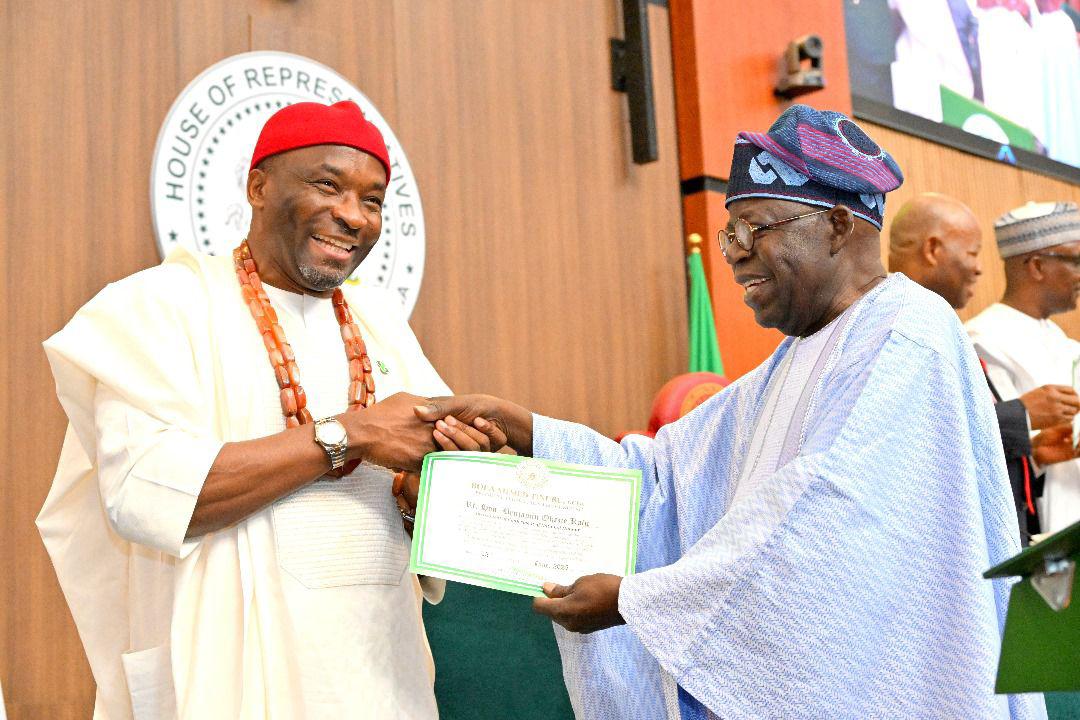
This philosophy found practical expression on the global stage at the recently concluded 152nd General Assembly of the Inter-Parliamentary Union (IPU) in Istanbul, Türkiye, where Nigeria’s Deputy Speaker of the House of Representatives, Rt Hon. Benjamin Kalu PhD, CFR paid tribute to His Excellency, President Bola Ahmed Tinubu, GCFR for his leadership in advancing peacebuilding efforts.
Kalu’s recognition came in the wake of the adoption of a landmark resolution he proposed to the IPU, titled: “The Role of Parliaments in Establishing Robust Post-Conflict Management Mechanisms and Restoring a Just and Lasting Peace.” The resolution reflects a growing global consensus on the critical role of legislative institutions in stabilizing post-conflict societies and preventing the relapse into violence.
Equating Kennedy’s vision and Tinubu’s governance approach, Kalu highlighted the President’s commitment to fostering unity, strengthening democratic institutions, and promoting inclusive dialogue as essential pillars of sustainable peace.
He stated that President Tinubu’s policies and diplomatic engagements demonstrate a clear understanding that peacebuilding requires persistence, collaboration, and institutional resilience.
The landmark resolution, Kalu presented underwent intense deliberation over two days before securing unanimous global approval. The draft – containing over 36 proposed resolutions was thoroughly revised by the Peace and International Security Committee of the Inter-Parliamentary Union (IPU).
The adopted resolution emphasizes that lasting peace cannot be separated from justice, accountability, and national ownership of recovery processes. Its passage is widely regarded as a significant diplomatic victory for Nigeria, underscoring the growing influence of African parliamentary voices in shaping the global peace and security architecture.
Reacting to the development, Kalu noted that with the adoption of the resolution, parliaments across the IPU’s 183 member states are now encouraged to prioritize legislative frameworks that support peacebuilding and conflict prevention.
The lawmaker expressed gratitude to member states for their support during the General Assembly, commending their commitment to global peace and stability.
Key provisions of the resolution affirm that enduring peace is only achievable through justice, anchored on accountability for aggressors, enforcement of international law, and redress for victims. It warns that any settlement that sacrifices justice for expediency risks perpetuating cycles of violence and undermining the legitimacy of peace.
Reflecting on Nigeria’s domestic experience, Kalu credited President Tinubu with advancing reconciliation efforts in the South East.
He recalled that the Peace in the South East Project (PISE-P), launched in December 2024, as a non-kinetic approach to de-escalating tensions, received full presidential backing, with Vice President Kashim Shettima representing the President at its unveiling.
Kalu also recalled that the signing of the South East Development Commission Bill marked a historic milestone, establishing, for the first time since the end of the Nigerian Civil War in 1970, a structured mechanism for federal investment in the region’s development.
This, he said, fulfills the long-promised “3Rs” of reconciliation, reconstruction, and rehabilitation.
He also made reference to increased inclusion of the South East in national leadership structures as a key step toward reintegration, helping to address longstanding concerns of marginalization.
“In one stroke, President Tinubu addressed three critical issues, reconciliation, reconstruction, and reintegration thereby healing longstanding wounds and demonstrating the effectiveness of deliberate post-conflict peacebuilding policies,” Kalu stated
The Deputy Speaker dedicated the global adoption of the resolution to President Tinubu, describing his administration’s peacebuilding efforts as security-focused yet community-driven.
These include the deployment of peace envoys to conflict-prone areas such as Plateau State, the promotion of community-based security committees, engagement of traditional rulers as grassroots peacebuilders, and the development of a cohesive national peace policy.
He added that the administration’s emphasis on youth empowerment, education, and economic inclusion is crucial in addressing the root causes of instability and preventing violent extremism.
Kalu concluded by noting that President Tinubu’s leadership reflects the timeless words of Eleanor Roosevelt: “It isn’t enough to talk about peace. One must believe in it. And it isn’t enough to believe in it. One must work at it.”
*Orizu is media aide to Nigeria’s Deputy Speaker
🚨 BREAKING: Watch the full clip here ➤

