

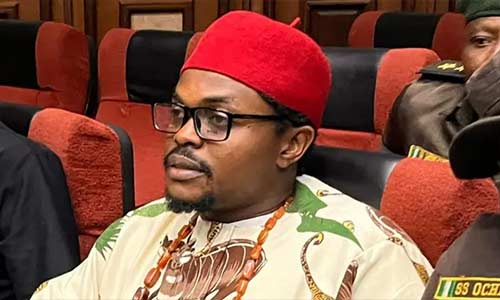
The Federal High Court in Abuja has granted bail to popular cryptocurrency entrepreneur Linus Williams Ifejirika, known as Blord, after he spent 16 days in Kuje Correctional Centre over allegations of impersonating social media activist Martins Vincent Otse, popularly known as VeryDarkMan with strong indications emerging during the proceedings that both parties may be moving toward an out-of-court settlement.
Justice Rita Ofili-Ajumogobia granted bail on Friday on what lawyers described as liberal terms: self-recognisance, deposit of his international passport with the court, production of two sureties of good public standing, and a directive not to make public comments about the case.
The most significant signal from the hearing was the decision by VeryDarkMan’s lawyer to withdraw the counter-affidavit earlier filed opposing Blord’s bail application, telling the court he no longer had any objection a dramatic shift from the prosecution’s earlier position that had resulted in Blord being remanded in prison for over two weeks.
At the resumed hearing on Friday, the defence team informed the court that they had a motion on notice for bail filed on April 1, 2026, brought pursuant to relevant sections of the Constitution and the Administration of Criminal Justice Act.
The defence presented seven grounds for the bail application supported by a 10-paragraph affidavit, urging the court to exercise its discretion in favour of granting bail on self-recognisance and in the interest of justice. Alternatively, they asked that the sureties who had earlier secured Blord’s administrative bail from the police be allowed to stand as sureties in the court case.
In a pivotal moment, VDM’s lawyer told the court he wished to withdraw the counter-affidavit filed to oppose Blord’s bail and that he no longer had any objection to the bail application.
The prosecution counsel similarly did not object to the withdrawal.
With no opposition remaining, the court struck out the counter-affidavit and granted bail on the following conditions: Blord must deposit his international passport with the court, produce two sureties of good public standing, and refrain from making public statements about the matter.
Observers in court noted that Blord and his lawyers appeared to relate cordially with VDM’s lawyer before the case was called an interaction that suggested behind-the-scenes settlement discussions had already begun.
After the hearing, one of Blord’s lawyers, Abubakar Marshal, confirmed to reporters that his client had indeed offended VDM but that both parties were exploring ways to resolve the matter amicably.
“True, my client offended VDM but the two parties are looking at how to settle the matter amicably,” Marshal stated.
The withdrawal of opposition to bail, the cordial interactions between legal teams, and the defence lawyer’s public acknowledgment of wrongdoing while emphasising settlement talks all point toward a potential out-of-court resolution a development that could bring the high-profile social media dispute to a close without a full criminal trial.
Activist and former presidential candidate Omoyele Sowore, who was present in court during the proceedings, confirmed the ruling on his official Facebook page.
“Bail has been granted to Linus Williams, popularly known as Blord, on self-recognisance. The court, however, ordered that he deposit his international passport as part of the bail conditions,” Sowore wrote.
Sowore had been following the case closely, consistent with his broader advocacy on criminal justice and the rights of detained persons.
The case against Blord centres on allegations of criminal impersonation and unauthorised use of VeryDarkMan’s identity and image for commercial purposes.
The specific allegations include using VDM’s identity for commercial advertising without consent, forging documents to create the impression of an endorsement arrangement, creating and operating a fraudulent application, displaying VDM’s image on billboards and social media platforms presenting him as a brand ambassador for the “Billpoint” platform without permission, and fabricating a flight ticket to falsely suggest VDM endorsed the platform.
VDM has strongly denied any endorsement or agreement, maintaining that he never authorised the use of his image, trademark, or identity for any commercial purpose.
Blord’s defence team has suggested that an agreement existed between the two parties and that payment was made for the advertisements a claim VDM has categorically rejected.
At the heart of the dispute is VDM’s trademark “Ratel,” which Blord allegedly appropriated to open a new business. VDM claimed that Blord not only used the trademark without authorisation but also used his face on billboards and flyers to advertise the venture.

