

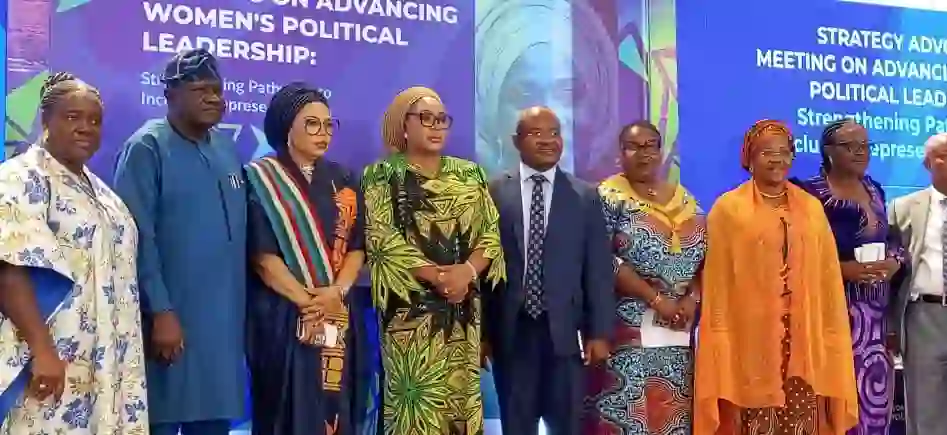
Some members of the House of Representatives and the wives of state governors have intensified calls on the National Assembly to pass the Special Seats Bill, describing it as critical to boosting women’s representation and strengthening Nigeria’s democracy ahead of the 2027 elections.
They made the call during a strategic meeting on women’s political leadership and inclusive representation convened by the Policy and Legal Advocacy Centre (PLAC), the Nigerian Women Trust Fund, the Nigerian Bar Association (NBA) section on Public Interest and Development Law (NBA-SPIDEL) with support from the European Union.
Chairperson of the Nigeria Governors’ Spouses Forum and First Lady of Kwara State, Olufolake Abdulrazaq, said the bill would address the glaring gender imbalance in governance, noting that Nigeria lags significantly behind global standards.
She cited global statistics showing that women currently occupy only 27.5 per cent of parliamentary seats worldwide, warning that at the current pace, gender parity may not be achieved until the 2060s.
“In Nigeria, the situation is even more concerning. Women occupy fewer than five per cent of seats in the National Assembly, which is among the lowest globally,” she said.
Abdulrazaq stressed that the absence of women in decision-making positions undermines inclusive governance, noting that women’s participation has been proven to improve policies on education, healthcare, peacebuilding, and social protection.
On her part, chairperson of the House Committee on Women Affairs and Social Development, Kafilat Ogbara, said the Special Seats Bill has gained significant traction within the National Assembly, with the leadership expressing support for its passage.
She, however, noted that more work is required to secure approval at both federal and state levels, as well as build public understanding of the initiative.
“This bill is not about giving unfair advantage. It is about correcting a long-standing imbalance in our political system,” she said.
Ogbara also urged political parties to reform their internal processes to create more opportunities for women, noting that candidate selection remains a major barrier to participation.
Executive Director of PLAC, Clement Nwankwo, warned that failure to pass the bill would represent a major setback for Nigeria’s constitutional reform efforts.
“If the Special Seats Bill does not pass, it will be difficult to regard the constitutional amendment process as a success,” he said.
He further called on political parties to ensure gender balance in candidate nominations, especially in the use of consensus arrangements, to avoid perpetuating male dominance in elective positions.
Also speaking, chairperson of NBA-SPIDEL, Uju Agomoh, described women’s underrepresentation as a “democratic deficit” that weakens governance outcomes.
She said, “Promoting women’s political leadership is not only a matter of justice but a strategic imperative for sustainable development and national progress.”
Participants at the meeting agreed that beyond legislation, deliberate efforts must be made to dismantle structural, cultural, and economic barriers limiting women’s participation in politics.
They also emphasised the need for sustained advocacy, mentorship, and public engagement to build support for the bill and ensure broader inclusion.
The stakeholders expressed optimism that with growing political will and public awareness, the Special Seats Bill could mark a turning point in Nigeria’s quest for equitable representation and inclusive governance.
🚨 BREAKING: Watch the full clip here ➤

