

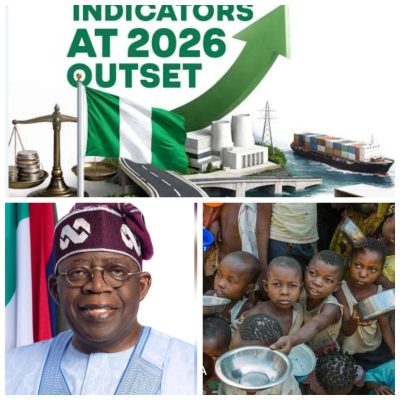
With the chanting of the “Renewed Hope”, it appears to be Uhuru in Nigeria, following the recent World Economic Outlook presented by the International Monetary Fund, which projected that Nigeria’s economy would expand by 4.1 percent in 2026. Though this specifically shows an economy faster than economies like the United States and the United Kingdom, as it handed the administration of President Bola Tinubu a powerful narrative. No doubt, the projection happens to be a narrative of progress, of reform, of a nation supposedly turning the corner after years of instability and setting the kind of moment that reassures investors, quiets critics and signals competence.
But once its statistical sheen is put aside, the weight of reality takes centre stage. The truth is while Nigeria may be growing on paper, it is simultaneously shrinking and does not in any way reflect the lived experience of its citizens, as the populace can attest to. With the current lived experience, nowhere is this contradiction more glaring than in the widening gulf between macroeconomic projections and the daily economic suffering of over 200 million people.
The truth is uncomfortable, but it must be said plainly that a country where poverty is deepening, inflation is persistent, debt is rising, and basic survival is becoming more difficult cannot meaningfully claim economic success, no matter what the growth figures suggest.
The most damning evidence against the “fastest-growing economy” narrative as enumerated by the Special Adviser to President Tinubu on Policy Communication, Daniel Bwala comes not from opposition voices or political critics, but this time it is coming from the World Bank itself. Alarming to this is that according to its latest Nigeria Development Update, poverty in the country rose to 63 percent barely months back, translating to roughly 140 million Nigerians living below the poverty line.
This is not just a statistic; it is a humanitarian crisis unfolding in real time, which in a real sense calls for quick interventions.
Even more troubling is the trend. Poverty has not plateaued; it is accelerating, worsening and not stabilising at all. From 56 percent in 2023 to 61 percent in 2024, and now 63 percent in 2025, the trajectory is unmistakable, as can be seen the data shows a clear upward trend over time that calls for concern. And projections from PwC suggest that the numbers will climb even higher, with an estimated 141 million Nigerians expected to be poor in 2026.
It would surprise many that these figures expose a fundamental contradiction; it is a total irony that an economy is growing while its people are becoming poorer, hence, while no one would hesitate to say that the type of growth taking place is flawed. Well, without jumping to a hasty conclusion, the answer lies in that growth. To say that the economic growth taking place is imbalanced, it is uneven, exclusionary, and not absolutely linked or largely disconnected from the sectors that sustain the majority of Nigerians. Growth driven by services and capital-intensive industries does little for a population whose livelihoods depend heavily on agriculture and informal enterprise. When growth bypasses the poor, it ceases to be development and becomes mere arithmetic.
The government’s defence often leans on the argument that inflation is easing and that reforms are beginning to stabilise the economy. But even this claim is increasingly fragile, as reported that the recent data from the National Bureau of Statistics shows that inflation has begun to rise again. This now shows that the headline inflation is ticking up to 15.38 percent in March 2026, alongside a sharp month-on-month increase of 4.18 percent. The pain Consumer Price Index climbed to 135.4, underscoring sustained pressure on household spending.
Another aspect that raises further questions is that the most critical component for ordinary Nigerians, which is the food inflation skyrocketed to 14.31 percent, with also a similar month-on-month surge. It must be made known that these are not just numbers on a chart; they represent the escalating cost of survival, mostly for the common man. The ripple effect of this, which is yet to change, is that families are compelled to pay more for basic meals, more for transportation, and more for the essentials of daily life.
Noteworthy is that even when inflation showed signs of moderation in previous months, the fact is that it did little to reverse the damage already inflicted. The World Bank has been clear on this point when it said that household incomes have not kept pace with price increases. The underlying point is that the earlier spikes in inflation eroded purchasing power to such an extent that any subsequent easing has been insufficient to restore real income levels and this is where the figures churned out were misleading.
This explains the inconsistency at the heart of Nigeria’s economy, where nominal indicators are improving, but real conditions are deteriorating. Nigerians are earning more in absolute terms but are able to afford less. This is further confirmed by data showing that while nominal household spending increased significantly, real consumption declined, while it would be said that people are spending more money, but they are consuming less. That is not growth; but the right word for it is economic suffocation.
The structural consequences of ongoing reforms compound the situation. The removal of fuel subsidies, which was the gift to Nigerians for electing President Tinubu and the liberalisation of the foreign exchange market were framed as necessary steps toward long-term stability. And in theory, they are defensible policies. But in practice, the result has been an extraordinary cost-of-living crisis, especially for the larger section of struggling Nigerians.
Speaking of the fuel subsidy removal, which has driven up transportation costs across the country, affecting both urban commuters and rural farmers, as the pain has been further intensified by the geopolitical conflict in the Middle East. The second policy shift which was the exchange rate liberalisation, has led to currency depreciation with the experiences biting hard across board, making imported goods more expensive and fueling inflationary pressures. These policy choices, which were perhaps deemed necessary, and without further ado have imposed immediate and severe burdens on households that were already vulnerable.
The International Monetary Fund has warned that these pressures are far from over. Rising global tensions, particularly in the Middle East, are pushing up the cost of energy, food, and transportation. For Nigerians, especially those at the lower rung in society, this translates into even higher living costs and deeper economic strain to contend with.
In this context, the government’s insistence on celebrating growth projections begins to appear not just disconnected, but insensitive. Because for millions of Nigerians, the economy is not an abstract concept measured in percentages. It is a daily struggle defined by whether they can afford food, transport, and shelter.
Compounding these challenges is Nigeria’s growing debt burden. Unexpectedly, public debt has climbed to over N159 trillion, with projections indicating a continued rise in the coming years because of the government’s appetite for borrowing. While the debt-to-GDP ratio may appear moderate compared to global averages, this comparison is totally misleading. The question is why the debt is ballooning when Nigeria’s revenue base is narrow, heavily reliant on oil, and constrained by a large informal sector that contributes little to tax income.
The current position of things is that debt servicing consumes a disproportionate share of government revenue, leaving limited fiscal space for investment in infrastructure, healthcare, education, and social protection, which has continued to expose the majority of Nigerians to untold hardship. It is a precarious position, one where the government is borrowing more while having less capacity to translate that borrowing into meaningful development outcomes and the part that is also critical is that Nigeria’s rising debt profile is entering discomforting quarters, as concerns shift from the sheer size of borrowings to the growing risks associated with refinancing existing obligations.
Even more troubling are the emerging questions around fiscal transparency and governance. Only recently, there were allegations by Peter Obi on the missing N34 trillion in federation revenue that remains unaccounted. This, according to him, has intensified concerns about systemic leakages and institutional corruption. The fact is, even though these claims remain contested, they resonate deeply in a country where public trust in government financial management is already fragile and has remained a subject of discussion for many Nigerians.
The truth is that if even a fraction of such resources were effectively managed and invested, the impact on infrastructure, social services, and poverty reduction could be transformative but this is yet to be embarked upon. Instead, the persistence of such allegations reinforces the perception of an economy where wealth exists but is inaccessible to the majority, which brings to bear if there will ever be a respite in a situation like this.
Adding another layer to this complexity is the excessive contradiction of oil revenue. With global crude prices that were once sold above $113 per barrel and currently hovering around $85 to $90, which is still far exceeding Nigeria’s budget benchmark, and the country stands to hugely benefit from a significant windfall, as was the case in the past. You know that history is more revealing than ever; it suggests that such opportunities are often squandered.

