

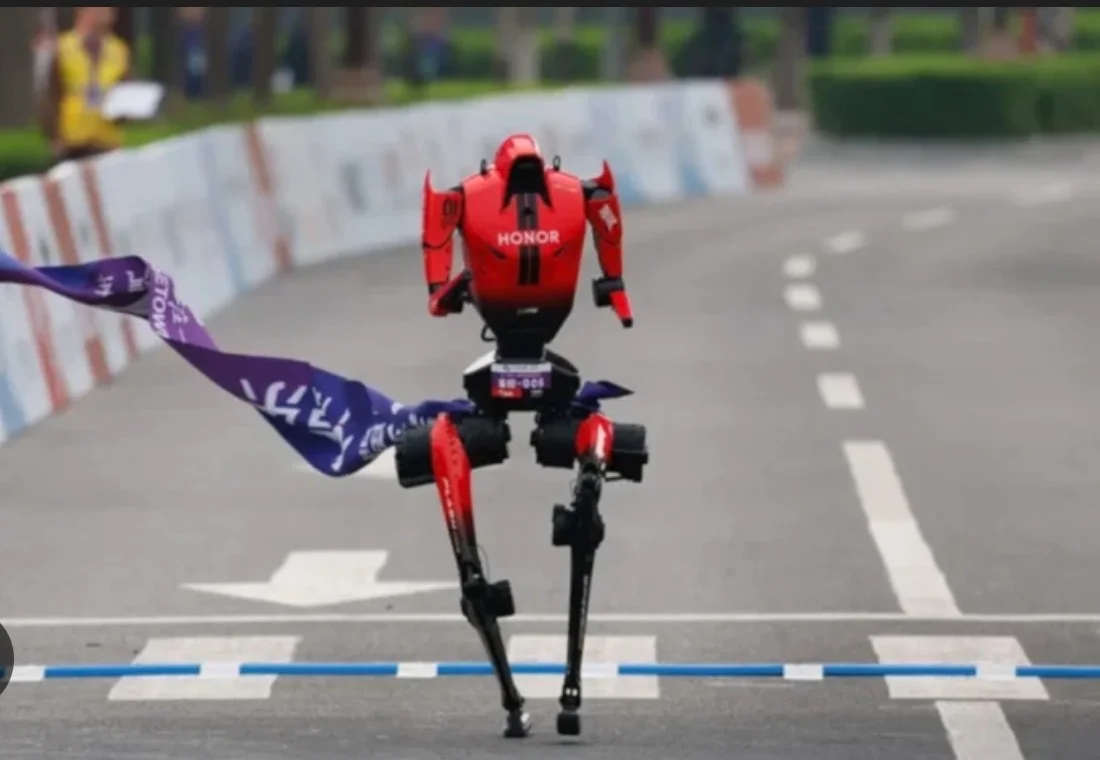
A humanoid robot known as Lightning has made headlines after reportedly winning a half-marathon race in Beijing, outperforming all human competitors in a moment that underscores the rapid evolution of robotics and artificial intelligence.
The race, held on April 19, 2026, covered the standard 21-kilometre distance and featured both elite human runners and robotic participants.
Lightning crossed the finish line ahead of the field, setting what organisers described as an unprecedented benchmark in endurance racing.
Event officials confirmed that the robot was entered alongside human athletes as part of a demonstration of emerging technologies in competitive environments. Its victory has since ignited widespread discussion among experts in sports and engineering.
According to its developers, Lightning’s performance was powered by a combination of advanced motion control, real-time balance correction, and energy optimization systems.
These features allowed the robot to maintain consistent speed and stability across the entire course key factors in long-distance running.
Read also:
The result is being viewed as a milestone in the field of Artificial Intelligence and robotics, highlighting how machines are increasingly capable of executing physically demanding tasks once thought to be exclusively human.
However, the achievement has also sparked debate about the future of competitive sports. Analysts are already raising questions around fairness, regulation, and whether robotic participants should compete directly with humans or in separate categories.
While Lightning’s win represents a leap forward in innovation, it also signals a broader shift, one where the boundaries between human capability and machine performance are becoming increasingly blurred.
🚨 BREAKING: Watch the full clip here ➤

