

Billions spent, millions displaced, and a region on the edge of transformation—an in-depth look at recovery, impact and the gaps that remain.
By Michael Olugbode
For more than a decade, Nigeria’s North-East has stood as one of the starkest examples of protracted conflict and humanitarian crisis on the African continent. The insurgency driven by Boko Haram and its splinter factions did not only claim lives—it dismantled entire communities, disrupted economic systems, and altered the social fabric of a region once sustained by agriculture and trade.
Humanitarian estimates paint a grim picture. The conflict has claimed over 350,000 lives, both directly and indirectly, displaced more than 2.5 million people, and, at its peak, left about 8.4 million people in urgent need of humanitarian assistance. Towns across Borno, Adamawa, and Yobe were reduced to rubble, while livelihoods disappeared almost overnight.
It was against this backdrop of widespread devastation that the North-East Development Commission (NEDC) was established—not merely as a reconstruction agency, but as a vehicle for restoring a region on the brink.
The Cost of War and the Birth of a Commission
The NEDC was created in 2017 under former President Muhammadu Buhari, in response to mounting calls for a coordinated and large-scale rebuilding effort in the North-East.
Initial post-conflict assessments estimated damages exceeding $9 billion, with critical infrastructure—homes, schools, hospitals, and roads—either destroyed or severely degraded. At the height of the insurgency, more than 1,400 schools were destroyed, while in some of the worst-affected areas, over 70 per cent of health facilities were rendered unusable. Agricultural production, once the backbone of the regional economy, collapsed, deepening poverty and food insecurity.
To address these challenges, the Commission was tasked with implementing the North-East Stabilisation and Development Master Plan (NESDMP)—a comprehensive framework designed to move the region from emergency response to sustainable recovery and long-term growth.
From Relief to Recovery: Tracking the Scale of Intervention
Since its establishment, the NEDC has overseen interventions running into hundreds of billions of naira, drawing from federal allocations, development partners, and international support.
Its footprint cuts across all six states of the North-East—Borno, Adamawa, Yobe, Taraba, Bauchi, and Gombe—where thousands of projects have been executed at varying stages.
Available data show that the Commission has:
• Constructed and rehabilitated thousands of housing units for displaced persons
• Delivered over 1,000 infrastructure projects, including roads, schools, and health facilities
• Distributed millions of relief materials during the peak of the humanitarian crisis
• Supported agricultural programmes benefiting hundreds of thousands of farmers
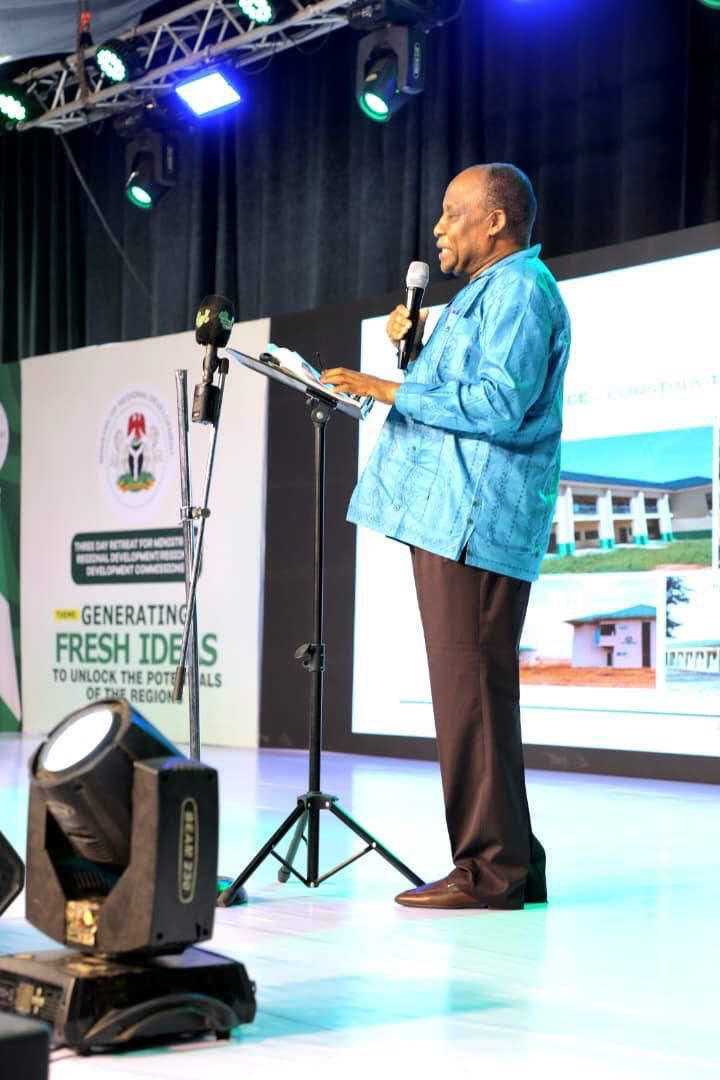
Speaking at a stakeholders’ engagement held last week, the Managing Director/Chief Executive Officer of the Commission, Managing Director/Chief Executive Officer of the North-East Development Commission, Mohammed Goni Alkali, said the agency is now deliberately shifting its focus.
“We are transitioning from humanitarian interventions to sustainable development. The emphasis is on building systems that will endure beyond immediate recovery,” said Mohammed Goni Alkali.
He further stressed that the Commission’s mandate extends beyond physical reconstruction.
“It is not just about rebuilding structures. It is about restoring livelihoods, rebuilding institutions, and ultimately giving people a renewed sense of hope,” he added.
Rebuilding Lives: Evidence from the Ground
Across the six states, the impact of these interventions is becoming increasingly visible, not just in infrastructure, but in the gradual return of normalcy.
In the area of housing, thousands of internally displaced persons have begun returning to reconstructed communities, easing the pressure on previously overcrowded camps. In education, rehabilitated schools and renewed teacher support programmes are restoring learning opportunities for children whose schooling was disrupted for years.
Healthcare delivery has also improved, with dozens of facilities rebuilt and equipped, particularly in rural areas where access had been severely limited. Meanwhile, road projects are reconnecting once-isolated communities, enabling the movement of goods and people, and revitalising local economies.
The Governor of Borno State, Professor Babagana Umara Zulum, Executive Governor of Borno State, acknowledged the Commission’s contribution to the recovery process.
“The NEDC has played a critical role in supporting the rebuilding of communities and restoring hope to our people,” said Babagana Umara Zulum.
Economic Revival: Restoring the Backbone of the Region
Before the insurgency, the North-East was a major hub of agricultural production. The conflict, however, disrupted farming cycles and displaced rural populations, leaving vast farmlands abandoned.
Recent interventions are gradually reversing this trend. Through the distribution of seeds, fertilisers, and farming tools, as well as support for irrigation and dry-season farming, agricultural activities are beginning to rebound. Small businesses and cooperatives are also receiving support, helping to revive local economies.
“Economic empowerment remains central to our strategy because without livelihoods, recovery cannot be sustained,” said Managing Director/Chief Executive Officer of the North-East Development Commission, Mohammed Goni Alkali.
Speaking during her tenure, Dr. Betta Edu, who served as Honourable Minister of Humanitarian Affairs and Poverty Reduction, had underscored the importance of aligning humanitarian response with long-term development.
“What we are seeing in the North-East is a deliberate effort to connect humanitarian response with long-term economic stability,” she said.
Beyond Aid: A Shift Towards Self-Sufficiency
One of the most significant developments highlighted at the recent stakeholder engagement is the gradual shift from aid dependency to self-sufficiency.
While millions still require assistance, there are clear signs of progress. As displaced persons return home and economic activities resume, communities are slowly regaining their independence.
During his time in office, Mr. Matthias Schmale, who served as United Nations Resident and Humanitarian Coordinator in Nigeria, observed that recovery efforts were beginning to yield tangible results.
“There is clear evidence that recovery efforts are improving living conditions and restoring basic services,” he noted.
Fragile Gains: Security and the Risk of Reversal
Despite the progress recorded, the region remains fragile. Although military operations have significantly weakened insurgent groups, sporadic attacks and insecurity persist in some areas.
The Chairman of the Governing Board of the Commission, Major General Paul Tarfa (rtd.), Chairman, Governing Board of the North-East Development Commission, emphasised the need to consolidate gains through sustained development.
“Security gains must be reinforced with development initiatives. Only then can we achieve lasting peace,” said Paul Tarfa.
The Gaps: What Still Needs to Be Done
Notwithstanding the scale of investment and visible progress, significant challenges remain. Millions of people are still in need of humanitarian assistance, youth unemployment remains high, and climate-related shocks continue to threaten agricultural recovery.
Funding constraints also persist, with the scale of need often outpacing available resources.
Acknowledging these realities, Alkali said the Commission remains committed to its mandate.
“The scale of devastation is enormous, but we are determined to continue working with all stakeholders to deliver sustainable recovery,” he said.
A Region in Transition
The North-East today stands at a critical juncture. While it remains one of Nigeria’s most vulnerable regions, it is also one of its most ambitious reconstruction efforts.
The progress made so far suggests a region slowly but steadily moving from crisis to stability, from dependency to resilience, and from destruction to development.
As Schmale had noted during his stewardship:
“The transition is significant, but sustaining it will require continued investment and strong collaboration.”
Conclusion: Reimagining the Future
The work of the North-East Development Commission represents more than reconstruction—it is an attempt to redefine what post-conflict recovery can achieve.
From rebuilding homes to restoring livelihoods, the Commission’s interventions are laying the foundation for a more stable and prosperous region.
Yet, as stakeholders reiterated at last week’s engagement, the real test lies not just in rebuilding what was lost, but in sustaining the gains already made.
In the North-East, recovery is no longer just about survival.
It is about reimagining the future—and making it possible.
🚨 BREAKING: Watch the full clip here ➤

