

By Prisca Sam-Duru
Imagine waking up as a foreign teenager in Lagos, Nigeria, to find the wing of a crashed warplane in your backyard without having heard a sound. That is the vivid memory Dorothy Davis holds of the ill-fated Nigerian Civil War.
Last month, Dorothy returned to Nigeria for the first time since the 1970s to honour her late father, Griffith J. Davis with an exhibition of his works. Though Griff Davis, as he was fondly called was an American diplomat, his real legacy was captured through the lens of his camera.
“When I moved here in Nigeria, I was in my teens, we first lived on Awolowo road, and that was when I was introduced to the Nigeria-Biafra war. I recall one morning I woke up, and there was the wing of a plane in our background. Surprisingly, we just saw it there. There was no sound. I was scared. There were soldiers with loaded guns at checkpoints, and my father offered cigarettes to them as a friendly gesture. Lagos was never with lights on…,” Dorothy recounts.
Five decades after leaving Nigeria, an excited Dorothy shared a hidden treasure: her father’s lens on African history.
Though her father died in 1993, his works during his service in Nigeria and across the world, more than 50 years after the Nigerian Civil War, delighted audiences during the show.
The rare photographs capture powerful moments from the Nigerian Civil War and other defining periods in Africa’s history.
Dorothy was invited as a member of the Haitian delegation to the 89th birthday celebration of former President Olusegun Obasanjo, held in Abeokuta, Ogun State. Seizing the opportunity, she organised an exclusive exhibition on March 9 2026, at Freedom Park, Lagos showcasing selected works from her late father’s vast archive.
Griffith Davis served in Lagos between 1966 and 1971 as a communications media officer for an American aid mission. His role involved teaching electronics and film as tools for education and development. However, beyond his official duties, he combined photography, journalism, and diplomacy to document historic moments across Nigeria and other parts of Africa.
From the Nigerian Civil War to events leading to Ghana’s independence, his camera captured scenes that are now considered rare historical records.
Dorothy recalls that photography was always part of her life growing up.
“Every time I turned around, there was a photograph. It was like the camera was a fifth member of the family,” she said.
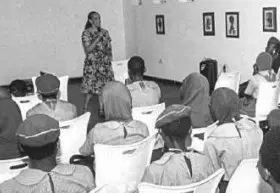
The exhibition, titled “Towards Freedom and Independence Across the Diaspora,” was hosted by culture journalist Jahman Anikulapo and supported by Nobel Laureate Professor Wole Soyinka. It featured two sessions—one for secondary school students and the other for adult audiences—aimed at educating Nigerians about historical events that are often overlooked.
Griffith was more than a diplomat; he was a storyteller. While working as a communications officer, he documented pivotal moments, including the McPherson constitutional talks and the early days of the Biafran War.
Since her father’s passing in 1993, Dorothy has been the custodian of a massive archive containing roughly 55,000 images. So far, she has processed only 10% of the collection. Her journey of discovery began when she found a personal letter from Ghana’s first president, Kwame Nkrumah, among her father’s papers.
The exhibition featured 50 select photos, including rare shots of political icons such as Nnamdi Azikiwe and Kwame Nkrumah even before they became renowned; a “banned” photo of Richard Nixon meeting Martin Luther King Jr. during Ghana’s independence; war memories covering scenes of a darkened Lagos and the silent landing of plane wreckage in the family’s backyard during the Civil War.
Dorothy, who now runs a global consulting firm, hopes these archives will educate younger generations. “These images tell stories that aren’t always in our textbooks,” she said. “It is the untold story of the diaspora.”
Article ‘Wing of a plane in our yard’ – America’s Dorothy Davis brings father’s Civil War photos back to Nigeria Live On NgGossips.

