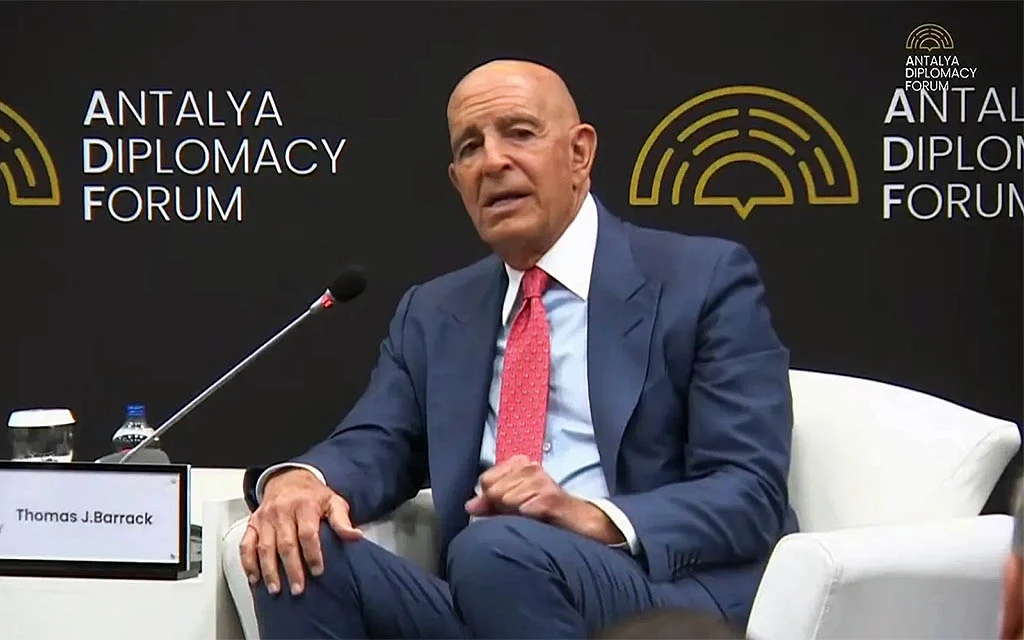
US President Donald Trump’s point man for Syria and Turkey appeared to knock Israel’s strategy in dealing with those countries on Friday, arguing that Jerusalem’s view of Damascus and Ankara as adversaries, rather than potential partners, was a strategic mistake.
Barrack, who serves as both US special envoy on Syria and as US ambassador to Turkey, claimed that Syria is interested in normalizing ties with Israel, and that Turkey can play a constructive role in the postwar rehabilitation of Gaza. He also appeared to question the depth of Israel’s ties to Druze communities in Syria, and to say that concern about global antisemitism is overstated.
During an onstage interview at the Antalya Diplomatic Forum, the US diplomat said that Syria’s new government, led by President Ahmed al-Sharaa, hasn’t fired a shot at Israel since Sharaa’s forces ousted longtime dictator Bashar al-Assad in late 2024.
Sharaa “has said time and time again that there are no issues with Israel. ‘We don’t want an adversarial issue with Israel. We don’t want to be at war with Israel. We want to work towards a non-aggression agreement and a normalization,’” Barrack said.
Israel has held several rounds of negotiations with Sharaa’s government, and the Syrian leader indicated this week at the Antalya Forum that the door to talks is still open, though he also accused Israel of acting with “brutality” and insisted on Syria’s claim to the Golan Heights.
He has given mixed signals as to whether he’s open to a normalization deal, saying at one point that “Syria is different” from Gulf states that normalized ties with Israel in 2020, because Israel and Syria are neighbors and Israeli troops have invaded his country.
Sharaa is an Islamist leader who was formerly affiliated with al-Qaeda, and Israel has viewed his rule skeptically. Israeli troops entered southern Syria following Assad’s ouster, and established a buffer zone in which it has stationed soldiers at several locations near the border. It has defended the move as necessary to protect its population from rogue militant actors.
Israel also intervened militarily last year after reports of government-allied forces attacking Druze in the province of Sweida and committing atrocities. The Israeli military bombed Syrian military convoys and struck the country’s Defense Ministry headquarters.
Israel said it was acting in support of the Druze, who form a substantial community in Israel and have deep ties across the border.
Barrack insinuated that Israel only discovered its connection to the Syrian Druze recently. In fact, Druze communities in the Golan Heights and northern Israel have longstanding, close ties to their Syrian counterparts.
“Israel has taken the point of view that the Druze in southern Syria are actually cousins of (the Druze in) Israel,” Barrack said. “The Sweida incidents, which were very, very difficult at the beginning of the al-Sharaa regime, led the Israelis to come across the border to protect their newfound Israeli cousins who were Druze.”
Barrack argued that Prime Minister Benjamin Netanyahu no longer cares about borders when taking steps he believes are necessary to protect Israel after Hamas’s October 7 attack.
Despite Israel’s aggressive actions in Syria, Barrack said the Sharaa government “was brilliant and not engaging in that fight” against Israel.
“The incursions are constant. Israel is coming across those lines every time they see a convoy because there’s still no trust between the two entities as to [whether Israel can] rely on the Syrian military establishment… to actually create a calm barrier,” Barrack said.
“In our opinion, Syria has been brilliant at not engaging adversarially against Israel. They have time and time again said, ‘We’re available to talk,’” he continued, recalling the negotiations he brokered between Syrian Foreign Minister Asaad al-Shobani and then-Israeli minister Ron Dermer.
“We got very close. It evaporated,” Barrack said of talks toward a non-aggression agreement between Israel and Syria.
“We’re dealing with five countries on five borders, two seas, and in the midst we have a war, so it’s a time-out from these conversations,” he added. “We’ll get there. My bet is we’ll get to a non-aggression and normalization agreement with Syria sooner than Lebanon.”
Envoy says including Turkey is ‘the only answer’
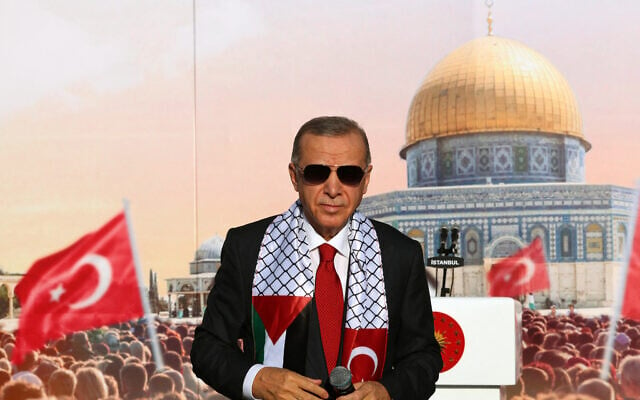
Separately in the interview, Barrack cautioned Israel against trying to box Ankara out of efforts to secure the six-month-old ceasefire in Gaza, arguing that President Recep Tayyip Erdogan has played a productive role in coaxing Hamas to cooperate.
Israel has staunchly opposed giving Turkey any role in the postwar Strip, as relations between the countries have collapsed since the Hamas-led October 7, 2023, attack, which began the war in Gaza. Turkey regularly hosts Hamas leaders, and Erdogan has praised Hamas as freedom fighters while condemning Israel, including by comparing it to Nazi Germany. Turkey has suspended trade with Israel and Turkish air carriers have stopped flying to Israel.
Barrack was asked about Israel’s fervent opposition to Turkey contributing troops to the International Stabilization Force, which would be tasked with securing Gaza in place of the IDF under a potential agreement.
The US envoy argued that both Turkey and Qatar have been able to play critical mediating roles between Israel and Hamas because they haven’t heeded calls from critics to outlaw the terror group.
Barrack said that Trump called Erdogan hours before the Gaza ceasefire was reached last October, requesting his assistance in bringing two Hamas leaders on board.
“President Erdogan, [Foreign Minister] Hakan Fidan, [Intelligence chief] Ibrahim Kalin all spent that afternoon and brought those two Hamas leaders over,” Barrack recalled. “It could have never happened had they agreed with us that Hamas was a foreign terrorist organization and that you have to exclude them.”
“If you invited Turkey into [the ISF], they would help with avoiding what’s happening now, which is atrocities, violations. They can speak the language,” Barrack maintained.
“I’ve been consistent [in telling] Israel that inclusion is the only answer. Exclusion is short-term,” he said.
He lamented the “horrible rhetoric” being exchanged between the two countries and said, “We have to figure out a way to solve it.”