

*President assents to bill extending implementation of capital component of 2025 budget from March to June
* Analysts urge prioritisation of capital projects
Deji Elumoye, Ndubuisi Francis and James Emejo in Abuja
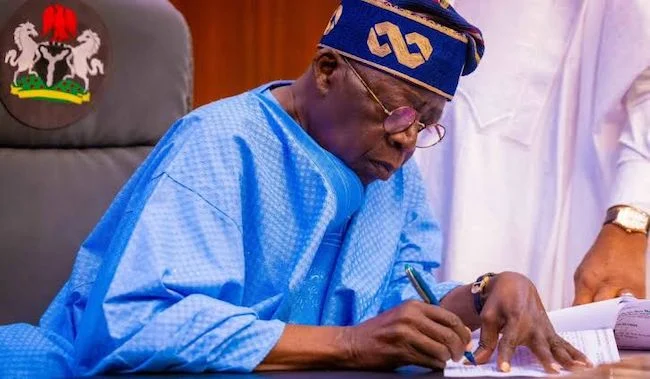
President Bola Tinubu has assented to the 2026 Appropriation Bill, which provides for an aggregate expenditure of N68.32 trillion.
This comes as analysts advised the federal government to prioritise capital budget.
The President also signed into law the bill extending the implementation period for the capital component of the 2025 budget from March 31, 2026, to June 30, 2026.
Presidential spokesperson, Bayo Onanuga, while giving a breakdown of the 2026 Appropriation Act in a statement yesterday, stated that the N68.32 trillion budget for this year earmarked N4.799 trillion for statutory transfers and N15.8 trillion for debt service.
It allocated N15.4 trillion to recurrent expenditure and N32.2 trillion to the Development Fund for Capital Expenditure.
According to the statement, with capital expenditure accounting for about 50 per cent, the 2026 budget underscores the administration’s continued commitment to economic stability, national security, infrastructure development, and inclusive growth.
The allocations reflect a strategic balance between statutory obligations, debt servicing, recurrent expenditure, and capital investments critical to driving productivity and improving the quality of life for Nigerians.
With the 2026 Appropriation Act coming into force on April 1, the federal government will commence full implementation in line with the Renewed Hope Agenda.
The President, therefore directed MDAs to ensure disciplined, transparent, and efficient utilisation of allocated re,sources, with a strong emphasis on value for money and timely project delivery.
He commended the leadership and members of the National Assembly for their diligence, cooperation, and patriotism in expeditiously considering and passing the budget.
Tinubu reaffirmed the importance of sustained collaboration between the Executive and Legislative arms of government in advancing national development objectives.
He further assured Nigerians of his administration’s resolve to deepen fiscal reforms, enhance revenue generation, and prioritise investments that will stimulate economic growth, create jobs, and strengthen social protection mechanisms.
Additionally, the President has assented to the Appropriation (Repeal and Enactment) (Amendment) Bill, 2026, which extends the implementation period of the capital component of the 2025 Appropriation Act from March 31, 2026, to June 30, 2026.
The extension will ensure the full and effective utilisation of appropriated funds, particularly for critical infrastructure and development projects that are at advanced stages of implementation across the country.
It will also enable Ministries, Departments, and Agencies (MDAs) to consolidate ongoing works, enhance project completion rates, and maximise value for public expenditure.
Commenting on the Appropriation Act, the President, Capital Market Academics of Nigeria (CMAN), Prof. Uche Uwaleke, described its signing into law as a significant fiscal milestone and a more deliberate attempt to align public spending with the country’s long-term development priorities.
However, he underscored the need to prioritise and ensure that the ambitious capital allocations translate into tangible outcomes.
He urged the federal government to focus on high-impact, economically viable projects while ensuring that funds are released in a timely manner to avoid implementation delays.
Uwaleke, who is also the Director, Institute of Capital Market Studies, NAasarwa State Unifiersity, Keffi (NSUK) told THISDAY that it was important to commend the clear prioritisation of critical sectors such as security, infrastructure, education, and health.
He said, “Allocations of N5.41 trillion to defense and security, N3.56 trillion to infrastructure, N3.52 trillion to education, and N2.48 trillion to health signal a recognition of the foundational role these sectors play in stabilizing the economy and improving citizens’ welfare. In a country where insecurity, infrastructure deficits, and human capital challenges have long constrained growth, this focus is both necessary and timely.
“Perhaps the most notable structural shift in the 2026 budget is the allocation of N32.2 trillion, nearly 50 per cent of total expenditure, to capital projects.
“This marks a welcome departure from previous fiscal cycles where recurrent expenditure dominated, often at the expense of investments that drive productivity and growth.
“A capital-heavy budget, if effectively implemented, has the potential to stimulate economic activity, crowd in private investment, and lay the groundwork for sustainable development. In this context, the decision to extend the implementation of the capital component of the 2025 budget to June 2026 is both pragmatic and justified.”
Given that many projects are already at advanced stages of completion, he argued that the extension provides Ministries, Departments, and Agencies (MDAs) the opportunity to consolidate ongoing works, avoid waste, and maximise value for public expenditure.
According to him, abruptly terminating funding in March 2026 would have risked leaving critical infrastructure projects stranded, thereby undermining both fiscal efficiency and public confidence.
On the revenue side, Uwaleke said he was cautiously optimistic that the targets set out in the budget may be realised, adding that global oil prices have remained above the budget’s reference benchmark, largely influenced by geopolitical tensions, including developments in the Middle East and the continued strategic importance- and recent stability- of the Strait of Hormuz.
Also, the Managing Director/Chief Executive, SD&D Capital Management Limited, Mr. Idakolo Gbolade, said the appropriation was expected to address serious security provisions, boost infrastructural projects and sustain spending to stimulate long-term economic growth.
He told THISDAY that, “If the budget is properly implemented, it is expected to boost the economy most significantly because it is a pre-election year and the present administration would have to show tangible economic progress to instill confidence in the electorate.”
According to him, “The 2026 budget is significantly larger than the previous budget and based on the prevailing security situation in the country it is expected to address serious security provisions, increased infrastructural projects and sustained spending to stimulate long term economic growth.”
Gbolade further stated that the extended 2025 spending deadline was to largely to complete ongoing projects.
He said, “The people need to see the positive impact of the budget because presently high cost of living and lower purchasing power is a major concern of Nigerians.
“And with higher revenues from increasing oil receipts and tax reforms, a lot is expected from the federal government to improve the economy and ease the burden of the populace.”
🚨 BREAKING: Watch the full clip here ➤

