

Ahead 2027 governorship and presidential elections, Jigawa State remains politically conscious and discerning. The electorate places a premium on integrity, performance, and quality leadership—values that are strongly reflected in the current APC-led administration.
The general public, and particularly the national headquarters of the All Progressives Congress (APC), may have recently taken note of sensationalised media reports alleging mass defections and resignations from the party in Jigawa State ahead of the 2027 general elections. Some of these reports often reference a purported internal crisis, claiming that a significant number of members have defected to the African Democratic Congress (ADC).
For the avoidance of doubt, such reports are largely the handiwork of desperate opposition elements and a handful of disgruntled party members—particularly those aligned with the former minister of defense, Muhammad Badaru Abubakar. These individuals have resorted to unconventional media platforms to falsely portray the current leadership as divided and ineffective. Their aim is to discredit the significant progress achieved by the present administration for personal political gain.
Contrary to these fabricated claims, the APC in Jigawa State remains stronger than ever. The reality on the ground reflects a different trend: since the inception of the current administration, thousands of members from the PDP and NNPP have officially defected to the APC. This influx has been so significant that opposition parties in the state have become virtually non-existent. Defectors consistently cite Governor Umar Namadi’s style of inclusive governance—which prioritises the welfare of all citizens regardless of prior party affiliation—as the sole motivator of their decision to join the APC.
Since the beginning of his administration, Governor Umar Namadi has prioritised transparency through the Citizens Engagement Programme (Gwamnati Da Jama’a). This historic initiative saw the governor tour all 27 Local Government Areas (LGAs) and engage directly with grassroots electorates. During these sessions, the governor, alongside political appointees and officeholders, presented detailed scorecards of ongoing and executed projects, thereby allowing citizens to assess performance and provide direct feedback.
This programme has served as a vital feedback mechanism, ensuring that governance remains a two-way process. Remarkably, submissions made by citizens during these tours formed the foundation of the 2026 fiscal budget.
By integrating public input directly into financial planning, the administration has ensured that the state’s budget genuinely reflects the yearnings and aspirations of its people.
The impact of the tour extended beyond governance into the political sphere. Across the 27 LGAs, the Citizens Engagement Programme triggered a massive wave of defections from opposition parties, particularly the PDP and NNPP. Over 10,000 former opposition members joined the APC during the tour. In several instances, entire executive committees—from ward to LGA levels—dissolved their previous affiliations to align with the ruling party.
Following the conclusion of the programme, the APC has continued to witness a steady influx of new members.
Decampees have cited several key reasons for their shift in allegiance, including widespread confidence in Governor Namadi’s vision and leadership style, the impartial completion of inherited projects regardless of location or political background, and the equitable execution of developmental initiatives across the state—including in traditional opposition strongholds—demonstrating a firm commitment to inclusive governance.
Some notable defections into the APC, which have significantly weakened opposition parties in the state, are highlighted below in chronological order:
In a noteworthy development, on 21st April 2025, the entire group of PDP propagandists, popularly known as “Sojojin Baka,” whose primary role was to promote the PDP agenda through electronic media, surrendered their membership cards and presented an Award of Excellence to Governor Umar Namadi.
Similarly, on 6th June 2025, a prominent financier of the PDP, Adamu Indallahi, defected to the APC alongside his teeming supporters. Mr Indallahi was a frontline sponsor of the PDP’s 2023 governorship candidate, Mustapha Sule Lamido, under the popular platform “Gobe ta Allah Ce.” This defection represents one of the most significant setbacks for the PDP in Jigawa State.
Since then, Mr Indallahi has continued to mobilise grassroots support for the APC, particularly in Birnin Kudu LGA—the hometown of former Governor Sule Lamido—which has long been regarded as a PDP stronghold.
On 21st June 2025, Umar Nabakin Dogo, an important founding member of the PDP in Jigawa State and leader in the Hadejia Emirate—which includes eight LGAs like Hadejia, Auyo, Kafin Hausa, Guri, Mallam-Madori, Kiri-Kasamma, Birniwa, and Kaugama—left the PDP to join the APC along with 30 other PDP members from their communities. This development significantly weakened the PDP in the zone, given that the defectors included ward executives, former sole administrators, former council secretaries, and former party chairmen at the LGA level.
Similarly, another prominent politician from Sule Tankarkar Local Government Area, Dahiru Gizo, alongside his followers, dumped the PDP for APC. In addition, on 19th September 2025, Aminu Jahun, a key pillar and stakeholder of the NNPP, joined the APC and subsequently encouraged several other NNPP members to follow suit.
Likewise, on 22nd September 2025, Muhammadu Gajarma, former State Secretary of the PDP, former member of the State House of Assembly representing Birniwa LGA, and then Chairman of the PDP Elders Forum in Jigawa State, defected to the APC alongside another PDP stakeholder, Sani Shuaibu.
And recently, on 15th April 2026, Hon Safiyanu Ubale Taura—a four-time member of the House of Representatives representing the Ringim/Taura Federal Constituency and a strong memberof NNPP who earlier decamped to ADC with his principal – Aminu Ringim, reversed and joined the APC. Abubakar Kazaure, a close associate of former governor Sule Lamido also joined the APC. In the same vein, Manu Vice, a former local government chairman and NNPP State Assembly candidate from Hadejia, announced his defection to the APC.
Also, Abdullahi Inusa Katako, former Chairman of Birnin Kudu Local Government Area—hometown of former Governor Sule Lamido and the PDP’s National ALGON Chairman—has defected from the PDP to the APC alongside a large number of his supporters. Likewise, a serving PDP chairman in the same local government area has also defected to the APC. This is around the same time Gambo Ibrahim Gujungu, who was PDP’s candidate for the Ringim/Taura House of Representatives seat in 2023, also decamped to APC.
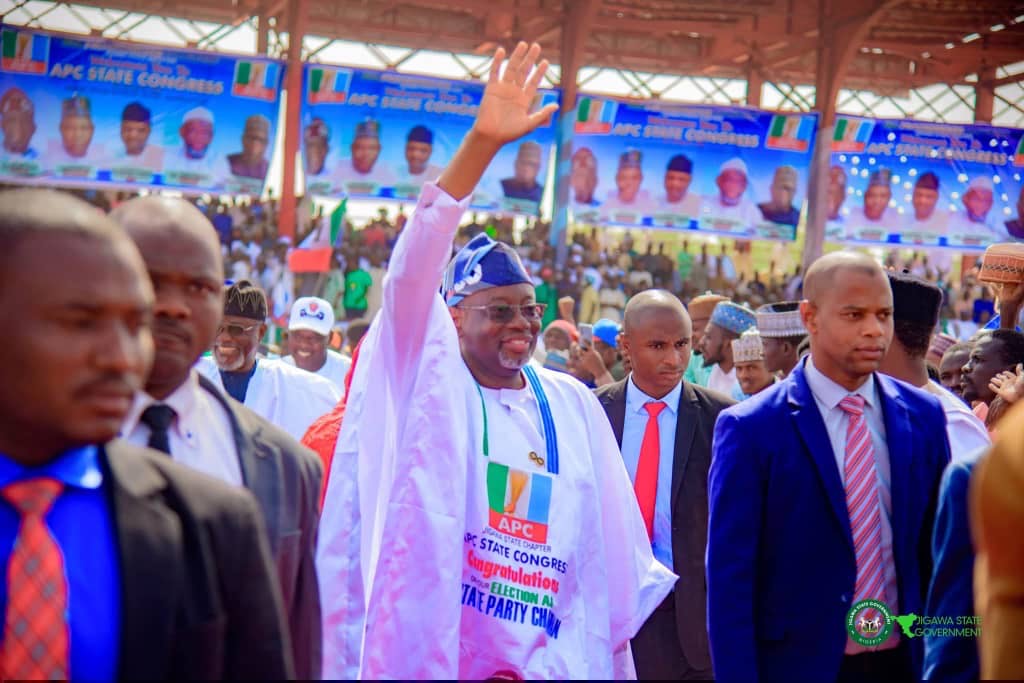
To cap it all, in a significant shift within the state’s political landscape, a grand rally was held on Sunday, 12th October 2025, at Dutse Stadium. The event served as a formal reception for over 66,000 defectors who transitioned from various opposition parties—primarily the PDP, NNPP, and ADC—into the ruling APC.
Governor Umar Namadi led a delegation of top national and state APC leaders, including the National Chairman, Professor Nentawe Yilwatda, and the Adviser to the President on Political Affairs to welcome the new members.
The gathering was widely rated as one of the largest political assemblies in the recent history of Jigawa State.
A critical factor in the APC’s sustained success in Jigawa is the dogged support of the Jigawa Elders Forum, led by the Waziri of Gumel, Adamu Nasoro. The forum maintains a robust and cordial relationship with the governor and has consistently commended the administration for its people-oriented projects, which have delivered tangible benefits to the populace.
This synergy extends beyond the Elders Forum, as the State Government also maintains a harmonious and productive relationship with the state’s five Emirate Councils as well as the Jigawa state Council of Ulamah.. This unprecedented level of institutional cooperation and advisory support remains a cornerstone of the administration’s stability.
In contrast, available records indicate that only a small fraction of individuals—fewer than twenty notable figures—have exited the APC. These departures appear largely driven by personal grievances, particularly relating to political appointments or future electoral ambitions.
Notable among them is Sabo Muhammad Nakudu, a former senator representing the Jigawa Central Senatorial District and a 2023 APC governorship aspirant. Nakudu was the only APC senatorial candidate who did not secure victory in the 2023 general elections. His defection to the ADC followed his inability to secure a guaranteed ticket for the upcoming electoral cycle.
Also among those who left the party is Ibrahim Abdullahi Kemba, former representative of the Dutse/Kiyawa Federal Constituency. Having lost his re-election bid in 2023 to the opposition PDP candidate, Kemba has been described by constituents as a politician who resurfaces mainly during election periods.
Similarly, Hussaini Namadi Abdulkadir, who represented the Auyo/Hadejia/Kafin Hausa Federal Constituency under the PDP, joined the APC after the 2023 elections with expectations of securing an appointment. Upon failing to do so—an issue he explicitly cited in his resignation letter—he defected to the ADC.
There is also Ado Sani Kiri, the former State Chairman of the APC under the previous administration of Governor Badaru Abubakar, who had effectively withdrawn from active politics prior to the 2023 election cycle. He neither sought re-election nor participated actively in the campaign, remaining in Abuja even on election day.
🚨 BREAKING: Watch the full clip here ➤

