

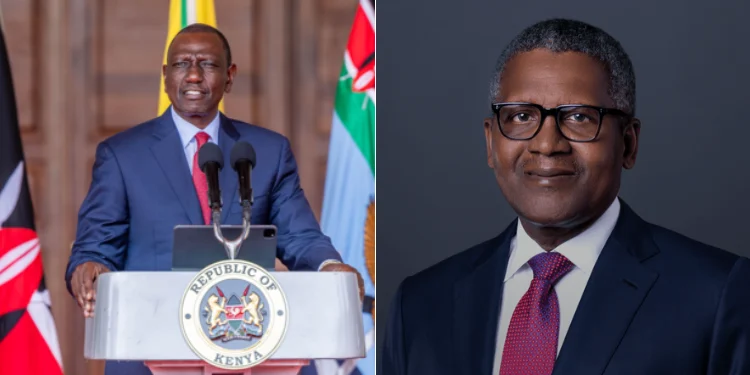
Kenyan President William Ruto has credited Nigerian billionaire Aliko Dangote with playing a pivotal role in addressing Nigeria’s long-standing fuel scarcity, describing the development as a model for African-driven solutions.
Speaking at a major infrastructure summit in Nairobi, Ruto noted that despite Nigeria’s status as one of Africa’s largest oil producers, the country had for years struggled with persistent fuel shortages and long queues at petrol stations.
According to him, the situation began to shift following Dangote’s investment in a large-scale refinery, which significantly boosted domestic refining capacity.
Ruto highlighted the development as evidence that African entrepreneurs and investors have the capacity to solve the continent’s most pressing challenges without excessive reliance on foreign support from Europe or Asia.
He urged governments, private sector players, and development partners across Africa to prioritise similar large-scale infrastructure projects to drive economic growth and energy security.
“The resources, leadership, and capital exist within the continent,” Ruto said, calling for faster and more decisive action in harnessing these strengths.
Dangote, who was present at the summit, expressed openness to supporting the development of a proposed refinery in East Africa.
However, he stressed that such investments would depend heavily on the level of commitment and policy consistency demonstrated by governments in the region.
Nigeria’s state-owned oil company, Nigerian National Petroleum Company Limited, has over the years made several attempts to rehabilitate public refineries in Port Harcourt, Warri, and Kaduna, with limited success.
Read also:
These challenges contributed to the country’s dependence on imported refined petroleum products despite its crude oil wealth.
While the Dangote refinery has improved supply dynamics, concerns persist among Nigerians over the high cost of fuel.
Many consumers argue that although queues may have reduced, affordability remains a major issue, underscoring the complexity of Nigeria’s energy challenges.
The discussion at the Nairobi summit has since reignited broader conversations about self-reliance, regional collaboration, and the role of private capital in transforming Africa’s energy landscape.
🚨 BREAKING: Watch the full clip here ➤

