

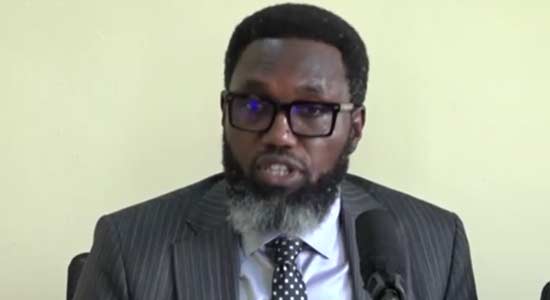
A legal practitioner, Maxwell Opara, has filed suit at the Federal High Court in Abuja seeking to halt the Nigerian military’s Operation Safe Corridor deradicalisation programme and compel the Attorney-General of the Federation to criminally prosecute over 700 former Boko Haram members who have been released and reintegrated into society without facing trial, conviction, or sentencing by any court of competent jurisdiction.
The suit, marked FHC/ABJ/CS/837/2026 and filed on Wednesday, April 23, names President Bola Tinubu, the Nigerian Army, and the Attorney-General of the Federation as respondents, raising fundamental constitutional questions about the separation of powers, the rule of law, the rights of terrorism victims, and whether the military and executive can effectively grant amnesty to individuals suspected of terrorism, murder, and kidnapping without legislative authorisation or judicial oversight.
The case comes just days after the military announced that 744 former insurgents and victims of violent extremism graduated from the latest cycle of the Operation Safe Corridor programme in Gombe, with the Chief of Defence Staff, General Olufemi Oluyede, describing the initiative as “not a reward for violence but a deliberate strategy to reduce violence, weaken extremist recruitment and promote long-term stability.”
The originating summons raises seven key legal questions for the court’s determination and seeks multiple declarations and orders.
Opara is asking the court to determine whether the reintegration of over 700 former insurgents into society without criminal prosecution, judicial conviction, or sentencing is consistent with the 1999 Constitution (as amended) and the Administration of Criminal Justice Act 2015.
He is seeking a declaration that the reintegration of repentant insurgents without prior prosecution and judicial conviction is “unlawful, unconstitutional and a violation of the rule of law and the ACJA 2015.”
He is asking the court to declare that the Nigerian Army and the AGF “lack the legal authority to grant de facto immunity or amnesty to individuals who have participated in acts of terrorism, murder, kidnapping and other violent crimes under Nigerian law, without legislative authorisation and judicial oversight.”
He is seeking a declaration that the military’s actions in releasing and reintegrating the insurgents amount to “a violation of the doctrine of separation of powers and a usurpation of judicial authority,” arguing that judicial powers are vested exclusively in the courts and that the military cannot perform what is essentially a judicial function of determining guilt or innocence, or granting what amounts to a pardon.
He is requesting an order directing the Nigerian Army to immediately suspend the Operation Safe Corridor Reintegration Programme pending the hearing and final determination of the suit.
And he is seeking an order compelling the AGF to initiate and pursue criminal prosecution of the over 700 released insurgents “in accordance with the provisions of the Terrorism (Prevention and Prohibition) Act, 2022, the Administration of Criminal Justice Act, 2015, and all other relevant laws.”
Opara’s case rests on several interconnected constitutional and statutory arguments.
On the separation of powers, he argues that the determination of criminal guilt or innocence is exclusively a judicial function under the 1999 Constitution. When the military releases individuals suspected of terrorism without submitting them to judicial process, it is effectively performing a function reserved for the courts, deciding that these individuals should go free despite being suspected of the most serious crimes under Nigerian law.
On the rule of law, he argues that the Terrorism (Prevention and Prohibition) Act 2022 and the ACJA 2015 prescribe specific procedures for investigating, prosecuting, and trying persons suspected of terrorism-related offences. Bypassing these procedures through a military-run deradicalisation programme, regardless of how well-intentioned, violates the legal framework established by the legislature for dealing with terrorism suspects.
On amnesty, Opara argues that neither the military nor the AGF has the constitutional authority to grant what amounts to de facto amnesty to terrorism suspects. The Constitution provides for presidential pardon under specific conditions, but Operation Safe Corridor is not structured as a presidential pardon programme. It operates outside the constitutional framework for clemency, creating what Opara describes as an extralegal mechanism for releasing individuals who should be facing criminal prosecution.
On citizens’ rights, the lawyer invokes Sections 33, 34, and 35 of the Constitution, which guarantee the rights to life, dignity, and personal liberty. He argues that releasing individuals who are “reasonably suspected to have participated in acts constituting terrorism, murder, kidnapping and other grave offences” without prosecution poses “a real and substantial risk” to citizens and violates their constitutional right to security of person.
In his supporting affidavit, Opara described himself as a public interest litigation practitioner and attached an official press release of the Nigerian Army as Exhibit A, documenting the graduation of former insurgents from the programme.
He deposed that under Operation Safe Corridor, over 700 individuals identified as former Boko Haram members have been released and reintegrated into society without being subjected to criminal prosecution, trial, or conviction.
“I know that many of the said individuals are reasonably suspected to have participated in acts constituting terrorism, murder, kidnapping and other grave offences under Nigerian law,” Opara stated.
He warned of the consequences of inaction. “I know that failure to prosecute persons accused of serious crimes erodes public confidence in the justice system and the rule of law,” the lawyer stated.
“I know that exposing citizens to potential harm from unprosecuted offenders violates these rights,” he added, referring to the constitutional rights to life, dignity, and personal liberty.

