

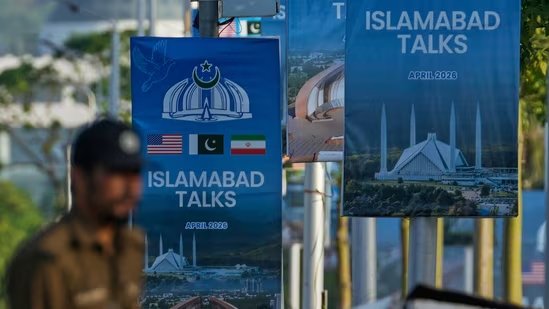
United States envoys Steve Witkoff and Jared Kushner are set to visit Pakistan on Saturday, the White House said, while Iranian foreign minister Abbas Araghchi has already reached Islamabad. This comes amid no clarity on whether a second round of talks will take place after the first meeting on April 11 ended without any agreement.
Washington and Tehran remain stuck in a costly deadlock as Iran has mostly shut the Strait of Hormuz, which usually handles one-fifth of global oil trade. Meanwhile, the US has blocked Iran’s oil exports. Follow US-Iran war live updates here.
The conflict, now in its ninth week, has led energy prices to levels not seen in years. This has also added pressure on inflation and raised concerns about global economic growth.
ALSO READ | Middle East conflict looks increasingly like war nobody can win
Here’s all you need to know ahead of the high-stakes negotiations:
Direct or indirect talks? A cloud of uncertainty shrouds Islamabad
White House press secretary Karoline Leavitt told reporters on Friday that “the Iranians want to talk in person”, adding that envoys Steve Witkoff and Jared Kushner would travel to Islamabad to “hear the Iranians out”.
However, Iran said that it will not hold any direct talks with the US. Soon after Araghchi reached Pakistan, officials made it clear that no direct meetings would be held with US representatives during the visit.
Foreign ministry spokesperson Esmael Baqaei wrote on X that “No meeting is planned to take place between Iran and the US.” He added that Pakistani officials would pass messages between the two sides.
What’s on agenda?
The lack of clarity over the talks is not new and does not rule out some form of communication between the two sides. If discussions go ahead, they are likely to cover the same issues that stalled the earlier round.
The previous talks between the US and Iran in Islamabad broke down over three key points. These included Tehran’s highly enriched uranium (HEU) and its nuclear programme, the reopening of the Strait of Hormuz, and Israel’s war in Lebanon.
Iran has maintained that it has the right to enrich uranium but reports also suggested that the level of enrichment could still be discussed.
Notably, Iranian foreign ministry spokesperson Ebrahim Azizi said that Araghchi’s visit to Pakistan is only for bilateral ties. He said that nuclear talks are a red line for Iran and will not be part of discussions in Pakistan.
In a post on X, he said, “In the meeting with foreign journalists, I mentioned that Mr. Araghchi, our country’s Minister of Foreign Affairs, has traveled to Pakistan to discuss bilateral relations. He has no mission whatsoever in this trip regarding nuclear negotiations, which are considered one of Iran’s fundamental red lines.”
The White House said vice president JD Vance is ready to travel to Islamabad if there is progress, but there is no clarity yet on what Iran may be willing to offer.
Islamabad under lockdown
Large parts of Pakistan’s capital have been under tight security for more than a week as of Saturday. This comes amid continued uncertainty over the possible second round of talks between the US and Iran.
The main roads leading into Islamabad have been closed. The Red Zone, which houses major government offices and diplomatic missions, remains heavily guarded.
In the nearby commercial ‘Blue Area’, markets are largely empty. Cafes are facing supply shortages. Public transport has also been affected, and bus terminals are not operating, leaving many commuters stranded, news agency PTI reported.
For residents, the ongoing uncertainty has been the most difficult part. Islamabad is a city where many people stay during the week for work and return to their families at the weekend.
This is the second lockdown in recent weeks. Islamabad was earlier sealed on April 11 for talks between the US and Iranian delegations, which ended without an agreement.
With inputs from agencies
🚨 BREAKING: Watch the full clip here ➤

