

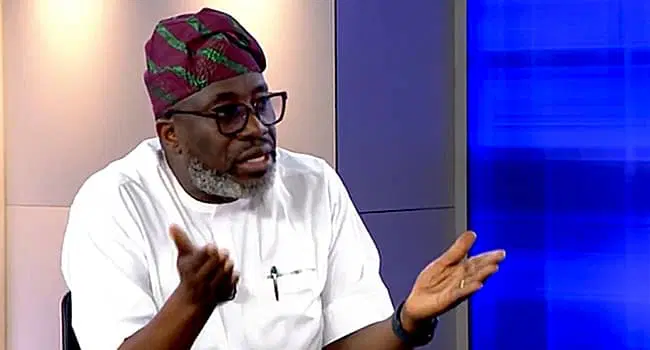
By James Ogunnaike, Abeokuta
The Convener of The Alternative Movement, Otunba Segun Showunmi, has attributed Nigeria’s worsening insecurity to decades of governance failures marked by corruption, policy inconsistency, and elite capture, warning that these challenges have deepened poverty and eroded opportunities, particularly in the northern part of the country.
Showunmi stated this on Wednesday while speaking at the Capitol Hill Forum on Terrorism and Religious Violence, where he assessed the country’s deepening security crisis, urged a shift from simplistic narratives to more structural and enduring solutions.
Delivering a lecture titled “Between Faith, Force, and Fragility: Confronting Nigeria’s Security Crisis with Clarity,” he cautioned against reducing the nation’s security challenges to narrow explanations.
“Reducing Nigeria’s turmoil to religion, regional blame, or government indifference may be emotionally satisfying, but none is analytically sufficient,” he said.
According to a statement made available to Nggossips in Abeokuta, Ogun State by his Media Aide,
Ajibola Busayo Oluwafidipo, Showunmi argued that the crisis is not rooted in religion itself, but in its manipulation by vested interests.
“What Nigeria confronts today is not the failure of faith, but the weaponization of belief — the deliberate manipulation of religious identity by actors who seek power, grievance, or control,” Showunmi stated.
He noted that while religion has historically inspired both peace and conflict, the determining factor lies in its interpretation, stressing that mischaracterizing the crisis as purely theological risks masking its deeper political and sociological causes.
On governance, Showunmi maintained that the state must assert its authority firmly but warned against the dangers of excessive force lacking legitimacy.
“The primary obligation of any government is to maintain a monopoly over the legitimate use of force. But a force not anchored in fairness, professionalism, and neutrality risks compounding the instability it seeks to resolve,” he said.
He further linked insecurity to widespread economic deprivation, noting that poverty creates fertile ground for violence.
“Where millions lack a credible pathway to dignity and livelihood, the opportunity cost of violence collapses. Extremist ideologies do not create this vacuum; they exploit it,” he added.
While acknowledging ongoing economic reforms aimed at stabilizing the foreign exchange regime, Showunmi warned that such measures often come at a social cost.
“Without parallel investments in social protection, education, and job creation, reforms risk deepening the grievances insurgents are quick to harness,” he cautioned.
He also raised concerns over the growing impact of misinformation and ethnic polarization, describing Nigeria’s information space as highly fragmented and susceptible to manipulation.
“Narratives in Nigeria are not neutral; they are instruments of power. In such an environment, even legitimate government action is easily recast as bias or persecution,” he said.
Speaking on democracy, Showunmi observed that although Nigeria’s multi-party system provides a platform for competition and representation, weak institutions and elite-driven politics have undermined its effectiveness.
“If insecurity continues to erode public trust, the risk is not just instability, but democratic regression,” he warned.
He called for decisive action against those sustaining insurgency, including financiers and political collaborators.
“The era of impunity for ‘big men’ who play both sides of the conflict must end. Anything less signals weakness,” he declared.
Outlining a path forward, Showunmi advocated for the professionalization and depoliticization of security agencies, inclusive economic reforms, credible governance, and stronger mechanisms to counter misinformation.
“None of these offers a quick fix. The Nigerian crisis is layered, adaptive, and long in the making. But with disciplined leadership and institutional reform, Nigeria can move from reactive crisis management to strategic stability,” he said.
He concluded by urging leaders at all levels to rise to the challenge of safeguarding the nation.
“No president takes satisfaction in the loss of citizens. But intent must translate into coherent and sustained action. The burden is heavy — but it is not an excuse for paralysis,” he added.
Article Nigeria’s insecurity rooted in decades of governance failure — Showunmi Live On NgGossips.

