

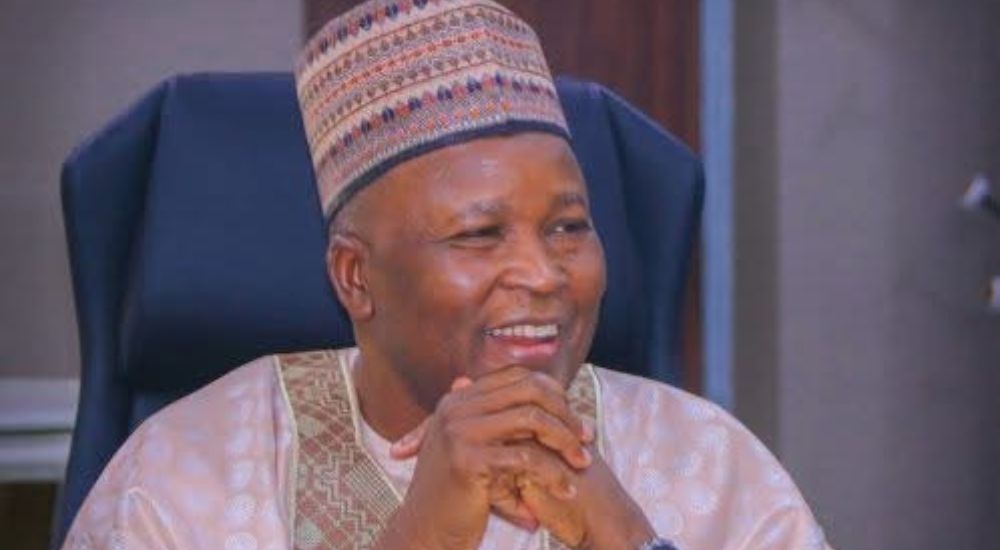
The declaration was long anticipated. What it has done, however, is crystallise what promises to be one of the most consequential intra-party battles in northern Nigeria ahead of the next general elections — a contest that pits a former deputy governor and minister against one of the most powerful men in Nigeria’s legislature.
The opponent Gwarzo will most likely face is no ordinary incumbent. Senator Barau Ibrahima Jibrin is the deputy president of the Nigerian Senate, the second-highest-ranking official in the upper chamber, currently on his third consecutive term representing Kano North. In the rarefied and often treacherous terrain of Nigerian politics, challenging a sitting Deputy Senate President for his constituency ticket is either an act of supreme political confidence — or a very high-risk gamble.
An Ambitious Challenger with Deep Roots
Gwarzo’s political credentials are not insignificant. His career in public life spans multiple decades and levels of government, beginning with his tenure as chairman of Gwarzo Local Government Area — the district after which he is named — serving multiple terms.
He rose through the ranks to serve as deputy governor of Kano State before being appointed Minister of State for Housing and Urban Development by President Bola Tinubu in 2023, a post he held until 2024.
At his declaration event, Gwarzo framed his candidacy around a narrative of experience and grassroots service. He pointed to a vocational training programme he has established, currently supporting about 100 youths with skills acquisition and monthly stipends, pledging to expand it across the district’s 18 local government areas as a flagship anti-unemployment initiative.
He also cited contributions to rural electrification and skills acquisition centres during his years in office and invoked his ministerial record, including involvement in the Renewed Hope Cities and Estates housing initiative under the Tinubu administration.
“His long record in public service positions him as the most experienced candidate for the seat,” his camp maintained — a claim that, while legitimate on its face, will be tested rigorously by political reality in Kano North.
The Incumbent’s Formidable Position
Barau Jibrin’s grip on Kano North politics has been built steadily over a decade. First elected to represent the senatorial district in 2015 on the APC platform, he was re-elected in 2019 and again in 2023 — his third consecutive term.
On June 13, 2023, when the 10th National Assembly was inaugurated, he emerged as Deputy Senate President unopposed, following endorsement by all his colleagues.
His rise to the second-highest office in the Senate did not happen by accident. In the Senate, Barau has chaired influential committees, including Petroleum (Downstream) and the Tertiary Education Trust Fund (TETFund), contributing to legislative oversight in energy and education sectors.
His contributions include championing the North West Development Commission, sponsoring bills to establish federal universities and polytechnics, and implementing constituency empowerment programmes.
On the ground in Kano North, Barau has invested heavily in his political structure. As recently as February 2026, he donated 26 cars and 141 motorcycles to chairmen, vice-chairmen, councillors, and secretaries across all 13 LGAs of the Kano North Senatorial District — a calculated act of grassroots infrastructure-building ahead of 2027 that money and titles alone cannot easily counter.
APC stakeholders across Kano North have pledged total commitment to delivering votes for Barau in 2027, with a stakeholders meeting convened by the Deputy Senate President drawing party leaders, elected officials, and grassroots politicians to consolidate unity ahead of the elections.
At the same gathering, the Deputy Speaker of the Kano State House of Assembly, Rt. Hon. Muhammad Bello Butu-Butu, declared that Kano North had never had a senator who performed as well as
The Governorship Variable
What makes the political calculus around Kano North’s 2027 Senate race even more complex is a question Barau himself has not yet publicly resolved: does he want the Senate seat at all?
A group of over 200 serving and former members of the Kano State House of Assembly has endorsed the Deputy Senate President for the 2027 governorship race, describing him as the most marketable candidate for the APC in Kano State. Their endorsement is based on what they call his long track record at the National Assembly and the fact that his influence cuts across all three senatorial zones of Kano.
Beyond the governorship, some voices have gone even further. A northern youth group has publicly urged President Tinubu to consider Barau Jibrin as his vice-presidential running mate in 2027, arguing that his pervasive political influence — particularly in delivering APC votes in Kano North — makes him a uniquely valuable asset at the presidential ticket level.
This ambiguity is politically significant. If Barau eventually opts for the Kano governorship or a higher office, the senatorial ticket he leaves behind becomes a far more open contest — and Gwarzo’s declaration suddenly looks less like a long shot and more like a well-timed positioning.
A Contest Within the Party
It is important to note that, as matters stand, both Gwarzo and Barau are members of the All Progressives Congress. This means the primary battle — should it come to that — will be fought within the APC’s internal machinery, a terrain notoriously susceptible to godfather influence, delegate manipulation, and federal executive pressure.
Gwarzo is not without allies in the corridors of power; his stint as minister places him within the patronage network of the Tinubu administration.

