


This article first appeared on our partner site, Independent Arabia
Four years after Israeli authorities demolished the home of Wael al-Tahan in Jerusalem, he was forced to tear down his second home. This time, however, he had to do it with his own hands. Tahan’s home has become part of a growing phenomenon in Jerusalem. Around 150 Palestinian homes have been destroyed since the start of this year on the orders of Israeli courts – 23 of these were “self-demolitions”.
Palestinians compare having to demolish their own homes to “gouging their own eyes out”, but those who made the choice to self-demolish say they did so to avoid paying exorbitant sums to Israeli authorities to carry out the demolition.
Speaking to Independent Arabia, Tahan says he demolished his home in Ras al-Amud, a Palestinian neighbourhood in East Jerusalem, himself after reaching a “dead end” with the Jerusalem municipality. He wanted to avoid paying the fee of more than $30,000 (£22,200) that the Israeli authorities would have charged to carry out the demolition, having already paid them over $40,000 in fines in recent years for “building without a permit”.
“The Israeli authorities demolished my first home in Ras al-Amud four years ago, which had stood for 30 years, on the grounds that it was built without a permit,” he says. “All I had left after that was a small flat, and today I was forced to demolish it myself because they will not leave us in peace.”
Prolonged legal battles
These demolitions come after prolonged legal battles between Palestinians and the Jerusalem municipality, most of which end with a final ruling by Israeli courts ordering the homes to be demolished, leaving residents with the choice of carrying out the demolition themselves or paying Israeli authorities to do so.
At the heart of these disputes is the issue of construction without a permit issued by the Israeli-run Jerusalem municipality, in a context where obtaining such permits is extremely difficult – often to the point of impossibility – particularly in what is referred to as the city’s “Holy Basin”.
Structural plans for Jerusalem, drawn up by the Israeli municipality, show that only 14 per cent of the city’s land is allocated for development in Palestinian neighbourhoods, with the remainder designated as green zones.
‘The closest point between Earth and heaven’
In the al-Bustan neighbourhood, not far from Ras al-Amud, Palestinian Mohammed Odeh has been forced to demolish his home himself, as well as the home of his brother.
Odeh explains that the Jerusalem municipality had issued a demolition order for the house as far back as 2009, on the grounds that it stood on a site considered, according to Jewish beliefs, to be “the closest point between Earth and heaven”.
According to Odeh, he “paid a fine of $70,000 for building without a permit, before being forced to demolish his home himself today to avoid paying exorbitant sums to the Israeli authorities”.
He adds that his family and his brother’s family have been living with relatives since evacuating their homes, until they can find a flat to reside in within Jerusalem – a city he insists he will remain in “even if under a tree”.
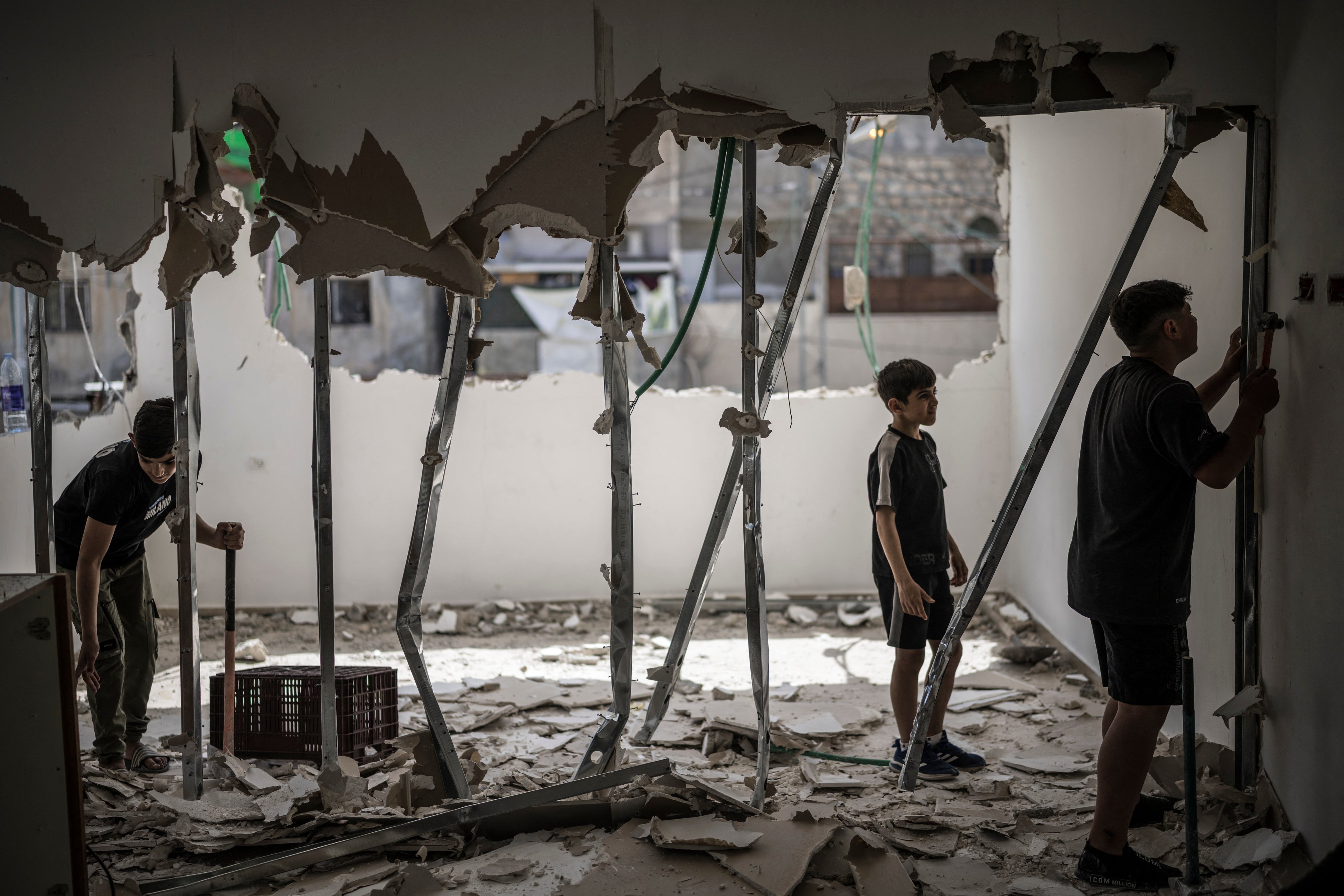
While Odeh is speaking with Independent Arabia, it emerges that his neighbour, Mohammed Qweider, is also busy demolishing his own home to avoid the high costs of enforced demolition.
Qweider notes that his family hold documents proving ownership of their plot of land in the al-Bustan neighbourhood, where they own more than 20 homes, dating back to the 17th century.
‘Billed for the guard dogs’
During the first three months of this year alone, Israeli authorities demolished more than 147 homes in Jerusalem, 23 of them through self-demolition by their owners, according to the legal adviser to the Palestinian Authority’s Governorate of Jerusalem, Marouf al-Rifai. He points to an “unprecedented increase in demolition operations”, noting that since the beginning of the month, more than 10 homes have been demolished.
In 2025, Israel demolished 367 homes in Jerusalem, while over the past five years the number has risen to more than 1,200 homes, on the grounds of “construction without permits”, says Rifai.
Regarding self-demolition, he says Israel “prefers this option because it can avoid being seen storming Palestinian homes in front of the world”.
He adds that Palestinians who don’t opt to self-demolish are charged “the cost of bulldozers, Israeli security forces, ambulances, civil defence vehicles, and even dogs used for guard duty”.
According to Rifai, “Israel is forcing Palestinians to work for years in order to pay the cost of demolishing their homes, which varies depending on the size of the demolished property.”
Translated by Dalia Mohamed; Reviewed by Tooba Khokhar and Celine Assaf
🚨 BREAKING: Watch the full clip here ➤

