Iran has resumed rail services on key routes after repairing sections of track damaged during the war with Israel and the United States, state media said on Monday.
The Israel Defense Forces said the Israeli Air Force bombed key rail sections and bridges in Iran as part of efforts to prevent the Islamic Revolutionary Guard Corps from moving weapon systems. Ahead of the strikes, the Israel Defense Forces warned Iranians to stay away from trains.
Iranian authorities have in recent days begun reconstruction work on bridges, railway lines and other infrastructure hit during nearly 40 days of fighting.
A fragile ceasefire has been in place since Wednesday.
In Iran’s northwestern Azerbaijan region, the director general of the railways said trains had resumed from the city of Tabriz, bound for the capital Tehran and Mashhad in the northeast.
“These trains have resumed service after an interruption of four to five days,” said Alireza Soleimani, according to Iran’s official IRNA news agency. “The Tehran–Tabriz–Van train also left Tehran for Van, Turkey, last night, using rebuilt tracks.”
A railway bridge near the city of Qom, south of Tehran, also reopened on Saturday after reconstruction work which lasted “less than 40 hours,” said Khosrow Samari, deputy governor in Qom province, according to the Tasnim news agency.
On Friday, Tasnim published video showing a train crossing the Yahya Abad bridge in the city of Kashan, in Iran’s central Isfahan province.
“After rapid reconstruction, the first train passed over the Yahya Abad Bridge today,” the news agency said, claiming the bridge had been targeted in a US-Israeli attack last week, prior to the ceasefire.
In the capital Tehran, residents have reported that authorities have moved quickly to clear debris from sites hit.
Where buildings have been too heavily damaged, they have sometimes been covered or cordoned off, including with Iranian flags.
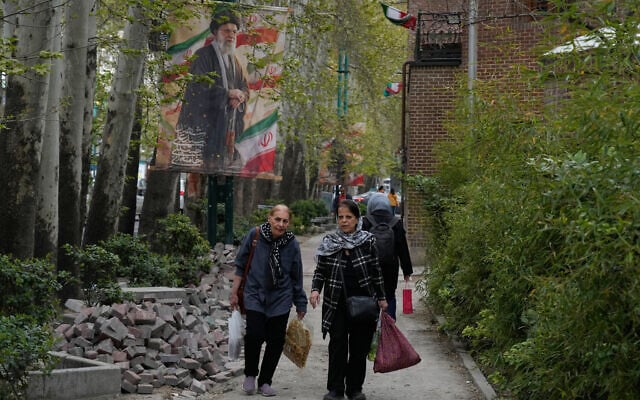
Government spokeswoman Fatemeh Mohajerani said on Sunday that reconstruction of damaged buildings would take between three months and two years.
She added that more than 125,000 buildings had been damaged since the war began, the majority of them residential but also schools, hospitals and other civilian facilities. The claim could not be independently verified.
The Israeli Air Force conducted hundreds of waves of strikes in Iran, dropping over 18,000 bombs on Iranian regime and military sites, including air defense systems, ballistic missile launchers, weapon production sites, nuclear facilities, and various command centers.
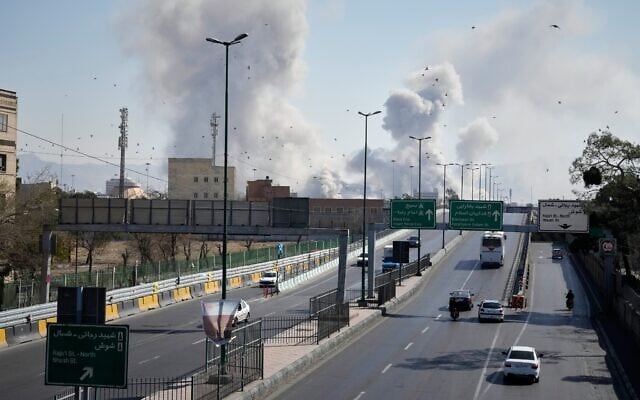
Some 650 ballistic missiles were launched from Iran at Israel during the forty days of conflict.
In all, at least 16 missiles carrying conventional warheads with hundreds of kilograms of explosives struck populated areas in Israel, causing extensive damage. There were also more than 50 incidents of missiles carrying cluster bomb warheads hitting populated areas, with hundreds of separate impact sites.
Iran also targeted the UAE, Kuwait, Bahrain, Saudi Arabia and Oman with missile and drone attacks.