

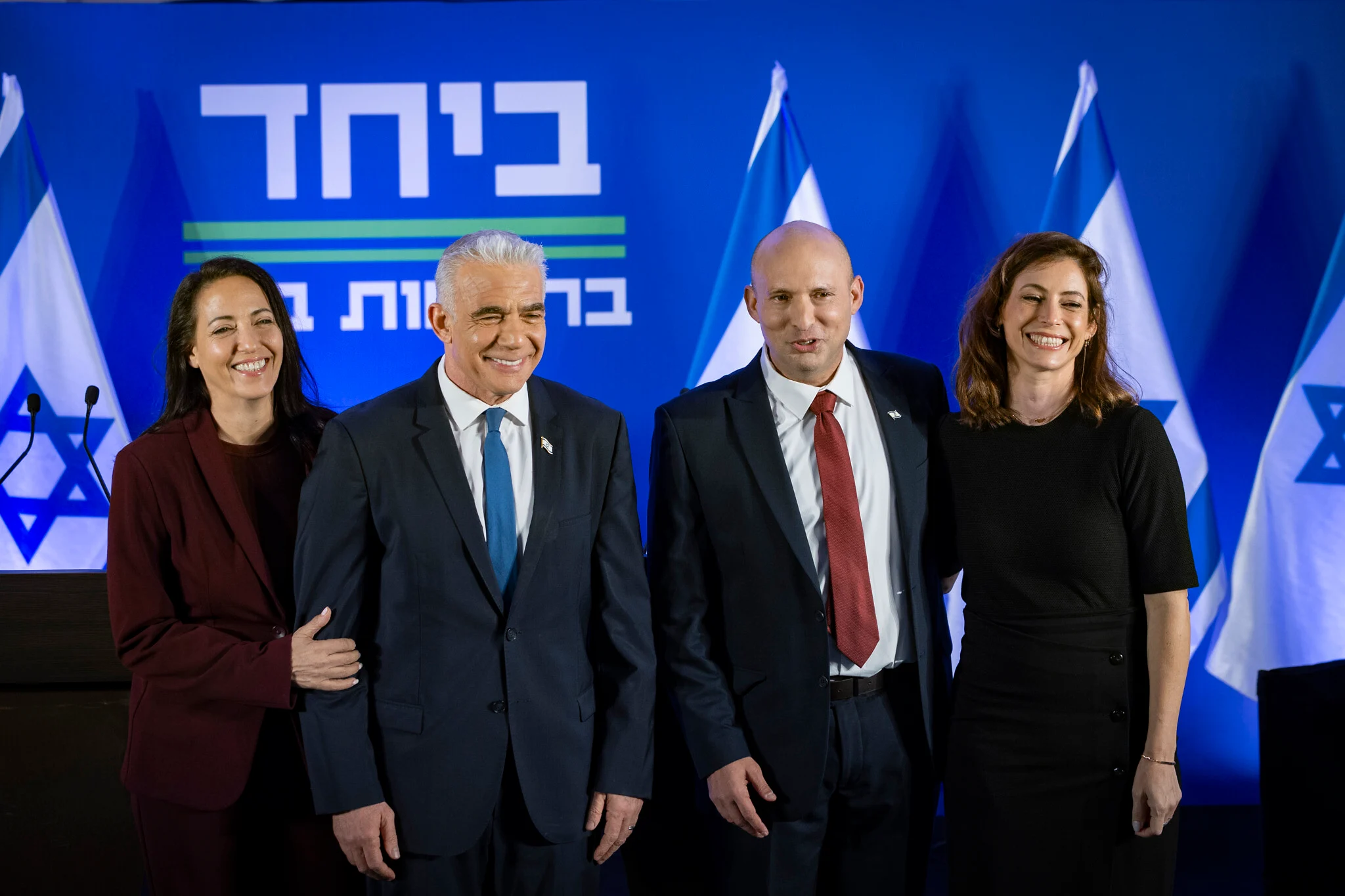
Launching their “Together” election alliance on Sunday night, Naftali Bennett and Yair Lapid unsurprisingly both highlighted the key shared positions that Bennett asserted will guarantee them a “giant victory” over Prime Minister Benjamin Netanyahu in general elections scheduled for October.
Bennett, in his opening remarks, vowed to establish a state commission of inquiry into the failures surrounding the Hamas invasion and massacre of October 7, 2023 — the powerhouse independent probe rejected by Netanyahu and supported by 60 percent or more of the Israeli public.
He promised to pass legislation requiring military service for all, and thus to reduce the burden on Israel’s exhausted reservists — in sharp contrast to the Netanyahu government’s unequal, undemocratic and hugely unpopular exclusion from the draft of most ultra-Orthodox young men.
Lapid, in his prepared statement, also vowed to draft the Haredim, and to tackle soaring crime, bring down the cost of living, and reform the education system.
What was less predictable, however, was the ease and confidence with which they acknowledged their markedly different positions on the political spectrum.
They’ve overcome those differences before, of course, when they formed a joint coalition after the 2021 elections, under which first Bennett and then Lapid served as prime minister.
But that was a post-election partnership that represented the only means by which either, indeed both, could attain the leadership of Israel — albeit briefly, as it turned out. Sunday night’s alliance is a pre-election choice, and the old-new partners made a virtue of their differences.
Bennett readily acknowledged that he and Lapid “have different views,” and declared himself a man of the right — a “right-wing, liberal, Zionist” as he put it. Lapid spoke for his centrist constituency, explaining that “to win the elections, the entire center must unite behind Bennett.” And both argued that the overwhelming majority of Israelis, more than just about anything else, are seeking unity and common purpose from their leadership, after years of internal division.
The merger of Bennett’s barely formed “Bennett 2026” party with Lapid’s well-established Yesh Atid makes clear sense for Bennett, who will be the leader of “Together” and thus likely the undisputed head of the anti-Netanyahu bloc going into the elections.
It marks more of a concession by Lapid, since there will be no rotating the prime ministership in the event of a win this time. Lapid indicated he might not even be No.2 on their joint slate if fellow opposition party leader Gadi Eisenkot comes aboard. (“Whatever it takes” to win the elections, said Lapid.) But Yesh Atid has been sagging heavily in the polls, and might have been at risk of falling below the electoral threshold altogether.
Bennett projected profound confidence in imminent victory and responded to questions about how he could draw votes from the Netanyahu camp and muster a Zionist majority without relying on Arab parties by asking one reporter how Netanyahu could possibly do so. The incumbent leads a bloc that only has enough support for “35 Zionist seats” in the 120-member Knesset, said Bennett.
Bennett also promised “surprises ahead” — presumably in the shape of further potential alliances and compelling new candidates.
But Netanyahu, the greatest Israeli political campaigner of his generation, will have known that this merger was on the cards, and is doubtless preparing surprises of his own. Bennett and Lapid may have ousted him in the summer of 2021, but within 18 months, Netanyahu had gradually persuaded most MKs in Bennett’s own party to abandon their leader. And it was Netanyahu who won the November 2022 elections and is currently on course to hold his coalition together for a full, four-year term.
Asked about the dangers of Netanyahu managing to prise defectors from Bennett’s next set of MKs, Lapid replied lightly that Bennett, as a smart man, has doubtless learned the lessons.
Bennett described their merger as a “daring” move, and asserted that “whoever dares wins.” “The people of Israel are thinking big,” he said. “They want a big change.”
Lapid, only a little more circumspect, told a watching nation — much of their press conference was televised on the main nightly news broadcasts — that the alliance guarantees “a government without Netanyahu” in an election that he said was not so much “fateful” for Israel as “existential.”
The right-wing Channel 14 had cut away from the press conference by that point, and soon after was showing its latest survey findings, which claimed to find that the Netanyahu-led bloc is heading for another Knesset majority, with 64 seats — a striking 13-14 more than other surveys have been finding in recent weeks — with Netanyahu’s own Likud on 34 seats, compared to a pitiful 20 for the new Bennett-Lapid “Together” alliance.
But even Channel 14 had shown the first 10 minutes of the presser, up to and including the final sentence of Lapid’s prepared remarks to the Israeli public. “You’re going to now hear 1,000 interpretations [of this alliance],” said the man who has now put aside any realistic prospect of again being prime minister himself. “But remember one thing: This thing that you’re feeling right now, that you haven’t felt for a long time, is called hope.”

