

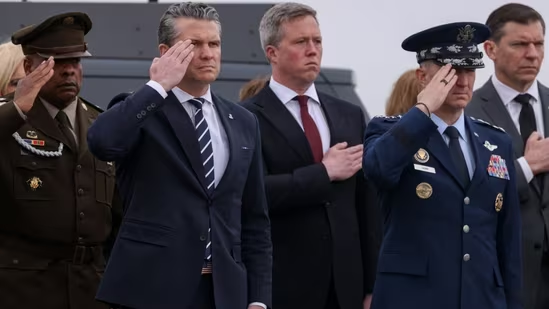
Soon after his first day at the Pentagon in early 2025, Army Secretary Dan Driscoll walked into his boss’s office with a proposal. Driscoll, a longtime friend and aide to Vice President JD Vance, offered to organize a visit by Vance and President Trump to meet soldiers and talk about reforming the Army.
Defense Secretary Pete Hegseth raised his voice, telling Driscoll that he, Hegseth, was in charge and ordered Driscoll to stay in his lane, according to people familiar with the encounter.
The meeting ended abruptly.
The encounter, which hasn’t been reported previously, was just one early episode in what has become a rocky relationship between the Pentagon chief and the Army secretary.
That tension spilled out into public view on Thursday, when Driscoll described to lawmakers his fondness for the Army’s former top general, Randy George, whom Hegseth fired as the service’s chief of staff on April 2 while Driscoll was on vacation.
“I, too, love Gen. George,” Driscoll told lawmakers during a hearing when asked about the four-star general’s sudden dismissal, calling him “an amazing, transformation leader.”
White House officials said Hegseth has the confidence of the president, who is pleased with the job he is doing running the Pentagon.
But the unusually public nature of the spat, along with the firing of a highly respected general during a war, has triggered fresh criticism within the Pentagon and in some Trump circles of Hegseth’s leadership. It has prompted questions about whether he allows personal vendettas to drive some decisions in a time of unprecedented military commitments around the world.
Retired Navy Rear Adm. Mark Montgomery, a senior fellow with the Foundation for Defense of Democracies, panned Hegseth’s decision to fire George.
“Effectively stripping the Army of a senior leader in a wartime environment, while trying to undergo transformation procurement-wise, I couldn’t think of two things I’d rather not do than that,” Montgomery said.
In a statement, White House spokeswoman Anna Kelly praised both Hegseth and Driscoll.
“President Trump has effectively restored a focus on readiness and lethality across our military with the help of leaders like Secretary Hegseth and Secretary Driscoll,” Kelly said.
Sean Parnell, the chief Pentagon spokesman, said Hegseth “maintains excellent working relationships with the secretaries of every military service branch, including Army Secretary Dan Driscoll.”
People familiar with the dynamic between Hegseth and Driscoll said their relationship was fraught with tension from the beginning. After the exchange over Driscoll’s proposal to organize a visit from the White House, tensions increased over the course of that spring, which was plagued with scandals for the Pentagon chief.
In March 2025, a journalist revealed that Hegseth had posted classified war plans in a Signal chat with senior national-security aides. The next month, three of Hegseth’s top aides were marched out of the Pentagon after being accused of leaking classified information. The aides denied wrongdoing, and no charges were filed.
People with knowledge of internal discussions said Hegseth was worried that Trump was eyeing Driscoll to replace him. Driscoll also was widely seen throughout the administration as protected in his job because of his close relationship with Vance, who attended Yale Law School with the Army secretary.
Almost immediately after taking office, Hegseth began targeting Army leadership, firing or sidelining officers with ties to retired Gen. Mark Milley, the former Joint Chiefs of Staff chairman who has clashed with Trump.
Hegseth has fired or sidelined several senior Army generals, including Lt. Gen. Joseph Berger, the Army’s former top lawyer; Gen. Douglas Sims, the former director of the Joint Staff; Lt. Gen. Joseph McGee, the former director for strategy, plans and policy at the Joint Staff; and Gen. James Mingus, the Army’s former vice chief of staff.
In November, Trump dispatched Driscoll to Ukraine to help negotiate a peace deal in the country’s war with Russia. It was an unusual task for a civilian service leader whose job was to train and equip soldiers, not lead peace talks. It led to widespread questions within the Pentagon on why Driscoll, and not his boss, Hegseth, was chosen for this task.
Hegseth told associates he wanted the White House to take Driscoll off the negotiations, according to several people with knowledge of the internal discussions.
Soon after, Driscoll was temporarily pulled from the high-profile assignment, and many of his press engagements were quashed, the people said.
By early 2026, Driscoll and Hegseth were feuding again, this time over a personnel issue. Hegseth and his aides had demanded that Driscoll remove several servicemembers from a highly selective list of officers slated to be promoted to one-star general, including Black and female officers, as well as Col. Dave Butler, Milley’s former spokesman, according to people with knowledge of the discussions. Driscoll repeatedly refused to strike the names of the Army officers from the list.
According to some of the people familiar with the discussions, Hegseth called Driscoll to his office in early February for what was supposed to be a 15-minute meeting. The encounter turned into a heated discussion that lasted more than an hour, during which Hegseth ordered Driscoll to fire Butler as a top communications adviser in the Army. The dismissal of Butler became public about a week later.
The friction culminated when the New York Times reported the rift over the promotions list. Hegseth and his aides suspected that George had leaked the story, and decided to ask for his resignation, according to people familiar with the internal deliberations.
Hegseth dismissed George in a terse phone call April 2, while Driscoll was on vacation with his family in North Carolina. Neither Army leader was given any explanation or advance notice, according to people with knowledge of the incident. The phone call, which George received during a meeting at the Pentagon, lasted less than a minute, those people said.
Driscoll told lawmakers that he and his family drove straight from North Carolina to George’s house, where the whole family “gave him a hug.”
“There is no person that has more respect for General George and his 42 years of service, his Purple Heart, his wife, Patty, their grandkids, their kids. I adore them,” Driscoll said.
Hegseth appointed Gen. Christopher LaNeve, his own former senior military aide, to replace George in an acting capacity. Hegseth also fired two other senior Army officers: Gen. David Hodne, who was head of the Army’s Transformation and Training Command, and Maj. Gen. William Green Jr., who was head of Army chaplains.
Some Republican lawmakers praised Driscoll’s leadership of the Army, while lamenting Hegseth’s treatment of George. “You are the right person, in the right place, at the right time,” said Rep. Tom Cole (R., Okla.).
Rep. Steve Womack (R., Ark.), a retired colonel in the Army National Guard, said the former chief was a “distinguished representative of our Army, and I, too, regret the fact and conditions he left the service in, and I think our country will regret that circumstance.”
In recent weeks, Hegseth’s chief spokesman, Parnell, has told administration officials that Hegseth has promised to tap him as Army secretary after Driscoll leaves, several people said. Parnell denied that characterization, earlier reported by the New York Post, saying in a statement that he is “completely focused on my current roles.”
Days after George’s firing, Driscoll issued an unusual statement to the Washington Post.
“Serving under President Trump has been the honor of a lifetime and I remain laser focused on providing America with the strongest land fighting force the world has ever seen,” Driscoll said in the statement. “I have no plans to depart or resign as the Secretary of the Army.”
He didn’t mention Hegseth.
Write to Lara Seligman at [email protected], Marcus Weisgerber at [email protected] and Meridith McGraw at [email protected]
🚨 BREAKING: Watch the full clip here ➤

