

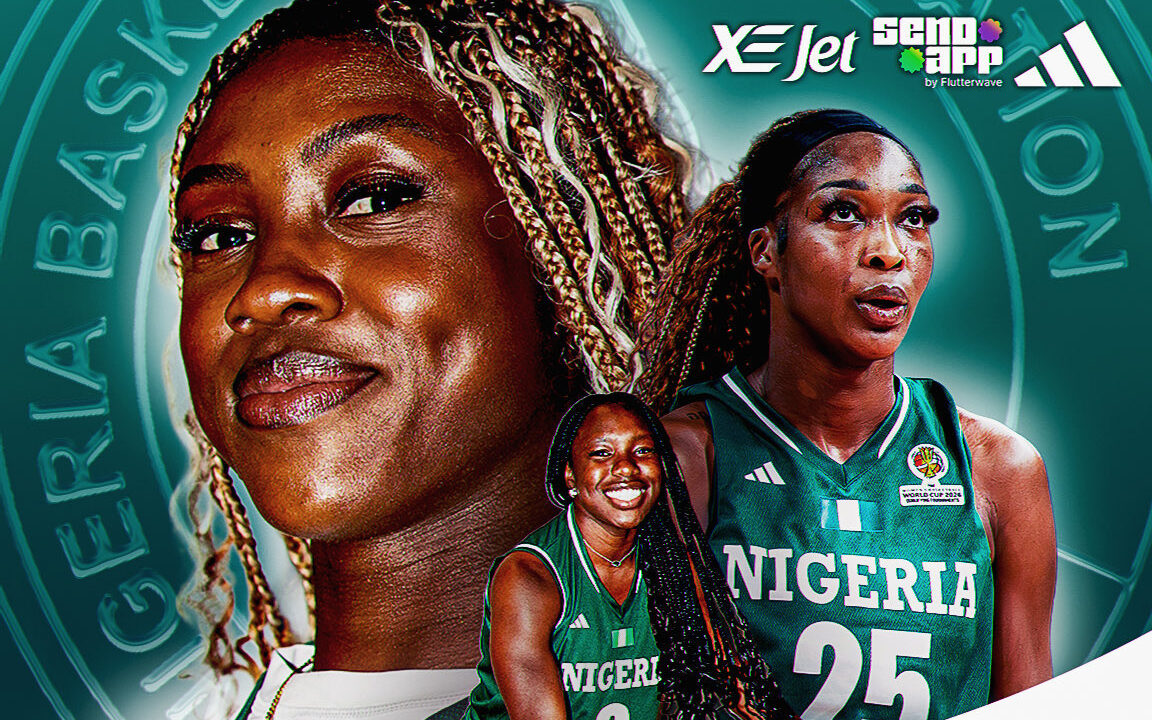
Nigeria is the first African national team to face a WNBA franchise, and only the fourth international side ever to do so
Nigeria’s women’s basketball story has always been built on defiance. Now, it steps into unfamiliar territory, and higher stakes.
Scheduled for 8:00 p.m. Nigerian time at Viejas Arena, the contest marks a historic first: Nigeria become the first African national team to face a WNBA franchise, and only the fourth international side ever to do so.
The occasion stretches beyond preparation.
For the Sparks, it is a return to San Diego for the first time since May 2010, when they defeated the Chinese women’s national team 78–58 in the city’s maiden WNBA outing. For Nigeria, it is an entry point into a new level of exposure; one that tests not just talent, but identity.
Because this is not the same D’Tigress.
This is a team in transition.
In the aftermath of a generational shift, the Nigeria Basketball Federation has leaned heavily into youth, and boldly so.
A 21-player training camp list tells the story: 15 players drawn from 14 NCAA programmes, the deepest collegiate pipeline the national team has ever assembled.
At the heart of that shift is Oluchi Okananwa.
The Maryland guard arrives not just as a prospect, but as a tone-setter. Averaging 17.8 points and leading her team in scoring in 28 of 33 games, her rise has been built on production, and mentality.
“Coach understands I’m a competitor at heart, I love to be coached hard,” she said, reflecting a mindset that mirrors the direction of this evolving squad.
She is not alone.
Towering presence Stephanie Okechukwu, the tallest player in NCAA women’s basketball history at 7-foot-1, headlines a group that includes Stanford’s Shay Ijiwoye and Nora Ezike, alongside Uche Izoje and Danielle Osho.
But even in transition, stability matters.
Veterans like Ezinne Kalu, Promise Amukamara, Victoria Macaulay, Nicole Enabosi, and Pallas Kunayi-Akpanah remain the spine; a bridge between what was and what is being built.
Kunayi-Akpanah was clear about the purpose of the tour:
“These aren’t just exhibition games. These are games for us to test our plays, our systems and how we communicate under pressure.”
Because the destination is already defined.
The United States tour is not an end, it is preparation for the 2026 FIBA Women’s Basketball World Cup in Berlin.
Drawn in Group B, Nigeria will face France women’s national basketball team, South Korea women’s national basketball team, and Hungary women’s national basketball team.
They open against South Korea on 4 September, before a quick turnaround against Hungary the following day, a schedule that demands depth, cohesion, and clarity.
Notably, head coach Rena Wakama will not be courtside for the tour due to her commitments with the Chicago Sky.
Instead, assistant coach Wani Muganguzi takes charge, another layer of adaptation for a team already navigating change.
Still, Wakama’s message remains aligned with the broader vision:
“Opportunities like this are critical for our growth. We are not just preparing to show up, we are preparing to make a statement.”
The Test: Sparks, Talent, and a full-circle moment
Standing opposite Nigeria is a Los Angeles Sparks side reshaped by offseason moves, including the arrival of Ariel Atkins and draft additions Ta’Niya Latson and Amelia Hassett.
They also retain Nneka Ogwumike, a player whose Nigerian roots and Stanford legacy create a unique narrative thread in this matchup.
For Los Angeles, the focus will be on improving offensive efficiency after shooting 33.7 percent from three-point range last season.
🚨 BREAKING: Watch the full clip here ➤

