

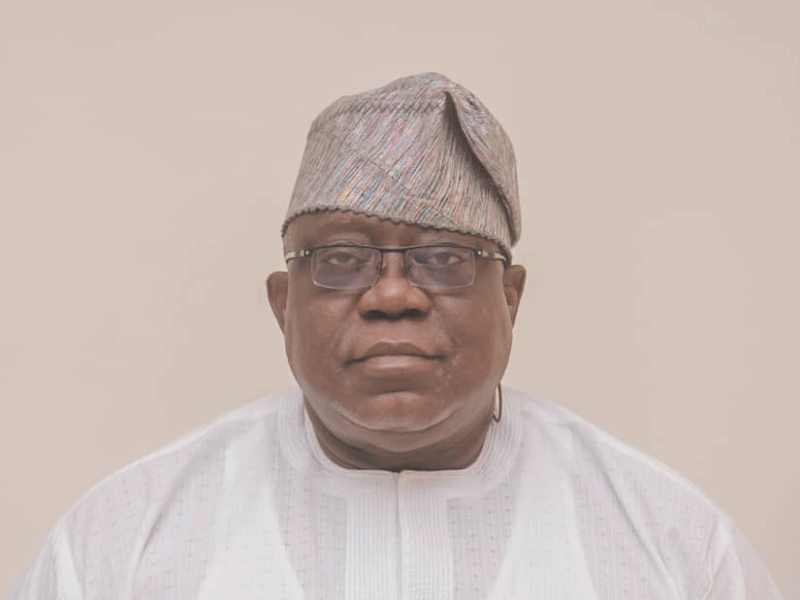
A viable local governance that is facilitated by a functional local government system is the bedrock of democracy, Prof. Tunji Olaopa has declared.
Olaopa who is the Chairman of the Federal Civil Service Commission stated this position while delivering the ninth yearly lecture of the Binuyo Foundation at the Federal School of Surveying, Oyo, on Saturday.
The Professor of Public Administration who spoke on “Strengthening Local Governance as Framework for Nigeria’s National Transformation” was nostalgic about how a functional local government system was instrumental to development at the grassroots level in the country up to the 1970s.
As he put it, “the
local government system is fundamental to the consolidation and sustenance of democracy and democratic accountability. And as grassroots participation is the most fundamental factor in governance, local governance remains the best platform for enlisting support for government development policies and programmes.”
According to him, active and well-positioned community-based structures enable bottom-up governance, and help government to strengthen its legitimacy and acceptance by the rank and file.
To him, the “Nigeria Project” has failed consistently largely because development strategies have not aligned with the needs of local governance as those initiated by most past administrations have been forced down the throats of local communities who then have no reason whatsoever to own them or do something meaningful with them to enhance their wellbeing.
Thus, to him, in strengthening the institutional framework for making local governance functioning as a democratic imperative, democracy itself becomes the foremost beneficiary not only because it makes possible the emergence of higher quality candidates for local offices but also because local councils then become the focal points of national project and change management.
According to him, such becomes the possibility as the federal and state governments incentivize the capability-readiness of local governments with conditional grants and allocations which in turn can serve as the basis for putting them on performance contracts that can translate to their periodic ranking relying on stakeholders-validated service standards that are published and celebrated.
He noted that in light of a myriad of self-help projects such as neighbourhood vigilance groups and boreholes to provide basic amenities at the grassroots level, bringing local governance back into democratic governance framework in partnership with local council operations should be seen as an appropriate response to the call for the restructuring of the Nigerian federation.
Such a response, according to Olaopa, suggests that there is the political will to relocate the people to the centre of democratic development in Nigeria .
Stressing the imperative of the local government system in the flourishing of democracy, Olaopa declared: “There is no doubt that the future of democratic governance in Nigeria lies squarely on how we constitutionally and practically manage the functionality of the local government as the third tier of government, and the benefits of local governance and grassroots development it brings. And the Binuyo Foundation has done us a national service by bringing its key significance to our collective consciousness once again”.
Earlier, Olaopa decried the collapse of the local government system due to the emergence of successive military administrations and constitutional impediments imposed by civilian governments.
He specifically condemned the 1999 Constitution which he said eroded the effectiveness of the local government system.
“Indeed, the Constitution made the power of state governments over local councils became complete as it empowers the states through the House of Assembly to make laws for the operations and functioning of the local councils.This not only undermined the autonomy of the local councils; it eroded the uniformity that the 1976 reform established”, he said.
🚨 BREAKING: Watch the full clip here ➤

