•Hustle for survival from rice husk
•Risk lungs, eyes, skin, other diseases
By Jeff Agbodo
ABAKILIKI rice mill industry, established in 1967, has been a source of livelihood to many families in Ebonyi State and beyond. It is located at the northern part of Abakiliki, the capital of the state. The mill is a historic and major hub for rice processing, packaging, and sales which has actively been operating since its inception to date.
At the mill, men and women gathered every day in their different sections, including rice paddy processing, milling and de-stoning, packaging and sales section.
The facility has continued to be a central player in Nigeria’s agricultural sector, with ongoing efforts to improve efficiency and modernize rice processing techniques. It serves as a major agricultural engine for Ebonyi State, reducing reliance on imported rice and supporting livelihoods.
The mill acts as a central hub for rice paddy traders, haulers, stunners, sorters, and machinery technicians. It processes locally grown, high-quality, organic, and nutritious popular Abakiliki rice. It is arguably the largest rice mill in Nigeria, with over 8,000 workers across the value chain, processing high-quality, organic local rice.
Major varieties processed in the mill include FARO 1, FARO 44, FARO 57, NERICA 19, and local strains like Brown and Ofada rice.
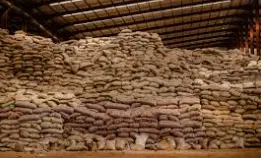
Over the years, a massive pile of rice husks (chaff) has accumulated at the site, a by-product of the intense milling activities. The mill is famous for its long accumulated mountain of rice husks, highlighting the high volume of production going on there.
The industry combines traditional methods with modern machinery, often relying on diesel generators, which leads to high costs and environmental concerns.
Many women earn their living in the massive pile of rice husks at the mill without any protective devices against respiratory and eye diseases, which have afflicted many of them over time.
The women excavating on the mountain of rice husks unrestrictedly inhale dust and smoke from the milling machines at the factory. They wear no protective devices. They delve into a dusty environment unprotected.
The women, mostly indigents, make their living from husks/chaff, sieving and sorting the chaff to get remnants of rice to sell or feed their family members. Some of the women who spoke with our correspondent said they have been in the business for many years as a means of survival.
Mrs. Rose Nwojoji said she joined her mother in the business when she was 15 years old and has continued till she got married and is still in it. According to her, the husk business has helped her to train her four children in secondary school.
“I am 30 years old, and I grew up to find myself working here. I was helping my mother, and when my mother died, and I got married, I continued with the business. We don’t have any other business apart from sorting and sieving rice from the chaff. So, at the end of the day, we gather the rice we got in a day. At times, I get a quarter bag or half, depending on how hard I worked for the day.
“When I gather the leftover rice from the chaff, I will sell it and use the money to solve my problems. I don’t buy rice at home; I feed my family from what I get here. In a week, I may get one full bag of rice, 50kg, or one and a half bags of rice. It has been helping me to take care of my needs and train my children in secondary school,” Nwojoji explained.
Another woman, Mrs. Ogechi Igboke, agreed that the business is very risky and hectic with the attendant health challenges, but she has no alternative. She said there is no gain compared to the health risk associated with it, inhaling dust from morning till evening, Monday to Saturday, without any protective measures.
“I am doing this job because I don’t have an alternative job or money to start another business. If I have a cash of N50,000, I will start a small business and leave this job. The job is too stressful, you stand under the sun from morning till evening, every day, and at the end of the day, you won’t get much rice.
“I am appealing to the state government led by Governor Nwifuru, and other good-spirited individuals, to come to our aid and support us with money to start other small businesses. In this place, you will see mothers and their three children doing this job just to feed themselves, not minding the health hazard. The rice we get from these husks is not enough to feed our families and sell to make money. We are just using it to sustain ourselves and keep life going,” Igboke said.
Mrs. Amaka Uchaji, who is also into the business, said whenever they are at the husk heap working, nobody will recognise them because of the dust that covers all their bodies like mentally-challenged people. She said the most annoying thing is that some people who claimed to be the owners of the land collect part of the rice gotten from the husk as their rights.
“After suffering from morning to evening, some group of old women will compel you to bring some quantity of rice as the owners of the land. You don’t challenge them, because they said that they are owners of the land and it is their right to take rice from us, or else you will not come there again.
“We have been doing it like that for many years. So, we don’t have a choice but to obey and share the rice with them to remain in business, or they will stop us from entering the site to hustle. We appeal to the management of the rice mill and the state government to intervene and stop it.
“How can some women gather themselves and stay under a shade and wait for you to go up the husk pile and hustle and come back, only for them to collect the rice from you because the land belongs to their forefathers. Why should it be our suffering that they feed fat from instead of the revenue they collect from those doing real business at the mill? They should stop extorting the poor husk workers”, Uchaji lamented.
Health hazards
Some of the workers shared their experiences regarding the health hazards associated with the job. A milling machine operator, John Ovuoba, whose mother worked on the pile of rice husks for 17 years, narrated how he lost his mother to lung disease. He said the mother suffered the ailment for years before she died in 2021.
“My mother was working in the rice husks pile. A lot of women who are from poor backgrounds or who have lost their husbands have been working there. The women do this daily, and my mother was one of them. She worked in the rice husk heap. She was always weak each day she returned from the job. She coughed, had lung issues, and other health challenges, and there was no money to take care of her health because my father was very old and couldn’t afford the money to take her to the hospital. The sickness worsened, and she was taken to a private clinic where she died. She suffered a lot, and she was our breadwinner,” he said.
A 28-year-old mother, Mrs. Amaka Nworie, also lost her mother, who worked on the rice husks. And she has been doing the same work since then. She nurses a one-year-old baby. Nworie usually comes to the rice husks with the child. She said no one cares for her since the demise of her mother, and instead of being idle or engaging in a crime, it is better for her to do the work.
“This is my fifth year of working in this rice husk heap. My mother worked here, and she died five years ago. When she was alive, I used to follow her, I assisted her. We suffered at that time because things were so hard for us.
“When she died, things became worse, and I looked around and thought of what to do to survive. Is it prostitution that I will engage in, or should I steal? There was nothing that I didn’t think of doing because working on the rice husks is very tedious. It is very dangerous for health, and it contributed to my mother’s death because she was having respiratory issues and she didn’t treat herself due to a lack of money. When she became very sick, she couldn’t survive it.
“So, one day, I made a decision that I had to work here, and I have been here for five years. My baby is one year and I come to this rice husk heap with her because nobody will take care of her at home. Yes, I do experience pains; eye pains, nose issues, and cough after work. Sometimes I go to a patent medicine dealer to get medicine to have strength and continue the work; each time the pains become very serious,” she narrated.
A 72-year-old widow, Regina Nwankwo, has been working in the rice husk heap for 18 years.
“I have been doing this rice husk job for 18 years. It is full of health hazards, but I don’t know what else to do to survive. I feed from this rice husk job. My six children and I feed from it. I lost my husband 16 years ago, and nobody takes care of my children and me. This is why I do this work for survival, and each time I do it, I have waist pains, headaches, and breathing issues. But God has continued to protect me.
“I have never bought medicine for the treatment of these health issues I usually have because I don’t have money. I don’t have anyone taking care of my children and me. We survive through this job, and it has become part of us. As you can see, there are young and old women working here, including girls.
These are people who have no one catering for them, and instead of stealing, they have decided to work here despite the health hazard,” she stated.
A 20-year old young lady, Miss Ginikachukwu Ogbudu, described the rice husk work as dangerous to health. She said the women are not supposed to do such a hard job, but because no one cares for them, they are doing it instead of stealing or engaging in other “bad work” which will bring shame to them and their families.
“This rice husk job is very dangerous to our health. It affects our health a lot. I have been having issues since I started this job. I have a persistent cough, waist pains, headache, and other issues. We need help; we are not supposed to be doing this work because of its health implications, but we don’t have anyone who cares for us; we don’t have hope, we don’t have work.
Our only means of survival is this rice husk work, and we can’t leave it because we have no alternative.
“We are suffering; hunger is dealing with us seriously, and that’s why we are doing this work, because we don’t want to steal or do anything that will bring shame to our families. It is better that we are doing this.
“The government should build a hospital here where we can check our health and treat the diseases we contract here. We also need safety kits and face masks”, Ogbudu appealed.
18-year old young Miss. Joy Awoke also narrated how she lost her mother early and resorted to the job to support her indigent father.
She said: “Since I lost my mother and had no other help, I decided to come to this place through a friend of my mother who introduced me here. I am doing the job to support my father, a poor farmer in the village.
“Yes, there are health hazards in this rice husk work, but what can we do? Should I steal? We are in this work because we don’t know what else to do; we don’t have any alternative to it.
“I have had serious health issues in this work. I have been having frequent headaches, cough, and chest pains, and if I complain, I will be told that the rice mill husk work is the cause, and I should stop it. But if I stop, who will care for my father and me? “, she retorted.
A health Officer in the State Ministry of Health, Dr. Jacob Nwodum, said that husk workers need help and support of the government and good spirited individuals to empower them and take them out of the place for skills and small businesses.
“The health risk involved in the job is far more than the gains, if any. For the interim, they need safety kits and face masks as well as medical checks because most of them have developed different accumulated diseases that need urgent attention.
“Then, the government should seal the heap of rice husks and stop the women from working there and provide alternative jobs and businesses for them to earn a living instead of gradually dying here without making any profit from the business”, he suggested.
Article Abakaliki rice mill, where women, children defy health hazards in search of daily bread Live On NgGossips.