Cruise companies are spending six-figure sums on consultants to read the tea leaves of an ambitious green-energy plan from the International Maritime Organization, the United Nations shipping agency. The framework was approved in April 2025, but after pressure from a U.S.-led bloc, a final decision was postponed until October. If there’s no agreement then, the cruise industry will be in regulatory limbo—along with all commercial shipping.
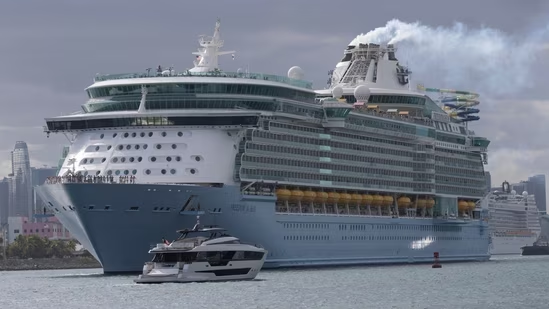
The Royal Caribbean Freedom of the Seas cruise ship, March 12.
Cruise ships are some of the world’s most expensive and complex ocean vessels—small cities on water. Each costs $1 billion or more to build and takes five to seven years to design and build, twice as long as most large cargo ships. Now cruise companies are hedging by building ships for a greener maritime future that may or may not come to pass.
The IMO’s Net Zero Framework is an aggressive regulatory package designed to push global shipping to net-zero emissions around 2050. “The plan is momentous because it would be the first internationally enforced decarbonization program,” Ella Baldwin, an energy policy consultant in the Houston office of Rystad Energy, a Norwegian research firm, says in an interview. Beginning around 2028, vessels that exceed emissions-intensity limits will pay an effective carbon tax of $100 a metric ton of excess emissions for smaller violations or $380 a metric ton for bigger ones.
The revenue the IMO generates—an estimated $10 billion to $12 billion a year—would go into a Net-Zero Fund to support U.N. climate-related goals such as mitigating “negative impacts on vulnerable States” and supporting “innovation . . . in developing countries.”
Sixteen of the IMO’s 176 member states, including the U.S., voted against the current proposal—with the Trump administration threatening retaliatory sanctions, visa restrictions and commercial fees on states that endorse it. The most likely outcome is a “gradual approach to transitioning shipping away from high greenhouse gas emission fuel,” but in a way that isn’t “as abrupt or as costly as what was being proposed,” says Brett Schaefer, a U.N. expert at the American Enterprise Institute.
Even a slimmed-down version of the plan could harm cruise companies. The industry has spent billions in recent years building green-friendly vessels, but the IMO plan will hurt their bottom line. Incorporating fuel flexibility into vessels and squeezing efficiency gains wherever possible saves money. But adding dual-fuel or “fuel ready” engine systems, which can be gutted and reconstructed later if regulators force a shift away from conventional fuels, costs about $10 million per ship. That’s not including the lost revenue from the space wasted.
Popular fuel alternatives, such as liquefied natural gas and hydrogen, require double to more than triple the tank size of oil. In an industry that monetizes every square foot of space, it’s a costly gamble for regulation that may not come to pass. If even a scaled-back version of the Net-Zero Framework passes, noncompliant ships could become too costly to operate—an unthinkable outcome for a vessel built to last 25 to 30 years.
Come October, other maritime industries may face the same dilemma if there is no final decision on the IMO plan. Commercial shipbuilders worldwide will have to decide whether to build expensive fuel-ready ships now or proceed with standard models and hope the IMO—and other green-thumbed U.N. regulators—abandon the effort.
While the cruise industry can absorb some losses, America’s commercial shipbuilding industry can’t afford to lose ground because of a global wealth-redistribution ploy. U.S.-flagged ships already cost more than four times as much to build and operate as international ones. Rising costs would push the industry into deeper decline and widen the gap with China, which has more than 200 times America’s shipbuilding capacity and builds more than 1,000 commercial ships annually to America’s five.
President Trump last year created an Office of Shipbuilding and recently released his Maritime Action Plan, which envisions a “Maritime Golden Age” by reviving American commercial shipbuilding, rebuilding the maritime workforce and expanding the U.S.-flag fleet. Similar efforts, such as the bipartisan Ships for America Act, are under way in Congress.
Mr. Trump will have to keep a close watch on the IMO if he wants these plans to succeed. IMO regulators know his presidency is up in 2029, so they may wait to push passage of the framework. But unless Washington secures an agreement this year, shipbuilders will be without regulatory clarity, and America’s maritime dominance could be lost to history.
Ms. Farmer is a social-media editor for the Journal editorial page.