

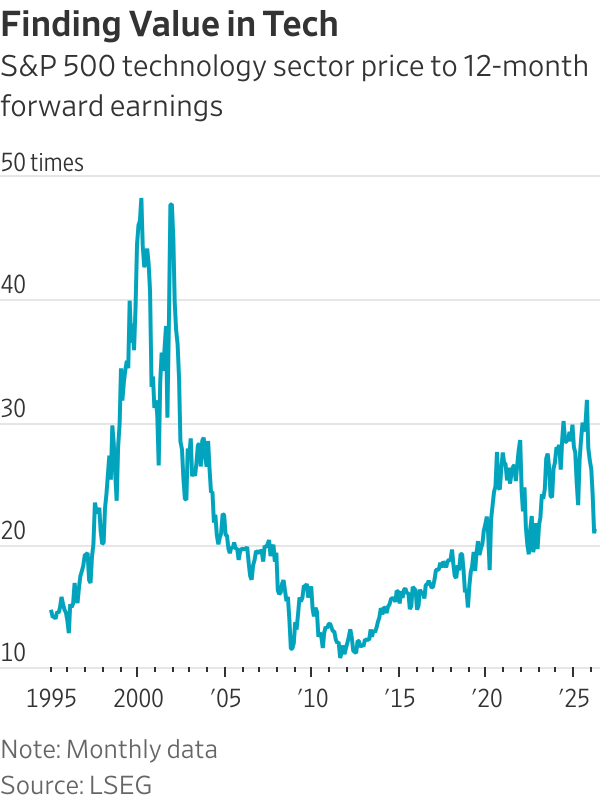
It’s six months, give or take, since AI excitement drove stock valuations above their 2020 bubble high to reach the highest since 2000, the peak of the dot-com bubble.
Something odd has happened since: Valuations, measured as the price-to-earnings or PE ratio, have plunged, while stocks rose to a record high this week.
This isn’t just unusual. It is unprecedented in data back to 1985. Valuations have never fallen so much over six months without stocks falling too.
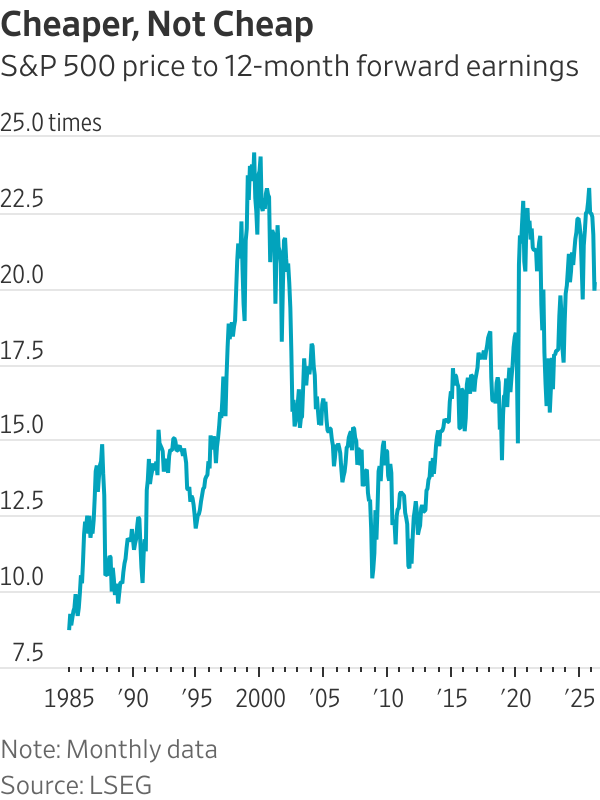
It helps to understand the basic mechanics of the PE ratio. The most useful version, the forward PE, measures a company’s stock price against how much Wall Street analysts on average expect the company to earn in profit over the next year. At its October peak, the S&P 500 PE ratio was above 23.
The reason for the recent drop in valuation is also unusual: The E part of the PE ratio, companies’ expected earnings, has soared. Because stock prices have made only small gains—the S&P 500 is up 3% from its high in October—the PE ratio has dropped, meaning shares are less expensive than back then. The rebound has lifted the index back up to 22 times, after dropping below 20 times, though both are higher than the long-term average of 16.
In the past, the norm was that when earnings expectations rose a lot, shareholders got very excited, and shares rose even more, so the stock was more highly valued.
Big drops in valuations were bad news: Until now they’ve always been because earnings expectations soured even more than share prices fell, often because of a recession.
This time, there are two big reasons earnings expectations have soared—and they are both probably temporary. The first is that microchip prices have soared because of huge artificial-intelligence demand. The second is the war in Iran, which has given energy companies a huge boost.
The question for investors: Do the stocks that have benefited from these one-off boosts really offer better value now?
The bull case for the AI stocks is that they are moving from a speculative trade closer to a reality where the technology makes real money.
In the months up to last October, AI-related stocks—especially suppliers to data centers—soared in the hope of something great, pushing up valuations while earnings predictions lagged behind.
In the past six months, stock prices gained little while analysts began to predict big profits. This brought their forward PE ratios back down from very expensive to be more reasonably priced. AI stocks, on this view, are proving their ability to grow into their valuations.
A related way to measure PE is to adjust it for how fast a company’s profits are expected to grow. Do this for the eight biggest tech and AI stocks and they were cheaper on the so-called PE-to-growth (PEG) ratio early this past week than they’ve been since 2013, according to Scott Chronert, head of U.S. equity strategy at Citigroup.
The bear case against AI stocks is that growth hopes are still far too high, data-center projections are way ahead of reality, Big Tech has gone from being capital-light to capital-hungry, and Wall Street forecasts are little better than guesswork anyway. On top of that, it’s just plain weird that the risks of the Iran war’s reigniting seem to have been forgotten by equity investors.
There’s a middle path, neatly illustrated by Micron Technology, which makes fast-memory chips needed for AI. Soaring sales have far outstripped predictions and enabled the firm to jack up prices and profit margins. In October, the median analyst expected earnings of $19 a share in 2027. Now, they predict $101 a share. But as estimated 2027 earnings quintupled, the shares a bit more than doubled, so the PE ratio plunged.
That lower valuation doesn’t mean the stock is cheap. Rather, it means superhigh profits are expected to be temporary. More capacity will eventually come online, as it always does in the highly cyclical memory-chip industry, and prices will drop. Data-center demand must eventually slow, too, as needs are met.
If data-center construction keeps going for years, and investors prove willing to finance it, that’s great for Micron, Nvidia and other providers of the modern-day versions of picks and shovels for the AI gold rush. If AI breakthroughs reduce computing needs, or if AI adoption disappoints the high hopes of investors, it’s terrible. A valuation based only on the next 12 months doesn’t tell us whether to buy or sell, because a slowdown is likely only the year after, or further out.
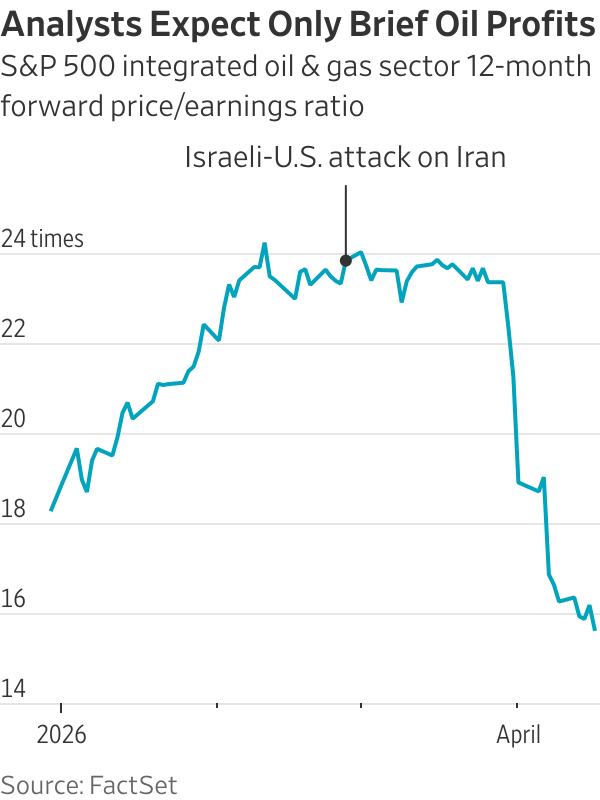
Something similar applies to how oil stocks have behaved during the Iran war. The soaring oil price as first Iran and then the U.S. prevented oil exports from the Persian Gulf naturally led to higher earnings forecasts for big oil companies. Earnings for the three oil majors 12 months ahead are expected to be about a third higher than they were at the end of February.
Initially, Big Oil shares soared, as the prospect of war profits had investors salivating. But even as share prices rose, valuations were slightly down—and this month the cease-fire led shares to slump back to where they started, even as profit forecasts rose further. The sector’s forward PE has dropped from 23.8 times earnings before the war to 15.6 times.
As with chip makers, a temporary boost to earnings is welcome for shareholders. But what investors really want is a rise in profit every year. Oil futures were already prepared for the price to come back down, and it fell fast on Friday on news of the Strait of Hormuz reopening—although Iran said it was closed again on Saturday, while markets were shut.
Current prices for both the AI stocks and oil are based on the market’s best guess for the two themes of the moment: Data-center building and the Iran war. This has made the market look cheaper than before. But it wouldn’t take much—the AI boom’s turning to bust or a peace deal in the Gulf—to make today’s cheapness look expensive in retrospect.
Write to James Mackintosh at [email protected]
🚨 BREAKING: Watch the full clip here ➤

