

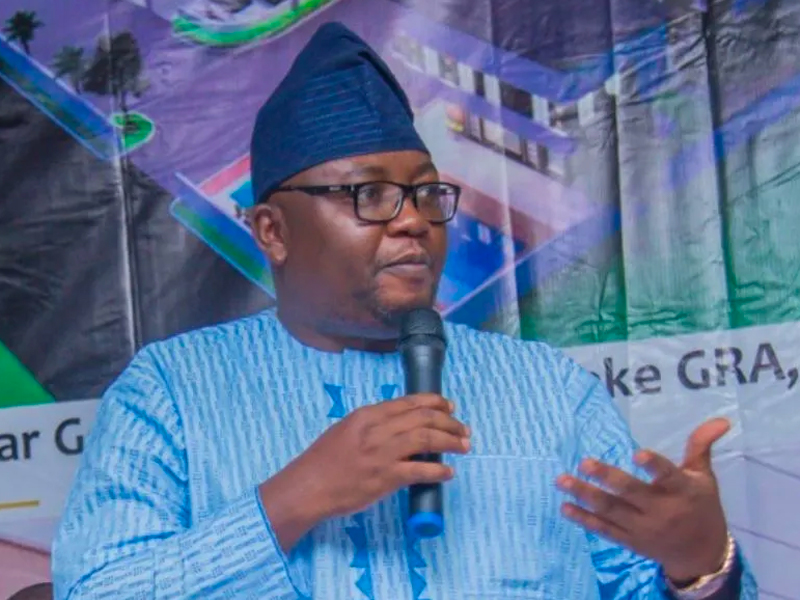
As President Bola Tinubu shops for Adebayo Adelabu’s replacement as the Minister of Power, the Association of Power Generation Companies and other stakeholders in the power sector have warned against appointing another politician.
Saturday NGGOSSIPS reports that Adelabu resigned his position as Minister of Power to pursue his governorship ambition in Oyo State. In a resignation letter dated April 22, 2026, and addressed to President Bola Tinubu, Adelabu said the decision would take effect from April 30, 2026, to allow for a smooth transition.
Saturday NGGOSSIPS gathered that the presidency is currently eyeing some individuals as Adelabu’s replacement, with many jostling to take over from the Oyo governorship aspirant.
But stakeholders cautioned the President against appointing someone like the outgoing minister, who was a banker with little or no knowledge of the power sector when he was appointed in 2023.
In an interview with our correspondent, the APGC Chief Executive Officer, Joy Ogaji, advised the president not to consider those she called political jobbers and not to use ethnicity as a criterion.
“My advice as a sector player is for the President to pick no political jobbers and ethnicity if power is critical to his agenda,” she said.
Ogaji said the new power minister must possess the requisite sector experience and expertise, stressing that this should not be just about the number of years but about the person’s proven, solution-driven capacity.
She pleaded that the incoming power minister should be an individual who is tired of the status quo and can turn the power situation around as early as possible.
“Appointments should be based on apolitical and non-transactional criteria. The person should be someone with requisite sector experience and expertise – not just number of years but proven solution-driven capacity, and he/she should be a passionate person,” she said.
Ogaji advised that gender sensitivity should also be considered, saying that the new power minister should be capable of hitting the ground running and must possess practical and not theoretical experience, while having strong interpersonal and sound communication skills.
“The power sector needs someone who is tired of the status quo and can turn around issues quickly,” she added.
Also, the convener of PowerUp Nigeria, Adetayo Adegbemle, advised the president to appoint an expert.
“I have always held and maintained that anyone who would be handling the power sector should be someone who has expressed sufficient knowledge on how things ought to be. The presidency needs to consult and appoint a person who will have the trust and access to the President to have enough power to do what’s right,” he said.
Adegbemle said the country has people who have the capability and knowledge to turn around the fate of the power sector.
“The presidency should just show enough willingness and dexterity to make the right appointment. I had also set out an agenda for the sector to focus on when this administration came into power. Focus has to be put on the financial health of the sector, metering, and divesting from projects like the Siemens deal, which has not benefited Nigeria in any way. A quick review of the National Integrated Energy Plan has to be undertaken so that we can have a policy direction for the power sector as well,” he noted.
An energy professor at the University of Lagos, Dayo Ayoade, posited that the country’s power sector is in a state of emergency, so professional competence is essential.
“The fact is that professional competence in the power sector is essential because the sector is in a state of emergency and we need an experienced personality to focus on immediate, medium, and even longer-term issues in fixing the sector,” Ayoade stated.
More importantly, the professor urged the president himself to direct the fundamental governance changes that are essential in the power sector, saying no minister can achieve results if the system continues to be defective.
“No matter who you make the minister, zero plus zero will continue to be zero. Fix the system, and the power sector will work effectively and efficiently. If you don’t fix the system, no individual, no matter how brilliant, can make a defective system produce good results,” the don added.
Earlier, a power sector expert, Bode Fadipe, advised the president to appoint a technocrat as Adelabu’s replacement. According to Fadipe, anybody to replace Adelabu should be someone with knowledge of the power sector and one who has a national agenda instead of self-interests.
“My choice will be a technocrat who has knowledge of the power sector and whose agenda is national rather than personal interests,” Fadipe stated.
Meanwhile, the outgoing minister on Wednesday proposed the creation of a coordinating minister for the energy office to drive integrated reforms across Nigeria’s power, gas, and related sectors.
In his resignation letter to the president, Adelabu outlined key achievements recorded during his tenure, including the implementation of the Electricity Act 2023, which decentralised the electricity market and improved the investment climate.
He said peak power generation rose to over 6,000 megawatts, driven by the integration of the Zungeru Hydropower Plant and the rehabilitation of thermal power plants, adding that transmission capacity was strengthened through grid upgrades under the Presidential Power Initiative.
However, the current power outages bedevilling the country since February are a major setback to the achievements being celebrated by the outgoing minister.
🚨 BREAKING: Watch the full clip here ➤

