AS A BLUE coach pulls up outside Chernobyl nuclear-power plant, friendly stray dogs approach it. It has passed through multiple Ukrainian military checkpoints—necessary since Russian troops briefly occupied the plant on the first day of the invasion in 2022. Out spills the next shift of workers, ready for 14-day stints on site. Just above the main entrance, employees tuck into a subsidised lunch of Ukrainian staples. The cafeteria is abuzz, even though the last of the plant’s four reactors shut down for good in 2000.
The accident that began unfolding here on April 26th 1986 was disastrous, and not only for the people who lost their lives during and soon after it.
Staff clad in three layers of white cotton dart into and out of the “Golden Corridor”, nearly a kilometre of narrow hallway that runs the length of the plant, its walls a distinctively Soviet gold-painted aluminium and its floors a staggering expanse of clacking broken tiles. Along its length there are pans with sodden rugs to step into, to collect any potentially radioactive dust on the bottom of shoes, and antiquated whole-body radiation-scanner gates: only the clean shall pass. Some of those traversing the corridor are involved in radiation monitoring. Many more carry out the excruciatingly slow business of decommissioning and dismantling. And some are still making new scientific discoveries.
The accident that began unfolding here on April 26th 1986 was disastrous, and not only for the people who lost their lives during and soon after it. But some good has come from it. It has provided a unique laboratory: an unnatural experiment that four decades on continues to produce valuable lessons on the biology, ecology and sociology of nuclear accidents.
When reactor number four exploded during a safety test, its core was exposed to the air. Out streamed a jumble of more than 100 radioactive elements. Inert gases such as xenon and krypton were swept quickly and harmlessly away. But the radioactive atoms that settled onto the region and its people—from iodine (which loses half its volume to decay every eight days) to technetium (which needs 200,000 years)—continued to move around the environment. It is the relentless tracking of these radionuclides, particularly strontium and caesium, the ones most worrisome for human health, that has preoccupied many researchers since.
Gennady Laptev and Oleg Voitsekhovych were roped in after the accident to assist as newly minted graduates. They were joined by Soviet scientists of every stripe to take environmental stock of what had been wrought. Dr Laptev soon found himself on helicopter missions, dangling detectors over the destroyed reactor to quantify the radiation pouring out.
Today they are both senior researchers at the Ukrainian Hydrometeorology Institute’s Department of Environment Radiation Monitoring, and are still at it. In a chilly office in Kyiv—heating and electricity come and go in wartime Ukraine—they finish each other’s sentences as they describe what they have learned about radionuclides’ journeys through lakes, rivers and groundwater.
Some of their most crucial work was determining the radiation risk from drinking water. After the accident, local people feared what came out of the tap. But Messrs Laptev and Voitsekhovych showed it provided no more than 10% of their total long-term internal radiation dose, and probably closer to 1%. The rest came from food and, in particular, milk.
The example that Chernobyl has provided of how the landscape, water dynamics and human behaviour affect radiation risk will be important when dealing with future disasters. Scientists never stop studying it, because radioactive isotopes can move in surprising new ways.
Mostly, when levels of radiation are found to be rising, they are still under acceptable thresholds. But sometimes those thresholds are breached. Drs Laptev and Voitsekhovych speak animatedly about the natural draining of Chernobyl’s cooling ponds, which had been topped up with water from the Pripyat River until 2014. The relatively clean groundwater beneath the ponds had acted as a barrier, hemming in the much more contaminated groundwater closer to the ruined reactor. As the cooling ponds have slowly drained, strontium levels in local waterways have begun to rise above WHO drinking-water guidelines.
Valery Kashparov of the Ukrainian Institute of Agricultural Radiology may be the world’s foremost expert on how a shower of radioactive particles affects land and the foods that come from it. The magnitude of the shower in any one place is not a definitive factor. The soil probably matters most: peaty and sandy earth gives up its contaminants to growing plants far more readily than black, humus-rich soils. And different foodstuffs, he has found, soak up radionuclides differently. Oats disproportionately draw in strontium; peas, caesium. Wheat and potatoes, however, leave more radionuclides in the earth.
Dr Kashparov has compiled a considerable list of agricultural countermeasures to reduce risk. Feed livestock and fish with a chemical called Prussian Blue that binds to caesium and helps it to be excreted; turn iffy milk into a form (such as butter or cheese) that can outlive dangerous radioactivity; add lime or mineral fertilisers to soil to impede uptake.
Yet human behaviour complicates matters. Early on, when radioactive iodine was still abundant, milk contributed to much of the spread in radiation because it was a means of barter for smallholders. For any post-disaster agricultural playbook to be effective, it must take into account local economies, dietary habits and risk tolerances, and encourage a focus on public awareness, stresses Dr Kashparov.
Another factor in how radionuclides pass from soil to food is the variety of bacteria nearby. Few have given that more thought than Olena Pareniuk of the Institute for Safety Problems of Nuclear Power Plants. Her work has shown that different bacteria can impede or enhance the transfer. Two preventive measures follow: inoculate the soil with the impeding kind and your crop comes up cleaner. Introduce the enhancing kind and the plant becomes a disposable contaminant sponge which helps clean up the soil. Results from laboratory tests of both techniques are modest but encouraging.
Dr Pareniuk has also studied the bacteria that live inside Chernobyl’s ruined reactor. They survive—thrive, even—in an inhospitably alkaline environment in which there are virtually no nutrients. Even more astonishingly, they are breaking down the wildly radioactive mixture of melted uranium fuel, concrete and metal known as corium. “Whatever material human beings create, nature will find its bugs to decompose it,” says Dr Pareniuk.
Even more hopeful stories have emerged further up the food chain. Jim Smith of Portsmouth University began studying Chernobyl in 1990 as a physicist. But he has since become an expert on the region’s wildlife. The evacuation of the exclusion zone is by now a well-documented experiment in rewilding. It is not just that animals took over when people left. Larger beasts particularly flourished; wolf and deer populations bounced back and long-gone species such as the lynx returned. There is still some debate about, among other things, the long-run effects on smaller creatures such as barn swallows and butterflies, but in general the accident left little legacy in animal populations or in their DNA. The zone has no three-eyed fish (though perch in the most contaminated areas seem slower to develop sexually).
Something in the air
A more harmful consequence of the accident, Dr Smith says, has been a misunderstanding of radiation risk among public and policymakers alike. Apart from an early spike in (mostly non-lethal) thyroid cancer, an exact count of human deaths caused by the ensuing radiation exposure is all but impossible. Other factors, not least natural radiation from the earth itself, add up to lifetime cancer risks that the disaster did not discernibly raise. Yet that is not the perception. Chernobyl gave the world a multigenerational case of the heebie-jeebies, widespread imaginings of mutant creatures and an inchoate fear that has ultimately influenced energy policy.
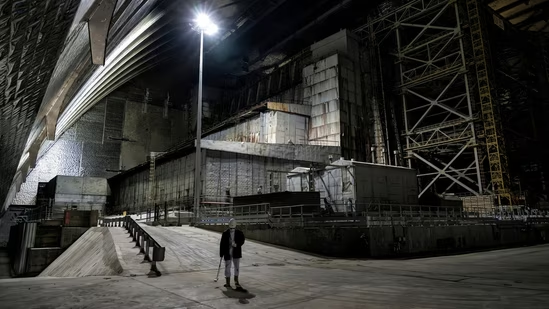
The sodden-rug pans and security doors multiply as the Golden Corridor reaches what remains of reactor number four, now beneath an aircraft-hangar-sized arch known as the New Safe Confinement (NSC). It was slid into place in 2016 to supplement the hastily built concrete “sarcophagus” built over the reactor in 1986. It cost $1.6bn and was intended to contain the growing radiation leaks for 100 years.
On Valentine’s Day in 2025, that timeline was curtailed. A Russian drone pierced the NSC, starting a fire that consumed more than half of an inner protective layer. At the back of the NSC is a modern control room that stands in sharp contrast to the Soviet design of the plant’s other nerve centres. Brows furrow as engineers grapple with how the damage will affect the NSC’s capacity to keep the remains of the core contained. Forty years on it is yet more research that misfortune has necessitated.