

By Omeiza Ajayi
ABUJA: In the quiet corners of Gadadin Primary School in Dutse, the Jigawa State capital, the dust carries a memory that the community cannot just shake off. It is the memory of a child who, many years ago, went looking for water and never came back. That stark memory sticks and constantly haunts the people like a plague.
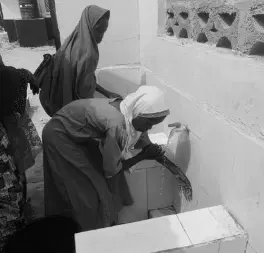
For the 1,084 pupils enrolled at Gadadin, the lack of Water, Sanitation and Hygiene, WASH, facilities is not a statistic found in a government report; it is a lived reality of risk.
A few years ago, a student died while attempting to fetch water during school hours. It was a tragedy that laid bare a harrowing truth: in the quest for education, the absence of a simple tap or a functional toilet can be a matter of life and death.
Until now, Gadadin stood as a testament to the “learning poverty” that has gripped parts of Northern Nigeria. All six toilets designated for the pupils were destroyed by floods and wild animals seven years ago. The staff toilets, though structurally present, are dry husks of infrastructure, disconnected from any functional water source.
Consequently, the children are forced into the surrounding bushes for open defecation, and the nearby community well – an unprotected, open mouth in the earth – has become a source of cholera rather than life.
However, a transformation is stirring. The Jigawa State Government, in an ambitious partnership with UNICEF, has declared that the era of “piloting” is over. They are now in a race to achieve 100 percent WASH coverage across all 3,345 basic schools in the state within the next two years.
The Executive Chairman of the Jigawa State Universal Basic Education Board, SUBEB, Professor Haruna Musa, made this known in Dutse, during a media dialogue organised by the United Nations Children’s Fund, UNICEF, in collaboration with the Child Rights Information Bureau, CRIB, under the Federal Ministry of Information.
The invisible wall for the girl-child
While lack of water affects every student, it builds an invisible, often insurmountable wall for girls. For a young woman reaching puberty, a school without a private toilet is a school that tells her she is not welcome.
Susan Akila, UNICEF’s Chief Communication Specialist, speaks with a raw, empathetic clarity on this issue. She notes that while many point to early marriage or poverty as the primary reasons girls drop out, the truth is often much simpler and more humiliating.
“We are blessed to have seasons in our lives that require privacy. In those moments, we require to have our own spaces where we can clean up and sanitise. When those things are not made available, the enrollment and retention of girls in school becomes an issue. A girl can drop out willingly because she is not comfortable during her menstrual period,” she explained.
In Jigawa, government is finally listening. Dr. Hauwa Babura, the Technical Adviser to Governor Umar Namadi on Basic Education, views the provision of WASH facilities as a moral imperative. She argues that there is no “true education” without dignity.
“Providing water to girls gives them the confidence and self-esteem to sit in the classroom and learn. It is about building their self-worth, knowing they have a separate space from the boys where they can care for themselves in safety,” she stated.
From milestone to mandate
Jigawa has already proven it can beat the odds. It was the first state in Nigeria to be declared Open Defecation Free, ODF, a feat that required a massive shift in communal behaviour and infrastructure.
But as UNICEF WASH Consultant, Mr. Job Obimini, pointed out, Nigeria’s WASH indicators are generally poor.
He said the ODF status was just the beginning. The 2021 national WASH survey showed that only 11 percent of schools across Nigeria have basic WASH amenities.
For Akila: “Jigawa has become a model for others, but there is still room for more to be done, especially in rural areas, so we can maintain that standard. We want Jigawa to be the model where children and women are safe.”
The state’s strategy for 2026 is one of scale. Prof. Musa explained that the upcoming budget is designed to move past small-scale projects. The goal is to replicate the “CRIB” programme structure across every primary and junior secondary school in the state.
“Resources are limited,” Prof. Musa admits, “but the governor accords priority attention to basic education. We are aiming at 100 percent budget implementation. We have a plan, and it is taking us somewhere.”
To ensure these new investments don’t suffer the same fate as the old toilets at Gadadin, the state has taken the unprecedented step of recruiting 10,000 school guards.
Their job is to protect the infrastructure from encroachment and insecurity, acting as the first line of defense for the state’s 3,345 schools.
But infrastructure alone is not the solution. Prof. Musa is calling for a cultural revolution within the schools themselves. He is challenging teachers, principals and the Mothers’ Association to move from being observers to being “co-owners.”
“Sustainability is key. We want them to own the facilities. Can you make sure that you leave the toilets clean? Many times, people enter a clean toilet but won’t spare the few seconds to leave it the way they found it. We are calling on the School Based Management Committees, SBMC, and the Mothers’ Association to pay attention to these facilities. Family co-financing and co-ownership are what we are looking for,” he stated.
The challenge remains daunting. With 2,727 primary schools and 618 junior secondary schools, the sheer volume of work required to reach 100 percent compliance is immense. Yet, the work has already begun. In the schools where the sounds of construction have replaced the silence of neglect, contractors are on-site, and technical working groups are monitoring progress.
For the parents in Gadadin and similar communities, these developments are a flicker of hope in a long night of worry. They remember the cholera outbreaks and the child lost to the search for water. They know that a school without water is a school that risks the lives of its students every single day.
If Jigawa succeeds, it will not just be a win for Governor Namadi or a milestone for UNICEF; it will be a victory for the girl who no longer has to stay home one week a month. It will be a victory for the 10,000 guards protecting the gates, and for the teachers who can finally focus on lessons rather than hygiene crises.
“Our learning poverty is about to be history,” Dr. Babura promises. In the dusty plains of Jigawa, that history is being written one tap, one toilet, and one child at a time.
Article Price of a drink: Jigawa, UNICEF partner to provide running water, wash facilities in schools Live On NgGossips.

