

By Adeoyo Tokunbo
Nigerian Safety Investigation Bureau, NSIB’s transition to the Office of the National Security Adviser signals a structural shift in Nigeria’s transportation safety architecture, one that, if guided with strategic clarity, can redefine the country’s credibility and present an unprecedented opportunity to recast Nigeria’s standing in global transportation safety.
Safety does not shout. It is built, quietly and deliberately, into systems, institutions, and the cultures that sustain them. When a nation’s transport investigation authority issues a directive or publishes its investigation findings, the impact may not register in the next news cycle, but across a decade, it shapes whether passengers return home alive. It is within this longer arc of consequence that the Nigerian Safety Investigation Bureau’s newly formalised reporting relationship with the Office of the National Security Adviser must be evaluated. Strip away the debate over administrative hierarchy, and what remains is something rarely encountered in Nigeria’s institutional history: a genuine structural opening, one that, if navigated with intent and sophistication, could elevate transportation safety from a technical afterthought to a pillar of the nation’s security and economic architecture.
The Nigerian Safety Investigation Bureau was established to fulfil one of the most demanding mandates in public administration: conducting independent, transparent, and technically rigorous investigations into transportation accidents and serious incidents across aviation, rail, maritime, and other transport occurrences, without fear or favour. Its work sits at the intersection of engineering analysis, legal procedure, diplomatic protocol, and institutional communication, a complexity not always legible to those who govern at the level of broad policy.
For decades, Nigeria’s approach to transportation safety was siloed, reactive, and often constrained by bureaucratic structures. The NSIB, formerly the Accident Investigation Bureau (AIB), focused on investigating civil aircraft accidents and serious incidents in or over Nigeria until December 2022, when it transmuted into its current form. Before March 2026, AIB-NSIB operated within the Ministry of Aviation and Aerospace Development, a parent structure with its own priorities and political weight. When a transport investigation body reports to the same Ministry that oversees the organisations it investigates, the risk of regulatory capture or subtle administrative pressure remains ever-present.
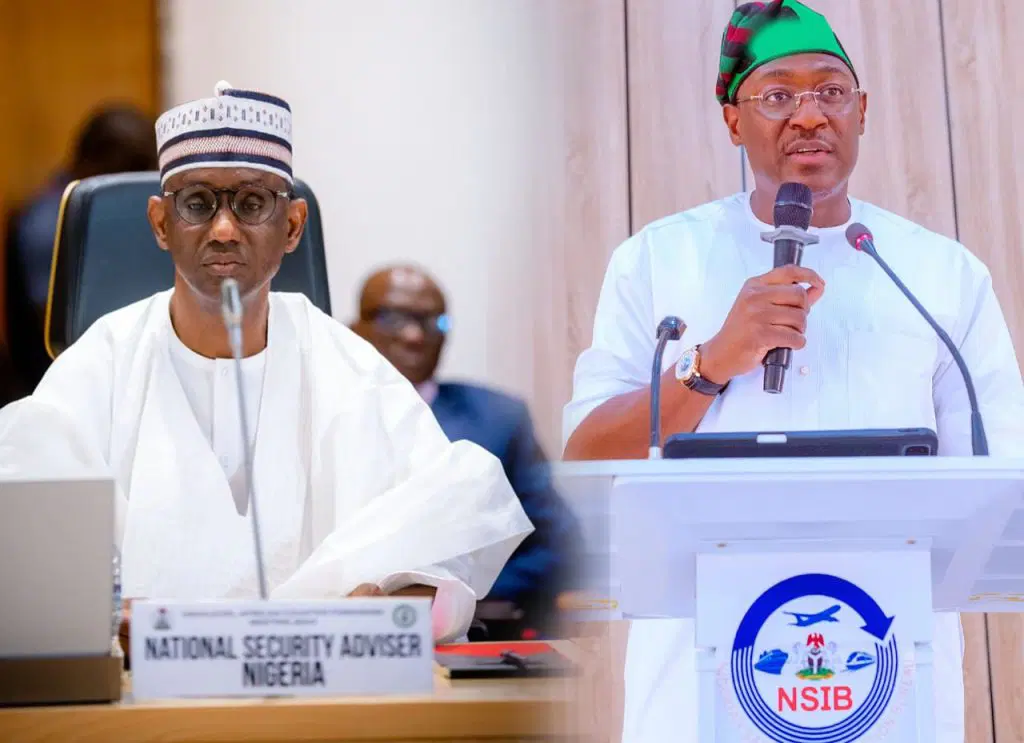
The recent repositioning of the Nigerian Safety Investigation Bureau to report directly to the President, under the oversight of the Office of the National Security Adviser, breaks from that pattern and introduces a new institutional dynamic. By placing the NSIB under the ONSA, the Bureau gains the “teeth” required to demand data, access restricted sites, and enforce safety recommendations across the aviation, rail, maritime, and road sectors without the friction of inter-ministerial bottlenecks. It transforms the NSIB into a supreme safety auditor, capable of looking into the soul of the nation’s transport infrastructure with an unblinking, objective eye.
Critics have raised legitimate concerns about institutional independence, whether proximity to a security-oriented office might, over time, condition the tone or reach of safety findings. These are questions worth asking. But they are also questions whose answers are not predetermined. The architecture of any institutional relationship is ultimately shaped by the people and processes that inhabit it. And on this measure, NSIB has something the sceptics may be underestimating: leadership.
Captain Alex Badeh Jr. assumed the directorship of NSIB in December 2023, at a moment when the bureau required both credibility and velocity. A trained pilot and safety professional with an understanding of investigation systems that extends beyond the procedural, Badeh Jr. has, since his appointment, moved with the deliberateness of someone who knows that the shelf life of institutional reform is short and that the window for real change rarely stays open long.
Since taking the helm, his focus has been on the “multimodal” mandate, a herculean task that involves transposing the high-standard safety culture of aviation into the more fragmented worlds of rail and maritime transport. Under his leadership, the Bureau is being retooled not just as a “crash investigator,” but as a proactive and data-driven intelligence hub. Captain Badeh’s approach is characterised by what experts call “Systems Safety”, the understanding that accidents are rarely the result of a single Captain’s error or a mechanical failure, but are the end-product of systemic cracks in the organisational fabric.
In August 2025, NSIB released its safety investigation regulations for maritime, rail, and air transport to improve security and shape transport safety in Nigeria, and months down the line in April 2026, unveiled its new Conditions of Service that set out clearer rules on promotions, training, welfare, and conduct, while news reports on the package described a more performance-based appraisal system. Those moves suggest an agency that sees credibility as something the bureau must earn through rules, staff standards, and field presence.
Those who have engaged with him on technical matters describe a leader who not only demonstrates expertise but also possesses it. His grasp of the International Civil Aviation Organization (ICAO) Annex 13 and the International Maritime Organization (IMO) standards, among others, his engagement with local and international transportation safety stakeholders, and his push to expand NSIB’s investigative mandate beyond aviation, maritime, and rail to emerging multimodal systems all signal an understanding that Nigeria’s safety architecture must mature beyond its aviation origins. Where previous administrations of the Bureau treated rail and maritime safety as peripheral concerns, Badeh Jr. has actively worked to bring them within a unified investigation framework, a shift whose significance will only grow as Nigeria’s national rail expansion accelerates.
“An investigation bureau is only as credible as its independence, and only as relevant as its capacity to be heard. Our work must do both, it must speak truthfully, and it must speak to power in a language that power can act on.” – Captain Alex Badeh Jr., Director General/CEO, NSIB.
This is not the posture of an official managing decline. It is the posture of one who understands that institutional evolution is not a concession; it is a strategy. The repositioning under the NSA’s office, far from unsettling Badeh Jr., appears to have sharpened his thinking about what NSIB must now demonstrate to retain and extend its credibility.
To understand why this moment holds genuine promise, it helps to look beyond Nigeria’s borders. The United Kingdom’s Air Accidents Investigation Branch operates under the Department for Transport, a relationship that could theoretically create tension between ministerial interest and investigative independence. Yet the AAIB is consistently ranked among the world’s most credible safety bodies, because its operating protocols, publication standards, and statutory protections have been built to withstand political proximity. The United States’ National Transportation Safety Board similarly occupies a complex institutional space, formally independent but deeply enmeshed in the regulatory and executive ecosystem. Its durability rests not on its distance from power, but on the rigour of its processes and the consistency of its public record.
The lesson for NSIB is clear: proximity to executive authority is neither salvation nor damnation. It is a variable, one that can be managed through the right statutory protections, the right operational protocols, and the right communication of findings to the public. If NSIB and the NSA’s office can jointly articulate an operating framework that guarantees the bureau’s operational and investigative independence while leveraging the Presidency’s convening power to ensure that safety recommendations are implemented, Nigeria would have achieved something its peers on the continent have not.
The African transportation system has long suffered not from a shortage of accident reports, but from a shortage of recommendations that translate into systemic change. Findings sit in archives. Corrective actions stall in bureaucratic corridors. NSIB, if properly positioned within a structure that commands cross-ministerial authority, could break this cycle. A bureau that reports to a senior security and advisory office carries, at minimum, the implicit weight of executive attention, a commodity that has historically been in short supply for safety institutions across the continent.
NSIB’s ambitions extend beyond Nigeria’s borders, and deliberately so. The bureau has, under Captain Badeh’s direction, deepened its engagement with the Banjul Accord Group Accident Investigation Agency (BAGAIA), Sierra Leone Aircraft Accident and Incident Investigation Bureau, Ghana Aircraft Accident and Incident Investigation and Prevention Bureau, among others, and has positioned itself as a reference institution for peer safety bodies across West Africa. Several neighbouring states operate investigation frameworks that are under-resourced, institutionally isolated, and procedurally inconsistent with international standards. Nigeria, as the continent’s most significant aviation market and one of its largest rail-development economies, has both the obligation and the opportunity to set a higher standard.
The current repositioning, if handled with sophistication, strengthens this argument rather than weakening it. A Nigerian safety bureau that retains its investigative independence while operating within a more senior advisory structure sends a signal to the continent: that safety institutions can be elevated without being subordinated, that political proximity need not mean political interference, and that good governance and good investigation practice can coexist within the same institutional framework.
The repositioning of the NSIB under the Presidency is not an end, but a beginning. It represents a strategic window, a “Golden Hour”, to entrench a culture of safety that may define Nigerian transportation for the next half-century. Despite the optimism, the path ahead is not without its hurdles. The renaissance this moment promises is contingent on several interlocking conditions.
The transition to a multimodal agency requires significant capital investment and a massive expansion of technical manpower. Moving from investigating 50-seater aircraft to 1,000-passenger trains and massive cargo vessels requires a diverse set of skills that the Bureau is still in the process of scaling. Furthermore, maintaining independence while reporting to the Presidency requires a delicate balance of administrative cooperation and investigative autonomy.
First, the legislative framework governing NSIB’s operations must be updated to reflect its new reporting environment, with explicit protections for investigative independence and administrative sovereignty, codified in statute rather than left to discretion.
Second, the NSA’s office must develop a clear understanding of what NSIB does and does not do, and resist the temptation to enable state capture of the NSIB to serve their interests and private gains at the expense of operational excellence.
Third, NSIB itself must accelerate its investment in technical capacity, data infrastructure, and human capital, because the credibility of any institutional redesign rests, ultimately, on the quality of the work the institution produces.
The NSIB leadership appears acutely aware of these interlocking conditions. The Bureau’s recent emphasis on building internal investigation capacity, formalising structured relationships with foreign counterpart agencies, and publishing findings in formats that are accessible to both technical and general audiences reflects an understanding that NSIB’s public standing must be maintained through output, not just positioning.
The most enduring institutions are not those that avoided structural change; they are those that managed it with enough intelligence to emerge stronger. Nigeria’s safety architecture has never lacked ambition; what it has often lacked is the governance coherence to translate ambition into durable performance. The repositioning of NSIB under the Presidency’s advisory architecture is, at its core, an invitation to build something different: a safety bureau that is operationally independent, politically anchored, and institutionally visible in the way that safety institutions in mature democracies have learned to be.
Captain Alex Badeh Jr. has, by all measurable indicators, the temperament, technical grounding, and institutional literacy to steward NSIB through this transition. The question that now confronts policy makers and political actors, in the Presidency, NSA’s office, and the legislature, is whether they will meet NSIB’s aspiration with the structural seriousness it demands. If they do, the story of NSIB’s repositioning will not be told as a cautionary tale of bureaucratic capture. It will be taught in the governance academies of Lagos and global Ivy League institutions, as the moment Nigeria chose to build an institution worthy of the lives it was created to protect.
Adeoyo lives in Lagos
Article NSIB’s New Order: A Window for Change Live On NgGossips.

