

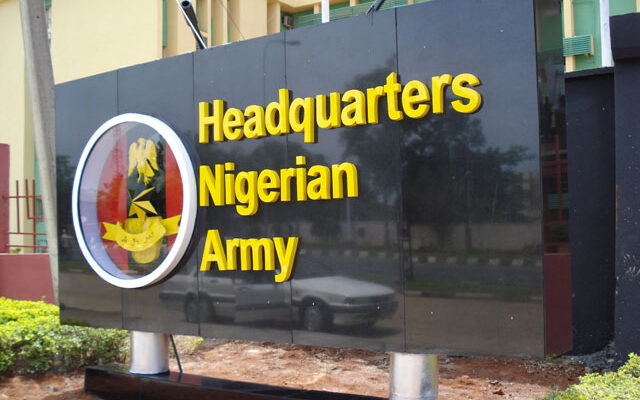
The officers, compulsorily retired on 9 June 2016, have exhausted every legal and institutional avenue open to them: they have won favourable judgments at the National Industrial Court, secured resolutions from both chambers of the National Assembly, engaged human rights lawyers, and written directly to two successive presidents. Nothing has worked.
Nine years after their arbitrary dismissal, 38 senior Nigerian Army officers, including major generals, brigadier generals, colonels and lieutenant colonels, remain on the margins, their lives upended and their dignity denied, as the Nigerian Army continues to defy court orders directing their reinstatement.
One of them, Ojebo Ochankpa, died in 2017 — still waiting for justice. His family later said he died “of a broken heart.” Associates of the late officer told PREMIUM TIMES that his widow, Ruth Baba-Ochankpa, and their three children, Joshua, Esther and Abigail, became living reminders of how institutional cruelty can destroy families as easily as it destroys careers.
In June 2016, the Nigerian Army compulsorily retired the 38 officers, citing “service exigencies, corruption in arms procurement, and partisanship” as grounds for what it described as “serious offences.”
The mass exit affected nine major generals, 11 brigadier generals, seven colonels and 11 lieutenant colonels.
Investigations by PREMIUM TIMES, however, show the authorities acted outside the law.
None of the affected officers was charged before a court martial or found guilty of any offence under the extant rules and regulations of the Armed Forces of Nigeria.
Most were neither queried nor indicted by any panel. Some were on official national assignments abroad when they learnt through the media that they had been dismissed.
One of the dismissed officers said he was never found guilty of corruption in arms procurement or any form of electoral partisanship. “I was never involved in any of the issues highlighted and/or any wrongdoing whatsoever. My compulsory retirement was without due process, as it was a clear departure from the disciplinary process and laid-down procedures of the Armed Forces of Nigeria, as well as natural justice,” he wrote in a letter to President Bola Tinubu.
Danladi Hassan, a colonel and one of the 38 officers, had in 2014 led troops to reclaim villages in Borno from Boko Haram insurgents. Commissioned in September 1994, he had participated in several foreign missions, including ECOMOG operations in Liberia and Sierra Leone, as well as the United Nations Mission in Sudan. Like his colleagues, he received no query, no panel indictment and no court martial before being dismissed.
Among those affected were a Director of Military Intelligence, defence attachés and officers who had served on the frontlines against Boko Haram. Some had received commendations for gallantry in the face of the enemy.
PREMIUM TIMES’ review of the relevant statutes reveals that the army violated its own rules in the manner in which the officers were disengaged.
The Harmonised Terms and Conditions of Service for Officers, specifically paragraph 09.02c(4), was cited to remove the officers. That provision allows for compulsory retirement “on disciplinary grounds, i.e. serious offences,” but does not define what constitutes “serious offences.”
More critically, the principal law — the Armed Forces Act — establishes all actions that constitute offences in the military and prescribes the procedures for punishing offenders.
A review of the Act shows no provision empowers the Army Council to arbitrarily punish or compulsorily retire officers for any offence. Section 11(a-f) of the Act, which governs the powers of the Army Council, does not include the authority to retire any officer on disciplinary grounds without compliance with the legally prescribed steps.
The officers petitioned military authorities in keeping with military rules immediately after their dismissal.
Their statutory appeal for redress, which ought to have been acknowledged within 30 days, was neither acknowledged nor replied to, according to documents seen by PREMIUM TIMES.
Courts rule in Favour of Officers.
The Court of Appeal ruled in favour of one of the officers, Danladi Hassan, declaring his dismissal “unfair, wrongful, unlawful, illegal, unconstitutional, invalid and contrary to the Armed Forces of Nigeria Harmonised Terms and Conditions of Service for Officers 2012.” The appellate court also directed his immediate reinstatement with effect from 9 June 2016.
Similarly, seven of the dismissed officers — Major-General Ijioma Ijioma, Brigadier-General Abubakar Sa’ad, Colonel Muhammed Suleiman, and Lieutenant Colonels Dukip Dazang, Thomas Arigbe, Abdulfatai Muhammed and Abubakar Mohammed — filed suits at the National Industrial Court.
Ruling in their favour between 2019 and 2021, the court declared their compulsory retirement illegal and ordered their immediate reinstatement with full rights, privileges, and outstanding salaries and allowances. The judgments were not challenged at the Court of Appeal. Yet the Nigerian Army refused to comply.
Mr Mohammed filed his suit at the National Industrial Court to reverse what he described as his “unlawful and wrongful compulsory retirement.” On 14 January 2020, the court declared his retirement “wrongful, unconstitutional, illegal, null and void” and ordered his “immediate reinstatement with all the rights and privileges.” The army has yet to act on the judgment.
In a subsequent letter to the Chief of Army Staff, Mr Mohammed noted that “despite the favourable judgment of the court in 2020 to redress the injustices meted out to me, the pattern of abuse that I have been subjected to since 2016 was continued with the deliberate neglect to comply with the court judgment which was duly served [on] the Nigerian Army.”
PREMIUM TIMES understands that a former Chief of Defence Staff, Lucky Irabor, attempted to resolve the matter in 2021. In a memo acknowledged on 7 July 2021, Mr Irabor sought ministerial endorsement for the “voluntary retirement of the 38 senior officers with effect from 1 January 2018.” The proposal was not approved.
Two other officers, Chidi Ukoha and Osita Nwankwo, approached the Senate and House of Representatives separately. Both chambers investigated their petitions independently, found no basis for their compulsory retirement, and recommended their reinstatement. The Nigerian Army ignored both legislative resolutions.
Human rights lawyer Femi Falana, a Senior Advocate of Nigeria, has taken up the officers’ cause, writing on their behalf to the Attorney-General of the Federation and Minister of Justice, Lateef Fagbemi.
In the letter seen by PREMIUM TIMES, Falana and Falana Chambers stated that the then-Minister of Defence and Chief of Army Staff had alleged in the media, “without any basis,” that the officers were professionally corrupt and had been punished after due process.
“Contrary to the libellous statement of both highly placed public officers, our clients were never accused nor tried for corruption or any other offence whatsoever,” the law firm wrote.
The firm urged President Tinubu to direct the Nigerian Army to implement the judgments of the National Industrial Court and the Court of Appeal, as well as the resolutions of the National Assembly. It specifically demanded the immediate reinstatement of all listed officers with effect from June 2016, their restoration to the current rank and seniority of their coursemates, and the full payment of salaries and emoluments from June 2016 to date.
PREMIUM TIMES reported that some of the officers submitted a separate letter to President Tinubu’s office, urging the president to compel the army to obey the court orders. Invoking his “avowed commitment to justice” as expressed in his inauguration speech, the officers described their compulsory retirement as a “malicious and wrongful” action compounded by “reputational damage actions in the media.”
🚨 BREAKING: Watch the full clip here ➤

