

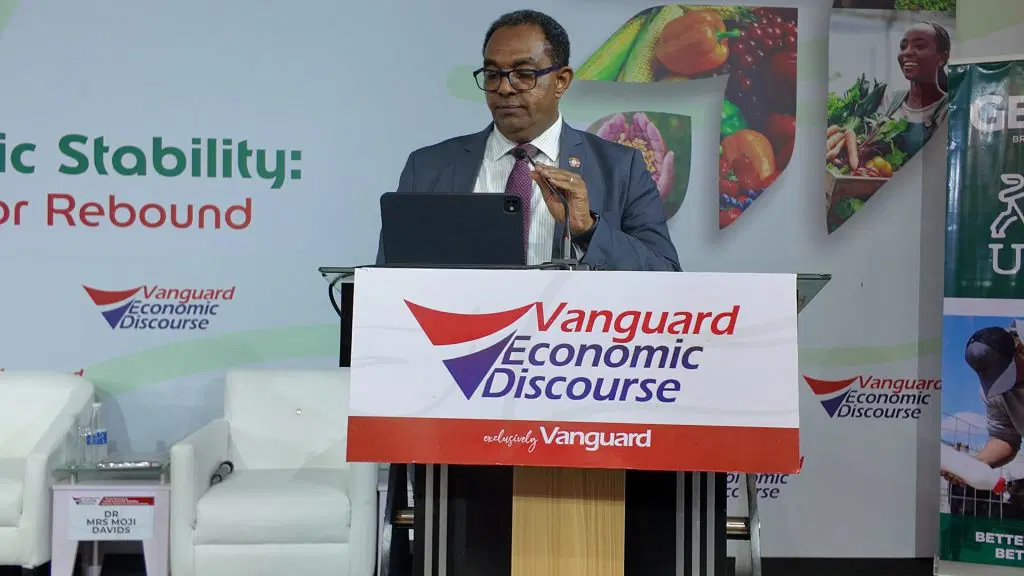
The Food and Agriculture Organization (FAO) has raised fresh concerns over the fragility of Nigeria’s food system, warning that conflict, climate shocks and economic pressures are increasingly exposing households to vulnerability, even as the country holds vast agricultural potential.
The organisation which was represented by Hussein Gadain, the Country Director, at the 2026 Nggossips Economic Discourse in Lagos, said the situation is already translating into deeper poverty and wider social strain, noting that shocks within the agricultural sector continue to ripple across livelihoods and stability.
“In Nigeria, fragile food systems affected by conflict, climate shocks and economic pressures translate into household vulnerability… it consistently shows how shocks to agriculture quickly affect livelihoods, malnutrition risks and social stability,” he said, stressing that both rural and urban communities are feeling the pressure.
He, however, maintained that the sector remains central to the country’s survival, describing agriculture as more than just a contributor to GDP.
According to him, it accounts for about 23 percent of the economy while serving as the primary source of livelihood for a majority of Nigerians.
“I can tell you, agriculture is key to stabilising Nigeria’s economy… over 70 percent of the population rely on it in one way or another, with about 40 million households engaged in agricultural activities,” he said.
Gadain pointed out that Nigeria’s agricultural outlook is shaped by a mix of opportunity and urgency, given its resource base.
With about 92 million hectares of land, including roughly 70 million hectares suitable for agriculture and 36 million hectares of arable land, he said the fundamentals for growth are clearly present. Yet, he warned that rapid population growth, currently estimated at about 2.1 percent annually, is placing increasing pressure on food systems, employment and natural resources.
At the same time, he noted that insecurity in farming communities, rising input costs and disruptions in global supply chains are putting additional strain on production, particularly for smallholder farmers.
“Climate shocks, conflict and rising production costs are straining our agri-food systems, especially for smallholder farmers and consumers,” he said.
He also drew attention to Nigeria’s trade imbalance in agriculture, describing it as a major gap in the country’s food system. Between 2016 and 2019, agricultural imports were estimated at about N3.35 trillion—nearly four times higher than exports valued at N803 billion.
According to him, this reflects both rising demand and missed opportunities for local value addition and competitiveness, particularly as commodities like sesame, cashew and cocoa dominate exports while staples such as wheat continue to drive imports.
Despite these challenges, Gadain insisted that Nigeria’s production capacity remains significant. He cited recent figures showing about 17.3 million metric tons of maize and roughly 30 million metric tons of rice harvested within a production cycle, adding that the country still leads globally in cassava and yam output. These, he said, underline the scale of opportunity if productivity and value chains are strengthened.
“Our work across states in Nigeria shows that targeted investments can yield rapid, transformative results despite the challenges,” he added, emphasising that unlocking the sector’s full potential will require deliberate efforts to address structural constraints.
For Gadain, the stakes go beyond agriculture alone. “The rebound of the agriculture sector is not simply a sectoral ambition; it is a national economic and social imperative,” he said, warning that without sustained action, the pressures on Nigeria’s food system could continue to deepen.
Article Nigeria’s food system fragile despite huge potential — FAO Live On NgGossips.

