

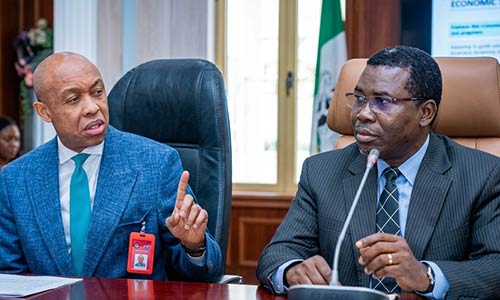
Former Chairman of the National Human Rights Commission, Professor Chidi Anselm Odinkalu, has dismissed INEC Chairman Professor Joash Amupitan’s claim that he accepted the leadership of Nigeria’s electoral commission only after receiving a “clear divine conviction” from God, warning Nigerians to “never trust any man who claims to have God on direct dial.”
Odinkalu’s terse response on X came after Amupitan, speaking at an end-of-tenure appreciation service organised by the Nigerian Baptist Convention in Abuja, told the gathering that God personally spoke to him before he took the INEC job, quoting what he said was a direct message from the Almighty.
“The Lord said, ‘Fear not; do not be dismayed. I will strengthen you; I will help you; I will uphold you.’ I heard this clearly before I accepted this job,” Amupitan stated.
The remarks, delivered at a religious event honouring outgoing Baptist Convention President Israel Akanji and his wife Victoria, are being widely interpreted not merely as personal testimony but as a strategic invocation of faith at a moment when the INEC chairman faces intense public scrutiny over unresolved allegations of partisan social media activity, calls for his resignation from opposition parties and civil society organisations, and deepening questions about the electoral commission’s neutrality ahead of the 2027 elections.
Odinkalu’s response was characteristically sharp and economical.
“Never trust any man who claims to have God on direct dial,” the former NHRC chairman wrote on X, in a quote-tweet of the report on Amupitan’s remarks.
The statement, while brief, carries layers of meaning. It challenges the use of religious language to deflect accountability, questions the sincerity of invoking divine authority while facing credible allegations of partisan conduct, and warns the Nigerian public against accepting spiritual claims as substitutes for institutional transparency and personal integrity.
Odinkalu has been one of the most consistent critics of Amupitan throughout the social media controversy, having previously called on the INEC chairman to resign, described INEC’s self-conducted forensic probe as evidence of the commission being “afraid of living its name,” and questioned why an institution with “Independent” in its title refuses to submit to independent forensic verification.
His latest intervention suggests he views Amupitan’s invocation of divine guidance as another form of the “obfuscation” he has previously criticised, a tactic for avoiding substantive engagement with the allegations by retreating into the realm of the sacred where questions become impolite and criticism risks being framed as irreverence.
Amupitan’s remarks at the Baptist Convention service were extensive and centred on the theme of divine calling and spiritual sustenance in public service.
He stated he would have declined the INEC appointment if he lacked spiritual assurance. “If I did not have the conviction for this job, I would not accept it,” the chairman stated.
He described the conviction as coming from a specific divine message. “The Lord said, ‘Fear not; do not be dismayed. I will strengthen you; I will help you; I will uphold you.’ I heard this clearly before I accepted this job,” Amupitan declared.
He said divine guidance had sustained him since assuming office despite challenges. “No matter the storm, no matter the difficulty, God is able to calm every storm. That is what God has been doing,” the INEC chairman stated.
He called on Nigerians to pray for the commission and for the 2027 elections. “Continue to pray for Nigeria, continue to pray for us, and continue to pray for me that the 2027 election will be the best ever. I cannot do it on my own, but with the Lord on my side, it is possible, and it is doable,” Amupitan stated.
He also offered broader guidance about public service and purpose. “My experience so far as the INEC chairman is that if God does not send you somewhere, do not go there. If God does not send you, do not do it,” Amupitan stated.
Amupitan’s invocation of divine mandate comes at a time when the earthly dimensions of his leadership are under unprecedented scrutiny.
The controversy over resurfaced social media posts allegedly showing sympathy for President Bola Tinubu and the ruling APC during the 2023 elections remains unresolved. NewsNGR’s investigation linked an X account formerly bearing a handle associated with Amupitan to his personal Yahoo email from his University of Jos CV. The account was rapidly altered after the controversy erupted, with the username changed from @joashamupitan to @Sundayvibe00 and the account locked and relabelled as a “Parody Account.”
INEC categorically denied that Amupitan operates any personal X account and conducted what it described as a forensic probe that “cleared” the chairman. However, the self-conducted investigation was universally rejected by Nigerians who cited the legal principle of nemo judex in causa sua, that no person should be judge in their own cause.
Senate President Godswill Akpabio’s defence of Amupitan inadvertently confirmed the tweet’s authenticity when he stated “whether manipulated or not, he said victory is sure,” directly contradicting INEC’s position that the account was fabricated.
SERAP has demanded a National Assembly investigation. Odinkalu has called for resignation. The ADC has demanded Amupitan’s removal. And NewsNGR has questioned why the accused should be the one to investigate himself.
None of these issues have been resolved. The National Assembly has not acted on SERAP’s demand. No independent forensic investigation has been conducted. And Amupitan remains in office.
The contrast between Amupitan’s request that Nigerians “pray for me” and the growing chorus demanding his resignation captures the fundamental disconnect between the INEC chairman’s self-perception and public perception of his leadership.
Amupitan presents himself as a man of faith undertaking a divinely ordained mission who needs the prayers and patience of the nation. His critics see a politically compromised official whose partisan social media history disqualifies him from leading the body responsible for conducting free and fair elections, and who is using religious language to avoid accountability.
The two perspectives are irreconcilable. Prayer and resignation are mutually exclusive responses to the same crisis, and Amupitan’s choice of the former over the latter signals that he has no intention of stepping down regardless of the pressure.
Amupitan’s remarks were delivered as the nation’s attention is focused on the Supreme Court’s reserved judgment in the ADC leadership crisis, the opening of the party primaries window, and the broader question of whether the 2027 elections will be free, fair, and credible.
His promise that the 2027 election will be “the best ever” rings hollow for opposition parties who accuse INEC of partisanship, for the ADC whose leadership was derecognised from INEC’s portal, and for the millions of Nigerians who watched the commission investigate and clear its own chairman of allegations that the Senate President inadvertently confirmed.
As Odinkalu’s response implies, divine conviction is not a substitute for institutional credibility. The question is not whether God spoke to Amupitan before he took the job but whether the man who took the job can be trusted to conduct elections without the partisan bias that his own social media history, his commission’s self-absolving investigation, and the ruling party’s vigorous defence of him all suggest.
“Never trust any man who claims to have God on direct dial,” Odinkalu stated.
For an INEC chairman who has invoked God as his credential while earthly evidence of partisanship remains unaddressed, the warning could not be more pointed.
🚨 BREAKING: Watch the full clip here ➤

