

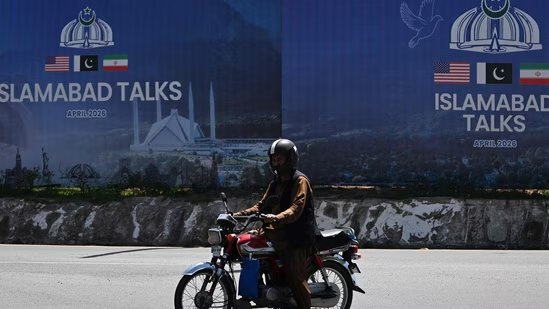
The next round of talks between the United States and Iran appears to be in limbo, as Tehran has said it is “not yet ready” to negotiate face-to-face with Washington, even as Pakistan prepares the ground for another round of discussions in Islamabad.
The US and Iran have been fighting a war since February 28, although a 14-day Pakistan-brokered ceasefire was announced on April 8. That deadline expires on April 22 with no deal in sight between the warring parties.
Iran’s parliament speaker Mohammad Bagher Ghalibaf said in a state television interview on Saturday that Washington and Tehran “are far from a final agreement”. The Islamic Republic has blamed the US’s refusal to abandon “maximalist” demands on key issues for not reaching a deal to end the conflict that has sent the world economy into a tailspin.
The major sticking points in the negotiations seem to be the reopening of the Strait of Hormuz, curbs on Iran’s uranium enrichment, and the fate of its already enriched uranium stockpiles.
Iranian President Masoud Pezeshkian has challenged the legitimacy of the United States’ efforts to restrict his country’s atomic programme, questioning the legal basis for such interference. As reported by Al Jazeera, citing the Iranian Student News Agency, Pezeshkian asserted that Washington possesses no valid justification for attempting to strip the nation of its technological entitlements.
During his address, Pezeshkian took direct aim at the American administration’s hardline stance.
“Trump says Iran cannot make use of its nuclear rights, but doesn’t say for what crime. Who is he to deprive a nation of its rights?” the Iranian President stated.
In an interview with The Associated Press, Iranian deputy foreign minister Saeed Khatibzadeh made it clear his country will not hand over its enriched uranium to the United States, a key demand put forward by Washington and something that US President Donald Trump claimed Tehran had agreed to.
“I can tell you that no enriched material is going to be shipped to the United States. This is a non-starter, and I can assure you that while we are ready to address any concerns that we do have, we’re not going to accept things that are non-starters,” Khatibzadeh said.
The deputy foreign minister did not elaborate on the specifics of the negotiations with the United States or say which issues remain unresolved, but called on Washington to address Iran’s concerns, including sanctions imposed on Iran.
Israel’s attacks in Lebanon are also a sticking point
Israel’s attacks in Lebanon are also a major sticking point for Iran. When the US-Iran ceasefire was announced, Pakistan’s Prime Minister Shehbaz Sharif said it also extended to Lebanon. But Israel launched a flurry of attacks the very next day to put everything in jeopardy.
US Vice President JD Vance said at the time that there was a “misunderstanding” and the Iran ceasefire did not, in fact, include Lebanon. Later, a 10-day ceasefire between the two neighbours was announced, with Trump saying that Israel is “prohibited” by the US from further strikes on Lebanon and that “enough is enough” in the Israel-Hezbollah war.
The US State Department put on another caveat to it, saying that the prohibition applies only to offensive attacks and not to actions taken in self-defence
Asked whether Iran would respond to renewed attacks by Israel on Lebanon despite the ceasefire, deputy foreign minister Khatibzadeh said: “Iran has no option, just to stop aggressors once and forever.”
The Strait of Hormuz
Saeed Khatibzadeh renewed Iran’s position that Tehran’s actions were defensive and in response to unprovoked aggression occurring in the middle of negotiations.
He also said that a “new protocol” would be put in place for the Strait of Hormuz as part of the negotiations with the US, and it would “remain open and safe for all civilian passage.”
Trump has said a US blockade of the Strait of Hormuz will remain, and attacks will resume if no agreement is reached with Iran. For now, Tehran has shut down the key oil and gas route once again, citing the blockade.
Pakistan prepares for talks, could happen next week
Despite no official announcement about a second round of talks between the US and Iran, Pakistani authorities have begun taking stringent security measures for the safety of foreign delegates.
Al Jazeera reported, citing two Pakistani security sources, that negotiations between Washington and Tehran will likely be held before Friday.
“Two US heavy airlift aircraft, C-17 Globemasters, have landed at Noor Khan Airbase in Rawalpindi”, they said.
Pakistan has kicked off preparations, with more than 10,000 police personnel deployed and over 600 checkpoints established across Rawalpindi, the sprawling city adjacent to Islamabad, the Express Tribune newspaper reported.
The security protocol is also being implemented in the capital city ahead of the possible talks.
Authorities have announced that from Sunday midnight, several sensitive areas surrounding Nur Khan Airbase and Islamabad International Airport will be sealed.
Pakistani authorities are not taking any chances after US President Donald Trump said he may visit Pakistan for the signing of the agreement with Iran.
The Express Tribune reported that a complete ban has been imposed on drone flights, pigeon flying and aerial firing in Rawalpindi. Officials say these measures are aimed at ensuring the security of aircraft carrying high-level foreign delegations.
Police confirmed that a red alert has been declared in Rawalpindi, particularly in the vicinity of Nur Khan Airbase and Islamabad Airport. Officers will also be stationed on rooftops as part of heightened vigilance.
Al Jazeera also reported that both the Serena and Marriott hotels in Islamabad are being cleared of guests with no new bookings allowed until Friday.
🚨 BREAKING: Watch the full clip here ➤

