

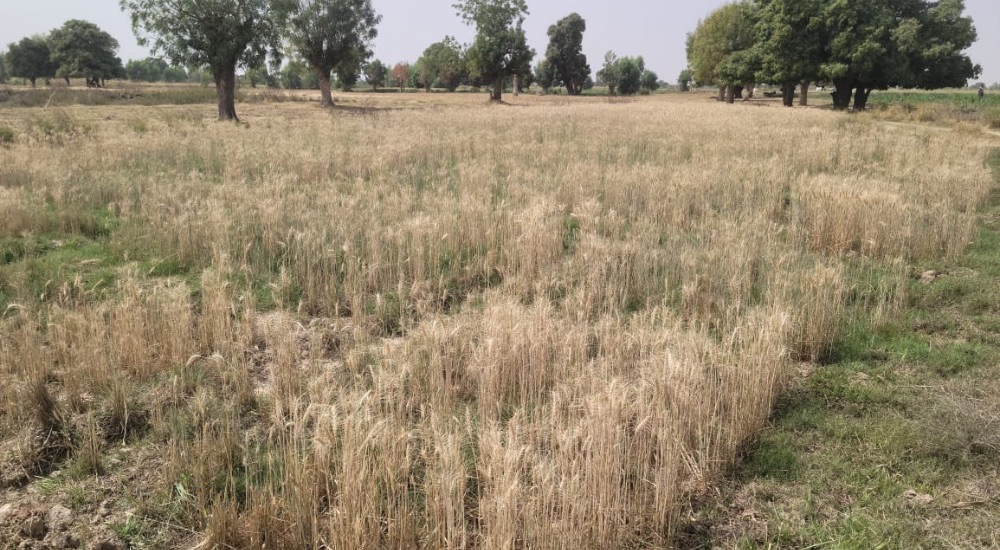
For more than three decades, he has been farming on his land, and recalled that the cold months turned these fields green and perfected into a rolling landscape, with harvest time devoted to stacking grain bags after finishing it.
That world feels distant now. Stunted, yellow and minuscule stalks appear before him but nothing seems to fix them.
With his fingers, he tosses a fistfull of pale, powdery soil into his mouth and drops it.
He whispered, “this crop requires cold weather,” but the temperature has risen.
The situation in Kura, an agricultural area located on the southern edge of Kano, is not due to bad luck or poor technique.
A visible manifestation of a slow-moving crisis is the assertion made by scientists and agricultural officers that climate change is slowly changing the conditions in northern Nigeria’s fragile wheat belt.
A farm fashioned to endure extreme coldness.
In tropical regions, wheat has never been a popular crop.
Unlike maize or sorghum, it needs to be kept cool to develop properly, especially during germination and flowering.
Dry Saharan winds that drop night temperatures below 15 degrees Celsius during the harmattan season in northern Nigeria resulted in a small window of opportunity for wheat farming to resume between November and February.
Before the heat set in, wheat will be able to germinate easily with firm stems and fill out grain heads under those conditions.
That window is shrinking.
Throughout Nigeria, the Meteorological Agency has noted a steady increase in temperatures throughout the northern region over an extended period.
The average minimum night temperature in Kano during the 1980s and 1990s was between 13 and 15 degrees Celsius, but it has now risen to over 18 degrees, which is devastating for crops that are sensitive to cold weather.
This may seem like a small change. Wheat yields are estimated to decrease by approximately 6% for every one degree Celsius rise in average temperature, as per the Intergovernmental Panel on Climate Change.
Ibrahim Shehu, an agronomist who has researched how temperature changes can affect small-scale agriculture across the Sahel said “the
nights are warmer, the cold season is shorter. This is only thing that can disrupt wheat production in Kano.”
“We Used to Harvest Bags, Now It’s Losses.”
The seasonal decline has been observed by Zainab Bello, an agricultural extension officer who works with farmers in Kura and Bunkure.
She said, “the harmattan is getting shorter. It takes a cold stress period for the heat to develop.”
“If not there, you will have poor germination, weak stems, and low grain yield. The farmers are seeing exactly that.”
The human cost is clearly visible to those who are dependent on the crop.
At Garun Malam, Zainab Sani, 30, sits beside a modest wheat pile that is barely enough to load five sacks.
The same plot of her family’s farm yielded more than 20 bags five years ago.
She said: “Last year we harvested only 9 bags but this year it was just five.

