

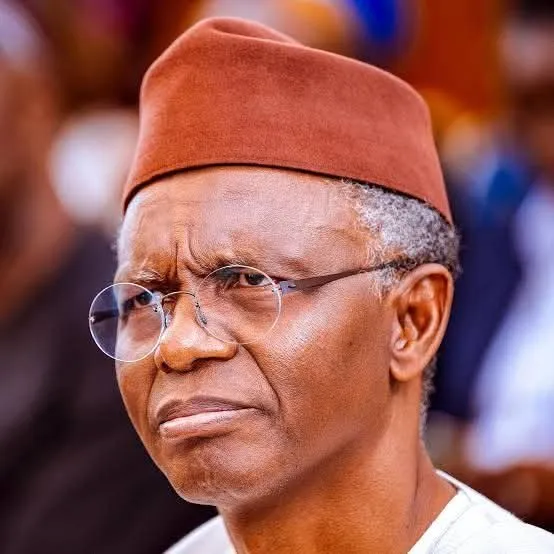
Contrary to media reports that the bail application filed by former Kaduna State Governor, Nasir El-Rufai, will be heard in June, a certified true copy, CTC, of the High Court of Kaduna State ruling showed that the application was refused by the court.
The court therefore ordered the former governor to remain in the custody of the Independent Corrupt Practices and Other Related Offences Commission, ICPC, pending trial.
According to the CTC obtained on Wednesday, the ruling, delivered on April 21 by Justice D.H. Khobo, rejected Mr El-Rufai’s request for bail in his ongoing nine-count corruption case and directed that the accelerated trial commence in June 2026, during which he will continue to remain in detention.
The ruling, delivered at Court 5, NDA Junction, Kaduna, followed a motion on notice filed by Mr El-Rufai on March 25, 2026, seeking bail either on self-recognisance or on liberal terms pending the determination of the charges against him.
Mr El-Rufai is standing trial on an amended charge dated April 10, 2026, and filed on April 13, 2026, containing nine counts, including allegations of inducing benefit under false pretences, conferring corrupt advantages in severance payments, criminal breach of trust, conspiracy to offer monetary benefits to investigators, and violations of the Kaduna State Public Procurement Law.
He is also accused of alleged misconduct relating to land revocations and allocations.
In his application, Mr El-Rufai, through his counsel, Ubong Esop Akpan, urged the court to admit him to bail on constitutional grounds, citing Sections 35(4) and 36(5) of the 1999 Constitution (as amended), which guarantee the right to liberty and presumption of innocence.
The defence argued that all the charges were non-capital in nature and therefore entitled the defendant to bail as a matter of right.
They further submitted that as a former governor (2015–2023) and former minister, El-Rufai had strong community ties, fixed addresses in Kaduna and Abuja, and no likelihood of absconding.
Counsel also told the court that the former governor voluntarily returned from Egypt on February 16, 2026, to honour an invitation by the Economic and Financial Crimes Commission, EFCC, describing it as evidence of cooperation with law enforcement.
The defence additionally challenged the validity of the charge, describing it as “defective and unintelligible,” and raised concerns over alleged health challenges requiring specialist medical attention.
Opposing the application, counsel to the ICPC, Dr. Osuobeni Ekoi Akponimisingha, urged the court to refuse bail, arguing that the charges bordered on serious economic crimes capable of undermining public institutions.
The prosecution described El-Rufai as a flight risk with the means and influence to evade trial and interfere with witnesses and ongoing investigations.
The ICPC also alleged that the defendant obstructed law enforcement officials during an attempted arrest at Nnamdi Azikiwe International Airport, Abuja, on February 12, 2026.
It further claimed that Mr El-Rufai failed to surrender his international passport and mobile devices for forensic examination and did not provide medical evidence to support his health claims.
In his ruling, Justice Khobo held that bail in non-capital offences remains a matter of judicial discretion, which must be exercised judiciously in line with established legal principles.
Citing several Supreme Court authorities, including Suleiman v. Commissioner of Police (2008) and Eye v. FRN (2018), the judge noted that the primary consideration in bail applications is whether an accused person will attend trial if released.
The court held that while El-Rufai relied on his status as a former governor and minister, such prominence could also increase the risk of interference with witnesses and investigation processes.
Justice Khobo also noted the prosecution’s specific allegations of obstruction of lawful arrest and non-cooperation with investigators, describing them as weighty considerations against granting bail.
On the claim of ill health, the court held that no medical evidence was placed before it to justify bail on health grounds, citing Mohammed Sani Abacha v. State (2002) on the requirement for credible medical proof.
The court further ruled that the defence’s claim that the charge was defective could not be determined at the bail stage, stating that such issues are reserved for trial or a motion to quash.
The judge also dismissed the argument by the defence that the prosecution failed to file a counter-affidavit, holding that a valid counter-affidavit had in fact been filed and contained substantial allegations against the defendant.
Justice Khobo relied on legal precedents, including Henry Stephens Engineering Ltd v. Yakubu Nig Ltd (2009), to hold that unchallenged depositions in a counter-affidavit are deemed admitted by the court.
He noted that the defendant failed to file a further affidavit to controvert the prosecution’s claims, thereby leaving the allegations unchallenged.
Consequently, the court refused the bail application and ordered that Mr El-Rufai remain in ICPC custody pending trial.
However, Justice Khobo directed that the case be given an accelerated hearing, ordering a day-to-day trial to commence in June 2026.
Following consultations between counsel to both parties, the court adjourned proceedings to June 1, 2, 3, and 4, 2026 for a continuous hearing.
The judge stressed that the accelerated trial was in the interest of justice and assured that the court would proceed without delay.
🚨 BREAKING: Watch the full clip here ➤

