

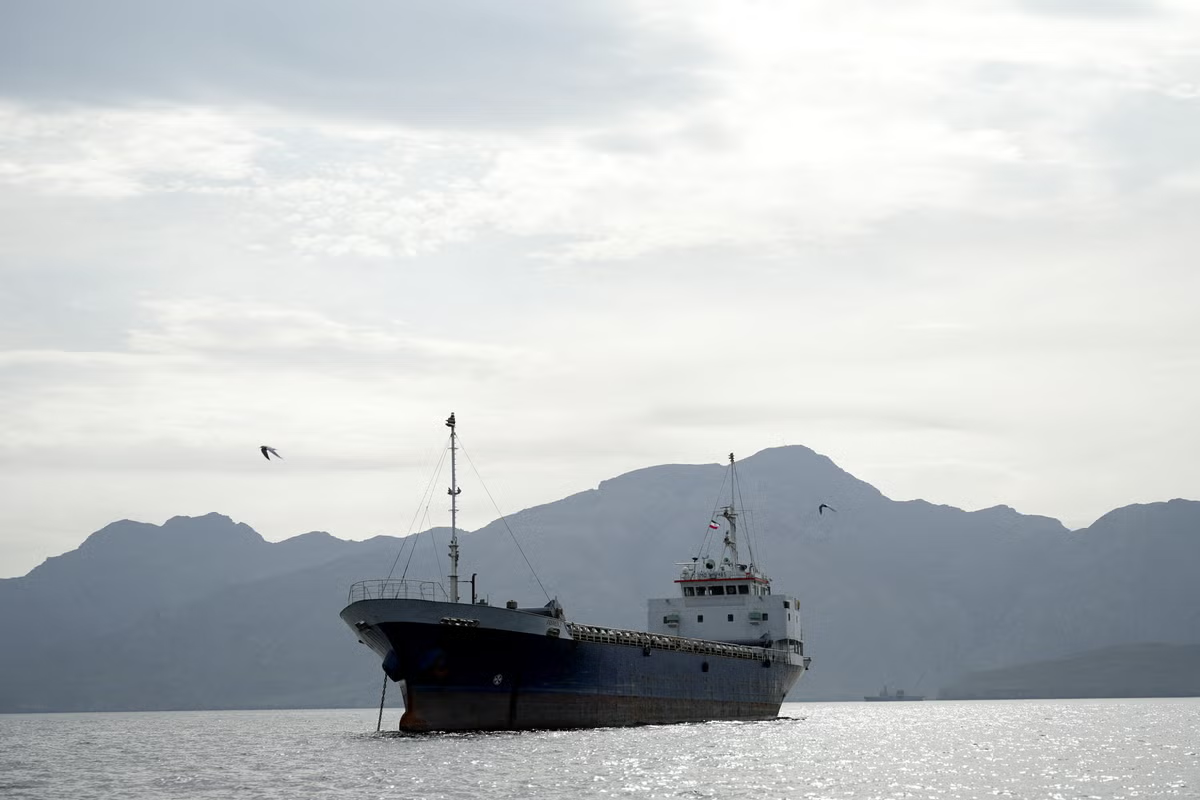
More than half a dozen Iran-linked vessels have breached the US naval blockade of the Gulf of Hormuz since it took effect four days ago, shipping intelligence firms say, contradicting Washington’s claim that it has successfully halted maritime trade with the Mideast nation.
Lloyd’s List reported that at least eight Iran-linked vessels had crossed the blockade line westbound since Monday, with some already reaching Iranian ports and departing again.
Vessel-tracking data showed two sanctioned cargo ships crossed westbound towards the Iranian port of Bandar Abbas on Wednesday and Thursday, with one anchored 16km from the port as of afternoon on Thursday.
Two sanctioned oil supertankers similarly crossed westbound and were still travelling within the Gulf, listing their destinations only as “For Order” to mask their routes.
At a briefing on Thursday, Lloyd’s List senior risk and compliance analyst Bridget Diakun said there was evidence of Iran-linked vessels pausing or reversing course but added: “We’ve also seen ships that have reached Iranian ports and that have departed as well.”
Tomer Raanan, a maritime risk analyst at Lloyd’s List, said “confusion reigns” over shipping movement through the strait.
Isaac Levi, analyst at the energy research firm CREA, said the pattern reflected structural weaknesses in the blockade’s design and execution. “Reports that ships are still passing the US blockade suggest it’s far from airtight, with some tankers willing to test enforcement risks to access Gulf fossil fuels. This continued flow highlights limits in monitoring, unclear policy, difficulties in enforcement and strong incentives to keep the trade moving,” he said.
The Pentagon claimed on Thursday that its blockade was working. Joint Chiefs of Staff chairman Dan Caine claimed that 13 ships had been turned back without boarding, calling it “a finely tuned machine rehearsed multiple times.”
The US military said in a social media post that 14 vessels had complied with orders to turn around so far, although unlike previous updates it did not claim to have prevented all crossing attempts.
Mr Caine clarified that the blockade targeted Iran’s ports and coastline, not the strait itself, and that it applied to all vessels, including Chinese ones, which account for 101 of the 823 vessels currently in the Gulf.
Windward Maritime Intelligence found Iranian oil exports continuing at scale regardless. Around 153.7 million barrels of Iranian oil are currently at sea, nearly 85 per cent of it bound for China.
Satellite imagery from 16 April showed three vessels actively loading an estimated five million barrels of new cargo at Iran’s Kharg Island oil terminal, one flying a fraudulent flag.
On 15 April, 117 vessels operating outside normal tracking systems were identified in the Gulf, 12 of them transmitting no location data, as operators continued to use deceptive practices including false flags and manipulated location signals to mask their movements.
The blockade took effect on 13 April after peace talks between the US and Iran collapsed in Islamabad. The US has since expanded its scope, giving its navy the right to pursue Iran-linked vessels anywhere on the open seas and broadening the definition of prohibited cargo to cover almost any industrial goods bound for Iran.
The Strait of Hormuz, through which a fifth of the world’s oil and liquefied natural gas normally flows, has been largely closed since Iran responded to US and Israeli strikes on 28 February. The closure has prompted the IMF to lower its global growth forecasts and warn of recession if the war drags on.
US president Donald Trump said on Thursday Washington was “very close to making a deal with Iran” and suggested the two-week ceasefire expiring next week might not need extending. A Pakistani source involved in back-channel mediation told Reuters that there had been progress and that an upcoming meeting could produce a preliminary agreement, with a comprehensive deal to follow within 60 days.
Iranian sources said gaps remained, with Iran’s nuclear programme the main sticking point. France and Britain are chairing a meeting on Friday of nearly 40 countries to coordinate on restoring navigation in the strait once hostilities end.
🚨 BREAKING: Watch the full clip here ➤

