

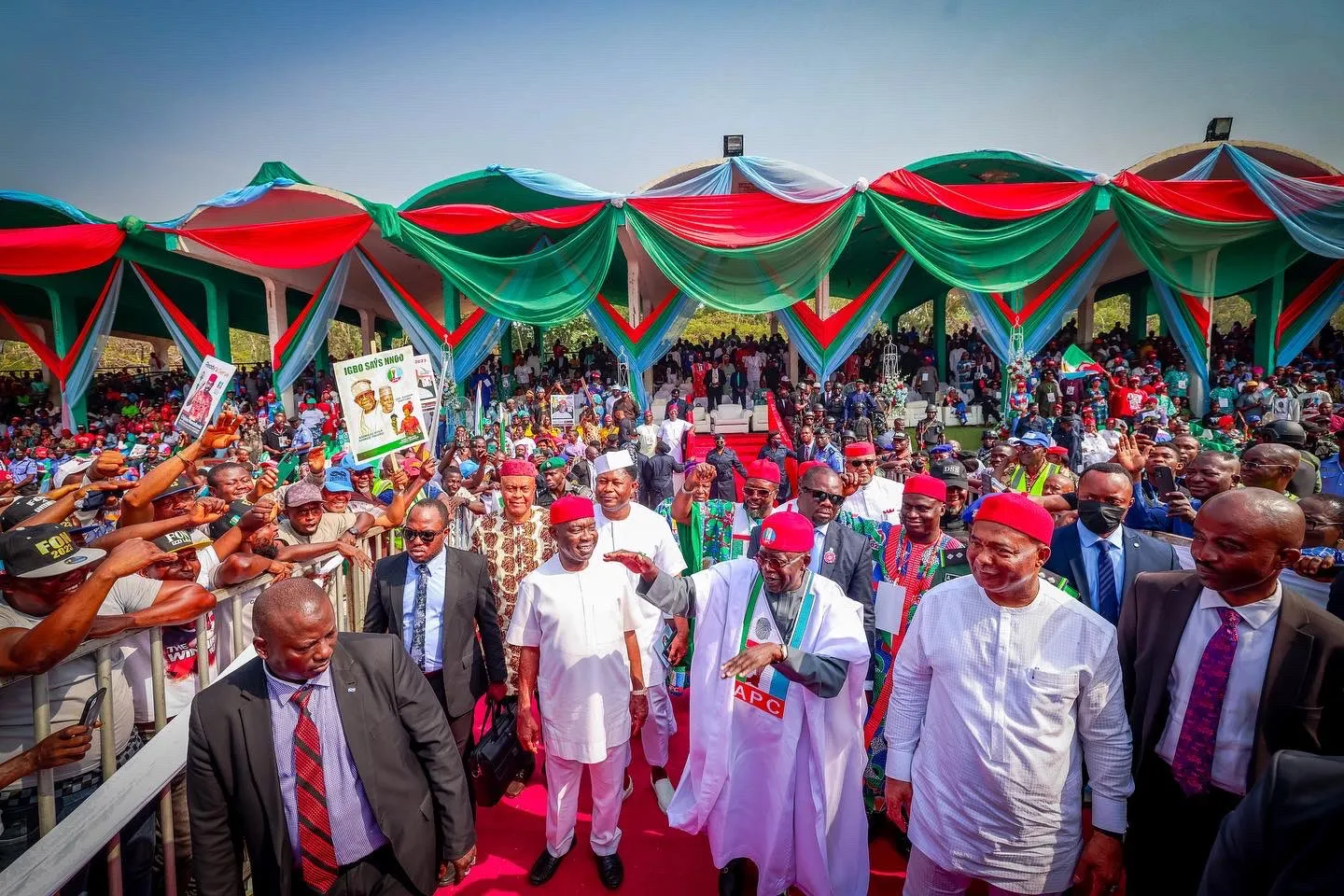
A non-corrupt permanent secretary would need to save every naira of their salary for 13 years to afford the APC presidential form.
Nigeria’s ruling All Progressives Congress has fixed the cost of its 2027 presidential nomination form at N100 million.
The announcement has prompted sharp questions from many Nigerians. How does a party ask people to apply for a job with a fee higher than the salary the job pays? Does such a structure invite corruption and illegal income to bridge the gap?
The Nigerian president earns a total salary package of N1.17 million monthly. This includes a basic salary of N292,892, a hardship allowance of N146,446, and a consistency allowance of N732,230, according to the Revenue Mobilisation Allocation and Fiscal Commission, the body that regulates public officials’ pay.
That works out to an annual presidential salary of approximately N14.05 million. Over four years, the maximum a president can serve without seeking re-election, the cumulative legitimate salary amounts to N56.2 million. That is barely half the N100 million the APC is demanding simply to purchase a nomination form.
Therefore, a non-corrupt president would need to work for seven years, earning N98.5 million in that period, without spending a dime of it, to be able to offset the cost of his APC nomination form. Even then, the figure falls short by N1.5 million.
The form itself is just a booklet, which could not have cost more than N10,000 to print. But to complete and submit this form will cost you N100 million.
The gap is just as stark further down the public service ladder. For instance, a permanent secretary, the highest rank in Nigeria’s civil service, earns a basic annual salary of N1.9 million. With allowances and benefits, the total comes to N7.4 million per year.
At that rate, a non-corrupt permanent secretary would need to save every naira of their salary for 13 years to afford the APC presidential form. They would need seven years to afford the governorship form, priced at N50 million, and nearly three years for a senatorial form.
A university professor earns approximately N6.1 million annually. A professor would need to save for 16 years to afford the presidential form, eight years for the governorship form, and three years for a senatorial form.
Many Nigerians argue that such costs entrench corruption and shut out qualified candidates who lack access to vast, unaccountable wealth.
Anti-corruption campaigner and Executive Director of Civil Society Legislative Advocacy Centre (CISLAC ), Auwal Rafsanjani, argued that excessive nomination costs turn political parties into elite financial clubs, encouraging money politics where wealth, not competence and track records, determine candidacy.
“This is also increasing the risk of corruption, as many aspirants try to “recover” their investment once in office rather than working for public interests.”
He added that such development also escalates exclusion of youth and women, as young people and women are disproportionately affected by economic inequality. “The high fees undermine Nigeria’s commitments to inclusive democracy and gender equity.”
The APC announced the nomination fees on Monday. President Bola Tinubu has made no public comment on the decision.
The announcement comes against a backdrop of serious economic hardship. Since the removal of the petrol subsidy in 2023 and the Central Bank of Nigeria’s decision on the unification of the foreign exchange, the naira has been under intense pressure. Manufacturing costs have risen sharply. Consumer prices have soared. Ordinary Nigerians have borne the bulk of the pain.
The high cost of nomination forms has given rise to a financing culture that analysts describe as opaque and difficult to regulate.
Rather than buy forms with personal funds, which would invite scrutiny of the source, aspirants increasingly rely on so-called “support groups” and “youth organisations” to purchase forms on their behalf and present them publicly. The arrangement is designed to create distance between the aspirant and the money. Many such support groups never explain how they source the funds and pay no taxes on them, amidst concerns that they are just fronts for the aspirants.
The practice gained national attention in 2018, when the APC fixed its presidential form at N40 million. Youth groups bought the form for former President Muhammadu Buhari, claiming he was too poor to afford it himself, having not enriched himself from public office.
That explanation created a template. It established a shadow financing architecture that has only grown more entrenched.
Analysts say that using proxies and faceless, unregistered groups to fund campaigns makes it nearly impossible to trace the source of money.
There are wider concerns too. When vast sums are openly spent on nomination forms, charter flights, hotel accommodation, and delegate payments, it sends a message to poor voters. It reinforces the idea that election day is primarily an opportunity to sell a vote to the highest bidder.
Mr Rafsanjani said he is concerned that political parties should be vehicles for representation, not revenue-generating institutions. Therefore, excessive fees reduce competition and limit developmental focus.
“CISLAC worries that this will affect electoral integrity and increase vote-buying, godfatherism and state capture by wealthy interest groups with dirty money.”
As of the time of filing this report, no APC member has formally declared an intention to contest the 2027 presidential primary.
President Tinubu, who has neither officially declared his re-election bid nor ruled it out, is widely expected to secure the party’s ticket without a contest. He dismissed speculation last week that he feared the opposition ahead of the elections.
Several APC leaders and close affiliates have already publicly endorsed him for a second term.
The APC’s timetable shows that nomination forms will be on sale from Saturday, 25 April to Saturday, 2 May, at the party’s national secretariat. The submission deadline is 4 May, with aspirant screening scheduled between 6 and 8 May. Results will be published on 11 May, and appeals heard from 12 to 13 May, the party said on Monday.
Primary elections are scheduled as follows: House of Representatives on 18 May; Senate on 20 May; State Houses of Assembly on 21 May; the presidential primary between 15 and 16 May; and the governorship primary on 23 May.
The Independent National Electoral Commission (INEC) has fixed the 2027 presidential and National Assembly elections for 16 January, with governorship and state assembly polls to follow on 6 February.
🚨 BREAKING: Watch the full clip here ➤

