

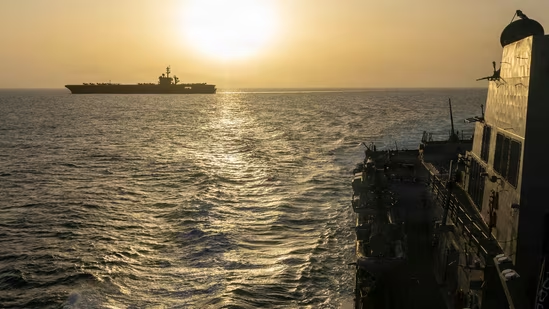
The Iranian-flagged oil tanker Dorena slipped past a U.S. Navy cordon and was headed out into the Indian Ocean when it switched off its location signal and went dark.
The ship, whose movements were tracked by shipping-intelligence firm Kpler, is one of hundreds of sanctions-evading ghost-fleet vessels playing a game of cat-and-mouse as the U.S. tries to lock down Iran’s oil trade and pressure the country to agree to President Trump’s terms for peace.
This time, the U.S. came out on top. Early Thursday morning local time, the military said a Navy destroyer was escorting the Dorena off the west coast of India after foiling its attempt to escape and deliver its cargo.
Shipping analytics firms say vessels continue to try their luck, testing the limits of a U.S. pressure campaign against the regime in Tehran, which includes a blockade and a separate effort to board shadow-fleet vessels. The shadow fleet’s numbers are so great that the U.S. will have to prioritize which ones to take on.
“It will be very hard to go after all of them,” said Emmanuel Belostrino, head of global crude and geopolitical market data for Kpler. “They didn’t even do that for Venezuela.”
U.S. Central Command, which oversees U.S. forces in the Middle East, said it also had intercepted two other Iranian-flagged ships—the Hero II and the Hedy—that had tried to breach the blockade. On Thursday, the military said U.S. forces had boarded a ship known as the Majestic X, which was full of Iranian oil and sailing in the Indian Ocean.
Sometimes, as with the Dorena, it’s a matter of whether a ship that gets through can keep going.
Since the imposition of the blockade, at least one ship, a bulk carrier, left an Iranian port and exited the region, according to publicly available shipping data. Liberia-flagged Basel listed its port of origin as Iran’s Bandar Imam Khomeini and on Thursday was on its way to Brazil.
“The Pentagon says they are trying to stop Iran from earning money, which is perfectly fine, but you can’t really stop every ship from coming and going,” said Yoruk Isik, a ship-tracking analyst and the head of the maritime consultancy Bosphorus Observer. “The tankers continue to load, and a small number are making it out.”
Central Command declined to comment about the Basel but vehemently rejected claims that ships were evading its forces. It said that it has turned around nearly three dozen vessels as part of the blockade as of Thursday and that U.S. forces are poised to intercept ships beyond the Middle East.
“U.S. forces have totally shut down commerce entering and exiting Iranian ports, and Iran hates it,” Capt. Tim Hawkins, a Central Command spokesman, said.
Instead of putting American forces in the Persian Gulf, where they are vulnerable to attack, the U.S. has set up a defensive zone, or “net,” in the Gulf of Oman. Central Command said there are more than 17 warships and 100 aircraft in the region to enforce the blockade.
The military is operating under two sets of orders to shut down Iranian shipping. The first is the blockade, which covers ships coming to or from Iran’s ports. The other allows the interdiction of ships that are providing materiel support to Iran, including ghost-fleet vessels and sanctioned ships. In either case, U.S. forces can intercept targets anywhere in the world.
The shadow fleet aims to find ways around the dragnet. Its hundreds of vessels use methods like spoofing their location signals and transferring oil at sea to misrepresent the origins of their cargoes and avoid getting caught.
They also use unconventional registration, false flags, concealed ownership and frequently-changed names to avoid detection and escape sanctions levied against countries like Iran, Russia and Venezuela.
The sheer size of Iran’s shadow fleet poses a challenge to U.S. forces, which have to prioritize which vessels to go after in waters around the world. The Treasury has put 440 ships under Iran-linked sanctions during President Trump’s two terms, a U.S. official said.
One vessel, a chemical and oil-products tanker called Salute Legend, which has a history of trade in Iranian products, illustrates the challenges. It is the lone vessel in the fleet of a company called Powerful Super LTD registered in the British Virgin Islands. The owner couldn’t be located for comment.
The vessel was in the Gulf of Oman—a common trans-shipment point for Iranian oil—and spoofing its signal from April 14 to 16, according to Lloyd’s List Intelligence analyst Bridget Diakun. The false signal was evident, because the ship broadcast the exact same coordinates for two days, which shipping experts say is highly unlikely under normal behavior.
On its previous trip, the Hong Kong-flagged ship delivered a cargo to China, a top buyer of Iranian oil. It appeared to have loaded its cargo at sea in the Persian Gulf after previously reporting a port call in Saudi Arabia in January. Lloyd’s List Intelligence satellite data shows it was never at that port.
Loading at sea is a potential loophole in the U.S. blockade, which only covers Iranian ports. Salute Legend left the Gulf of Oman on April 17 listing Singapore as its destination. Its last location signal showed it in the Indian Ocean near Sri Lanka.
“The blockade, if it only applies to the actual ports, can’t possibly encompass all of the supply chain of the oil, because naturally things are moving through ship-to-ship transfers,” Diakun said.
Central Command declined to comment on the Salute Legend.
The U.S. has stopped a number of ships linked to Iran in the Indian Ocean. When ships tried to flee U.S. forces near Venezuela earlier this year, American forces boarded the vessels in the Atlantic and Indian oceans.
Kpler pointed to a number of Iranian tankers currently near Singapore and heading toward China. Intercepting them, however, could be viewed as a threat to the country’s energy security.
The challenges the U.S. Navy faces aren’t only operational, they are geopolitical, Kpler wrote in a note to clients.
Write to Jared Malsin at [email protected] and Shelby Holliday at [email protected]
🚨 BREAKING: Watch the full clip here ➤

