

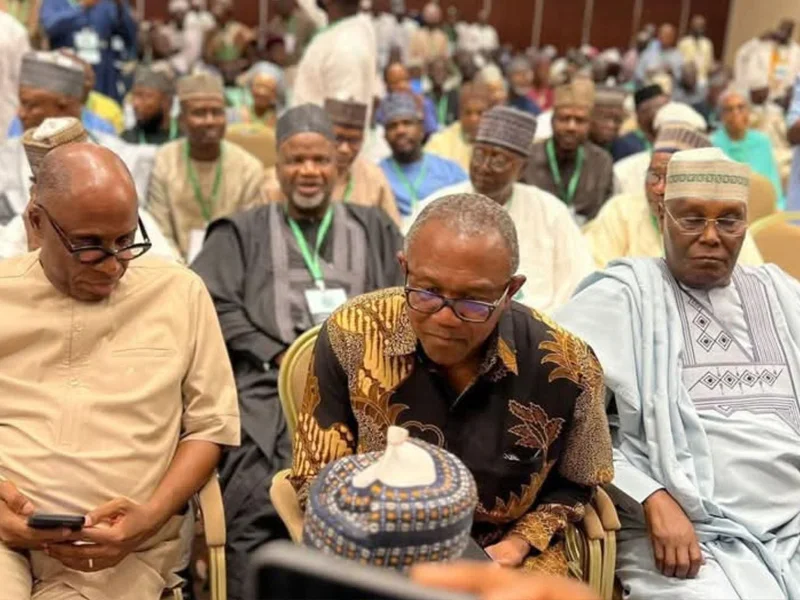
The African Democratic Congress is facing a deepening internal crisis as key political figures stake out positions that threaten party unity ahead of the 2027 presidential election.
Within days, Atiku Abubakar, Rotimi Amaechi, Rauf Aregbesola, and supporters of Peter Obi have issued statements that point to growing divisions over the party’s presidential ticket.
Atiku Abubakar has ruled out stepping down for any consensus candidate, signalling his intention to contest the presidency regardless of internal pressure. The former vice president, a veteran of multiple presidential races, is said to believe he remains the opposition’s strongest contender with the structure and experience to mount a national campaign.
His stance has unsettled party stakeholders who favour a unified front, with concerns that competing ambitions could weaken the ADC’s chances against established parties.
Read Also:
Tensions escalated after Rotimi Amaechi publicly questioned Atiku’s suitability for the 2027 race, citing age concerns. The remark has been widely interpreted within party circles as an attempt to undermine Atiku’s candidacy before the primary process begins.
Sources within the party indicate that relations between both camps have deteriorated, with Amaechi also seen as positioning himself for the presidential ticket. The exchange has introduced a sharper tone into internal discussions, raising doubts about the party’s ability to manage its leading aspirants.
Rauf Aregbesola has further complicated the situation, declaring that he would not support a political arrangement centred on Peter Obi if it favours one region over others. His position has raised questions about the feasibility of building a broad-based coalition across Nigeria’s geopolitical zones.
Meanwhile, the Obidient Movement, a key support base for Peter Obi, has issued a firm position that it will only back Obi as the party’s presidential candidate. The group’s stance reflects its strong mobilisation capacity, particularly among young and urban voters, but has also drawn criticism from party insiders who argue that such rigidity could hinder internal negotiations.
Party leadership is said to be increasingly concerned about the speed and public nature of the disagreements. Despite a series of consultations, no clear resolution has emerged, leaving the party at risk of entering the 2027 election cycle divided.
Political observers note that the crisis goes beyond policy differences, describing it as a clash of ambitions among high-profile figures. With time running out to build a cohesive campaign structure, the ADC faces mounting pressure to resolve its leadership question.
Failure to do so could weaken its position as an alternative platform to dominant parties and limit its chances in what is expected to be a highly competitive election.
🚨 BREAKING: Watch the full clip here ➤

