

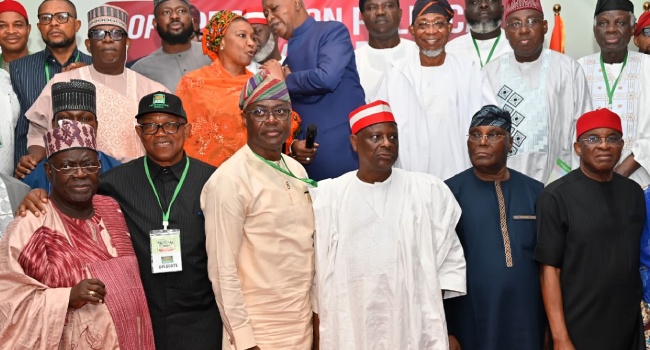
Political leaders from the opposition have resolved to present a united front in the 2027 general elections, agreeing to field a single presidential candidate to challenge President Bola Tinubu of the ruling All Progressives Congress (APC).
The decision was one of the major highlights of a National Summit of Opposition Political Leaders held on Saturday in Ibadan, Oyo State, where participants gathered to fashion the way out of the current challenges facing the country.
They also warned that Nigeria’s democracy is under increasing strain and requires urgent collective action to safeguard it.
The summit, themed “Safeguarding Nigeria’s Democracy: A National Dialogue,” brought together key opposition figures across party lines, culminating in the adoption of a joint communiqué known as the Ibadan Declaration.
Leaders at the event said the decision to rally behind a single candidate was driven by the need to avoid fragmentation of votes and strengthen the opposition’s chances at the polls.
Host governor, Seyi Makinde, in his welcome address, warned of a steady erosion of democratic competition, noting that the concentration of political power under one party threatens pluralism.
He took a trip down memory lane, reminding the ruling party that the ‘wet e’ era in Ibadan, which he said must not be allowed to repeat itself.
“Democracy without opposition is not democracy, it is a slow drift toward a one-party state,” he said.
Factional National Chairman of the Peoples Democratic Party (PDP), Taminu Turaki, described the move as both strategic and necessary, warning that disunity has historically weakened opposition efforts.
“A single stick can be broken easily, but a bundle of sticks is far more difficult to break,” he said, urging political actors to prioritise national interest over individual ambition.
Turaki maintained that Nigeria is currently experiencing what he termed “progressive regression,” citing worsening insecurity, economic challenges, and declining confidence in democratic institutions.
“This is not a moment for silence or division; it is a moment for decisive action,” he said.
Similarly, former Senate President David Mark described the moment as a “national rescue mission,” stressing that no single opposition party could confront the current political structure alone.
“We cannot confront the future as fragmented entities. This is the time to rewrite the story of coalition building in Nigeria,” Mark said.
In the communiqué issued at the end of the summit, opposition parties reaffirmed their commitment to contest the 2027 elections at all levels, rejecting what they described as attempts to impose a one-party state.
They also resolved to resist any move to make the election a one-candidate race, insisting that Nigerians must be presented with credible alternatives.
Beyond the consensus candidacy plan, the declaration raised concerns over the credibility of the electoral process.
They passed a vote of no confidence in the Chairman of the Independent National Electoral Commission (INEC), Joash Amupitan.

