

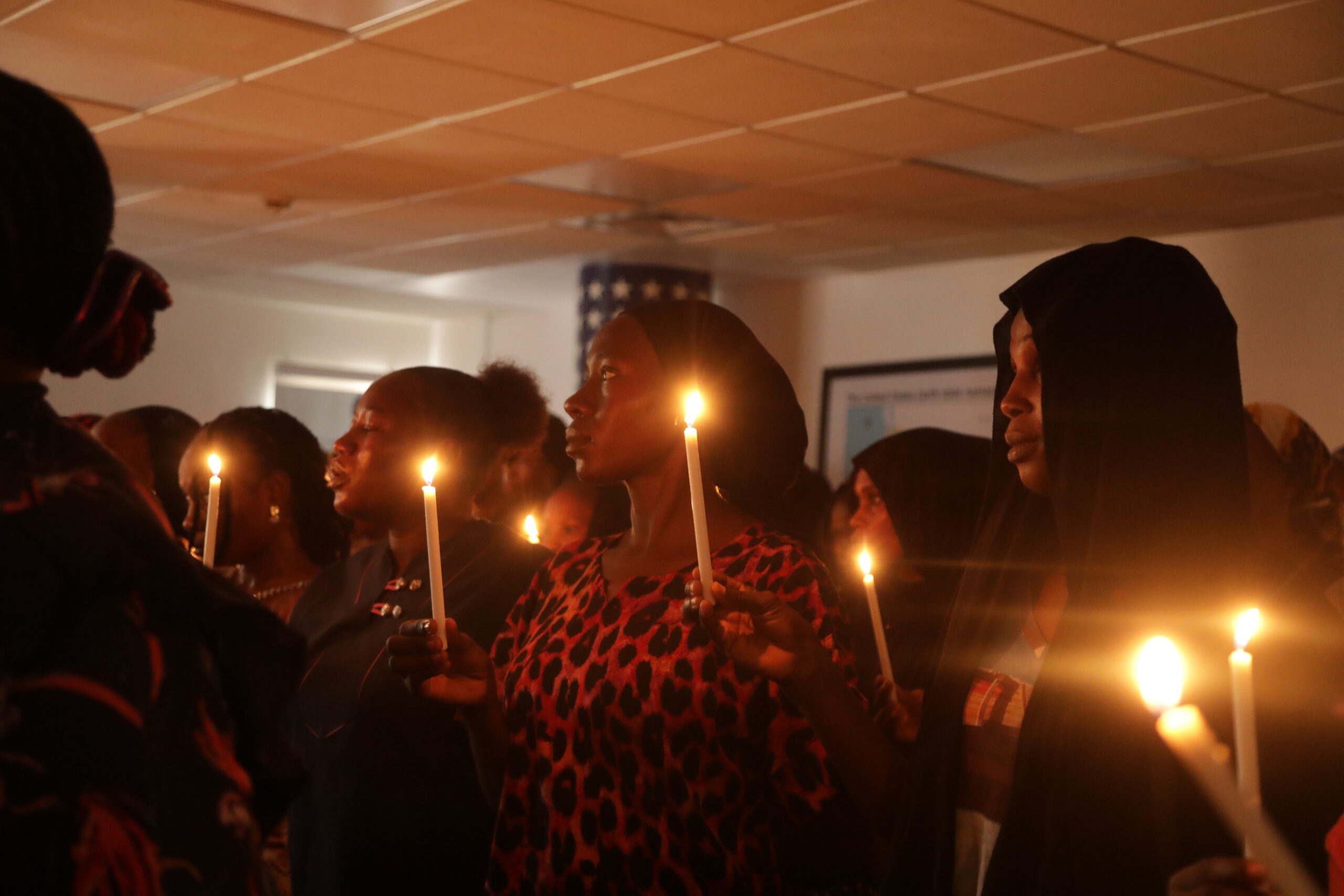
“What began as a tragedy has become a chorus of courage. Their poems were not simply recitations—they were affirmations that the Chibok Girls are no longer defined by what was taken from them, but by what they have claimed.”
In the 12th year since the abduction, the Chibok girls at the American University of Nigeria are more hopeful than despondent. Still prayerful and cautious, of course, they have since acquired a defiant voice for self-expression tempered by a deep sense of gratitude to everyone who has contributed to their healing journey.
The day was not one of grief but of hope and purpose. On this solemn anniversary, the AUN community—students, faculty, administrators, and staff—refused to let tragedy dictate the rhythm of remembrance. Instead, they chose to mark time by the steady pulse of resilience.
They gathered at the American Space, a place ordinarily alive with academic debate and cultural exchange, now transformed into a sanctuary of memory and resolve. In that hushed atmosphere, hierarchy dissolved: from the university president to the newest student, each hand cradled a lit white candle. The fragile flames flickered against the shadows, a quiet defiance of the insecurity that still grips many corners of the nation.
Together, they stood not as mourners bound by loss, but as witnesses to courage—each flame a testament that even in darkness, the heart of a community can be stronger than fear.
The Chibok girls at AUN indeed have much to celebrate. As they mark the 12th anniversary of their violent abduction, twelve (12) of them will be graduating from the university on May 9, at the university’s 17th Commencement Ceremony.
By no coincidence, the keynote speaker at the occasion will be Ms Stephanie Busari, the celebrated CNN reporter who produced the proof of life while they were still in captivity. The president of AUN, Professor DeWayne Frazier, stated that Ms Busari “is an Emmy, Gracie, and Peabody award-winning journalist and a powerful force in African storytelling.”
“With 25 years of experience in global media, including 16 impactful years at CNN International, Ms Busari pioneered the network’s first digital and multiplatform bureau globally. Her influence extends beyond journalism. Recognised by the United Nations as one of the 100 Most Influential People of African Descent in 2017, Ms Busari has been consistently named one of Africa’s 25 Most Powerful Female Journalists from 2020 to 2024. In 2020, she was selected as a Maurice Greenberg World Fellow at Yale University, a prestigious honour that further solidifies her reputation as a global thought leader.”
Their sponsors—the Federal Ministry of Women Affairs in Abuja—will be present to witness what promises to be a day of reckoning, a day when light overcomes darkness. It was the Nigerian government working through the American University of Nigeria that made this moment possible.
After the rescue of 106 of the Chibok girls from their abductors, they were sent to AUN to join 24 of their sisters who had escaped on that harrowing night, embarking together on a journey of healing through education.
From the late Aisha Al-Hassan to Pauline Tallen, and now to the incumbent minister, Imaan Sulaiman-Ibrahim, the Ministry of Women Affairs has stood steadfastly beside the Chibok girls, offering support at every stage of their transformation.
And now, before the eyes of the nation, the Chibok Girls—once kidnapped for being poor, vulnerable, and daring to pursue education in defiance of an extremist ideology—will walk past the podium not as victims, but as graduates.
No longer defined by vulnerability, they will be celebrated as scholars of public health, accountancy, mass communication, and environmental science. Each step across that stage will be a declaration: that education is not a taboo but a torch; that resilience can rewrite destiny; and that the power of knowledge can defeat the darkness of fear.
President DeWayne Frazier dwelt on the mythology of the number 12 on this occasion. In many cultures, he noted, 12 represents completeness, direction, and divine order—a full cycle. Twelve months make a year. Twelve hours reset the clock. Twelve tribes shaped a nation. For 12 long years, the world has waited, and the Chibok story has felt unfinished, suspended in agony.
But here, he announced, the number 12 would mean something new. This number would symbolise restoration.
“Twelve years of captivity for some,” the president said, cheered by the girls, “twelve graduates for the world. They did not just survive Sambisa Forest; they conquered the classroom. They will walk across that stage not as symbols of tragedy, but as public and environmental health officers, as communicators, film producers, storytellers, and as leaders. That is the myth we choose to believe.”
And then, the girls themselves gave voice to the moment. They recited poems—lines born of pain but lifted by hope—that perfectly captured their triumphant mood and their vision for the future. Each verse was both testimony and prophecy: testimony to the resilience that carried them through captivity and into classrooms and a prophecy of the lives they now stand ready to build. Deborah writes:
In Chibok,
I was just a girl with dreams, with books, with hope.
Until everything changed.
Taken by Boko Haram.
I remember the darkness.
I remember the fear.
I remember how silence felt louder than my voice.
Even when I was afraid
Even when I felt forgotten
Even when my voice was small
There was something inside me.
A quiet fire
A hidden strength
A whisper that said:
“You will rise.”
And today
I stand.
I am not standing as the girl who was taken.
But it was the girl who came back.
And today I am not just standing
I am learning.
I am growing.
I am currently enrolled at the American University of Nigeria.
I am building the future.
That was almost taken from me.
That is our victory.
That is our answer to the darkness.
They tried to stop our education.
But today, we are rising through it.
Their words convey a powerful metaphor of resilience and hope through the imagery of candles. It is education that has empowered them. The journey from fear to possibility is highlighted, illustrating a transformation where vulnerability has become a form of strength. This reflects a commitment to illuminating a brighter, more liberated future. In Rifktatu’s “We Still Rise,” the girls keep hope alive:
“On that night,
Dreams were taken in the darkness.
Fear was planted in each heart.
We were daughters, full of promise.
But our voices met with violence.
Far away from home and land.
Days turned into nights of waiting.
Tears we hid, but pain we knew.
Holding on to tiny whispers that
“Someday, we will make it through.”
Some are still not here beside us.
Their laughter we still miss.
We speak their names at every moment, in every prayer, in every wish.
What began as a tragedy has become a chorus of courage. Their poems were not simply recitations—they were affirmations that the Chibok Girls are no longer defined by what was taken from them, but by what they have claimed: knowledge, dignity, and a future of their making, captured succinctly in Maimuna’s “Still We Call Their Names”:
We will not rest, we will not tire,
Until they rise, reclaim their fire,
For stolen time cannot erase
The strength, the dignity, the grace.
So let the world not look away.
Let memory live beyond this day.
Justice walks, though slowly, it seems.
It moves in hearts; it breathes in dreams.
And though the night once claimed its due,
The dawn still comes for them, for you.
Presiding Pastor Raymond Obindu, who offered ‘words of hope,’ urged the Chibok girls to ‘stay hopeful.’
“Things we never planned for happen in life, but how you respond will determine how you’ll overcome it. You all have a future, so stay hopeful. Remember, there is hope for a tree cut down, because at the scent of water, it comes alive. The Bible says you’re special, chosen, and unique. “Never forget that challenges come to all, but how you respond is what matters, so I say to you today, respond with hope, and you will see the future getting brighter by the day,” he said.
🚨 BREAKING: Watch the full clip here ➤

